| What this guide holds | What that rests on | Who it suits | What it costs |
|---|---|---|---|
| This guide covers non-fiction about relationships, and nothing else. | A non-fiction book makes a claim a reader can test against their own life or argue with. A novel does not offer to be right. | Readers deciding whether a named book is worth an evening. | It leaves out the fiction a reader may credit with teaching them more about love than any manual did, and it means requests for romantic novels get a boundary rather than a list. |
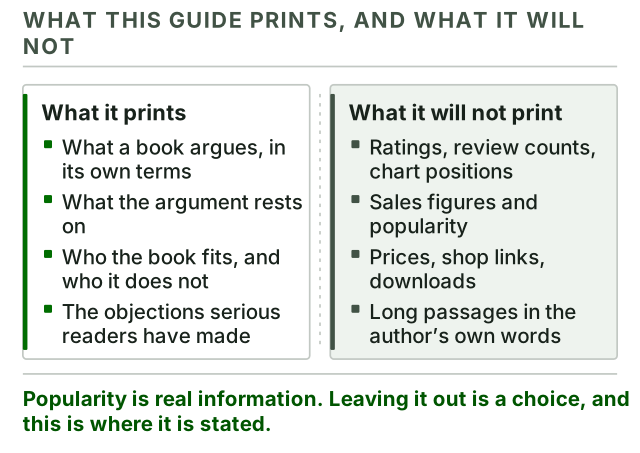
| No ratings, review counts, sales figures or chart positions appear anywhere on the site. | None of them can be traced to a record we could open and read. Aggregate scores drift, and print-run claims come from the people selling the book. | Readers who want to know what a book argues before they know how popular it is. | Popularity is real information, and refusing to print it means a reader has to look elsewhere to learn that a book is everywhere. |
| Passages are paraphrased rather than reproduced, and quotations are short and named to a chapter. | Circulated quotations detach from their source fast, and a guide that repeats one it cannot locate becomes worthless the first time it is wrong. | Readers who want to know what an argument amounts to, not what its most quotable line sounds like. | A paraphrase carries our reading of the sentence, and a writer's own phrasing sometimes is the argument. |
| There are no shop links, prices, affiliate arrangements or file downloads. | The site is paid for by its letter, so nothing on a page has to earn a click. Publishers are named in text where the record matters. | Readers who want to know whether a recommendation was bought. | It is less convenient: finding the book is left to the reader, a library, or a bookshop. |
This guide is an editorial reader’s guide to non-fiction books about relationships: one page per book, built to the same shape every time. That shape is set out in full on the main canon page, and it is applied here without exception. The questions about this guide collected below are the ones that belong to no single book’s page.
Different sorts of question end up here. Some cut across the whole shelf, such as which book anyone should start with. Others are about the guide itself: what gets covered, what is left out, and which things we refuse to print even where other guides print them freely. Both are answered once, here, rather than repeated in a box at the bottom of every book page.
What does this guide cover, and what is out of scope?
The scope is non-fiction about relationships, and nothing else. A non-fiction book offers a claim a reader can test against their own life, act on, or argue with, and that claim is the unit every page here works on. Novels are doing a different job, and judging them by whether they are correct would be a category error rather than criticism.
That boundary answers a question this site is asked: no, there is no ranking of romantic novels, and there will not be one. The same boundary keeps memoirs, poetry and fiction about love off the shelf even when a reader tells us a novel taught them more than any manual did. That may well be true. It is simply not something this desk can assess.
Within non-fiction, the shelf is narrower still. The books covered here are the ones people search for by name, which is why the main guide to the canon includes titles the writers have serious reservations about, alongside ones they recommend without hesitating.
- For example, The 5 Love Languages has a page here and a whole second-opinion page besides, not because we endorse the framework but because the reading public keeps asking what it claims and whether it holds.
- Consider a book with a devoted following and no page here at all: absence points to weak search demand or no substantive discussion to report, not to a verdict on the book.
How does a book get a page here?
A book earns a page when readers are asking what it claims and there is a real argument to report about it. Demand comes first, discussion second, and our own affection for a title comes nowhere. That order is deliberate: a guide built from the writers’ favourites is a taste list wearing the costume of a reference.
Every page is then built to one fixed template, which is what makes the set comparable. A writer has to name the objection and whoever raised it, rather than gesturing at critics in general, and has to say which reader the book was written for. Underneath all of that sits the question of where the argument came from — a clinical practice, a research tradition, or an author’s own observation — because the answer decides how far a reader should carry the conclusion.
Author qualifications are taken from the publisher’s page for that book and from peer-reviewed records, and from nowhere else. When a publisher page has not been verified, the book is discussed by title and the author’s credentials go unmentioned rather than being guessed at. The full list of records used sits on the sources page; the rules behind all of it are on the editorial policy page.
Why are there no ratings, review counts or sales figures?
Because none of them survive a check. An aggregate score is a moving average of strangers with different questions; a print-run or chart claim originates with the party selling the book. Neither can be traced to a record a reader could open, so neither belongs on a page whose whole promise is that its statements can be traced.
There is a harder version of this rule that operates behind the scenes: every figure that appears anywhere on this site has to exist first in an approved-facts file, with a named publisher, a year and a URL that was actually opened. Popularity numbers have never cleared that bar. Rather than print them with a shrug, the pages describe what a book argues and leave the reader to notice how often they have seen it recommended.
The cost is real and worth naming. Popularity is information. A reader who wants to know how visible a title is will have to learn that somewhere else. What they get here instead is an account of the claim that does not change because new reviews landed.
Why do you not quote passages from the books?
Because a quotation without a location is a rumour. Lines from popular relationship books circulate in graphics and captions until nobody can say which chapter they came from, and some were never in the book at all. A guide that repeats one of those has spent its only asset, which is that a reader can check what it says.
The working rule is narrow: a quotation appears only when the writer has the book open and can name the chapter it sits in, and it stays short. Everything else is paraphrase, marked as paraphrase. Where an author’s own vocabulary matters, the terms are named as theirs, such as Johnson’s “Demon Dialogues” on the Hold Me Tight page, without inventing sentences to surround them.
- For instance, the line attributed to Esther Perel and passed around without a chapter is not reproduced anywhere on this site. The Mating in Captivity page sets out her argument about desire and distance in our own words, which is the part a reader can actually use.
Why are there no prices, shop links or PDF downloads?
Because nothing on this site is paid for by a click. There are no affiliate arrangements, no prices, no buy buttons, no relationships with publishers, and no links to file-sharing or PDF sites either. The guide is funded by its letter, which means a recommendation costs the reader nothing and earns us nothing.
That decision changes how the pages read. A page that has to move a reader towards a purchase gets superlatives and a countdown; a page that does not can afford to say a book is overrated, dated, or only useful for one kind of reader. The criticism sections on this site exist because nothing is riding on the sale.
The practical consequence for a reader: finding the book is your job. Publishers are named in text where the record matters, and a publisher page is linked when it is the source of a fact about the author. A library catalogue or a bookshop will take it from there.
Which cross-book questions get answered here?
The ones with no owning page: broad questions about the shelf as a whole, questions about a theory that several books borrow from, and questions about the guide’s own conduct. Anything that belongs to one book is answered on that book’s page instead, which keeps an answer from being restated elsewhere in slightly different wording.
Attachment research is the clearest example of a theory that no single book owns. Several titles on this shelf build on it, so the underlying work is described once and linked to its record, such as Ainsworth’s work on infant-mother attachment, published in American Psychologist in 1979. The books that extend those childhood patterns to adult couples are gathered on the attachment reading list, where the extension is described as an extension rather than as settled fact.
What this page does not do is explain how to change your own patterns, repair a marriage, or decide whether you need therapy. Those are not reading-guide questions. This site tells you what a book argues and where it has been challenged; what to do about your relationship stays with you, and where it involves fear or harm, with a professional.
Why does every page carry a criticism section?
Because a book page that only reports what a book claims is an advertisement with footnotes. Every page here ends its argument with an account of what serious readers have objected to, who objected, and on what grounds. Applying that section to books we admire as well as ones we do not is what makes the set worth comparing.
The rules for that section are strict, and they are what keeps it from turning into a pile-on. The criticism has to be attributed to somebody in particular: a reviewer, a researcher, a professional body, or a pattern in reader response that can be described without guessing at its size. Unnamed critics do not count. Studies are not invented to support an objection, and where no source can be produced, the point is either rewritten as something plainly true or dropped.
The other half of the rule matters as much: criticism lands on the argument, not on the author. A book can be reductive, dated in its assumptions, or built on a research base thinner than its confidence suggests, and saying so is fair. Labelling the person who wrote it is not, and each criticism section closes by saying who the book still helps.
- Imagine a framework that hands readers a usable vocabulary, and which research has since complicated. That is exactly the case set out on the second-opinion page for the love languages, where the objections are reported in qualitative terms with the review named, and the reasons people still reach for the vocabulary are reported too.
What this guide does not do
A reader expecting the usual furniture of a book site will find it missing here on purpose. This is the list, so nobody has to guess.
- We do not sell books
- No affiliate links, no prices, no buy buttons, no shop or PDF links of any kind. Publishers are named in text when the record matters, and that is the end of it.
- We do not print ratings or sales claims
- No star scores, review counts, print runs or chart positions. They cannot be traced to a record a reader could open, so they do not appear.
- We do not invent quotations
- Short quotations only, with the chapter named, and only when the writer has the book to hand. Everything else is paraphrase and is labelled as such.
- We do not give relationship advice
- We describe what books claim and where they are disputed. What you should do in your own relationship is not something a reading guide can tell you.
- We do not cover fiction
- Non-fiction only. A novel is not making a claim that can be checked, and ranking novels is a job for a fiction critic.
Anything missing from this page has a page of its own. The full index lists everything on the site, grouped by what each page does, and the reading lists collect books by the question a reader arrives with rather than by how well they sell. If a page here states something you can show to be wrong, the editorial policy explains how corrections are handled.