
| What the book claims | What that claim rests on | Who it tends to fit | Where it is challenged |
|---|---|---|---|
| People each have one primary way of receiving affection. | Complaints a counsellor heard repeating in his practice, sorted into groups and written up as a framework. | Readers who cannot name what is missing and need a menu to react to. | A peer-reviewed review reports that people value all of the ways of receiving affection rather than one, which is not what a primary language implies. |
| The categories are distinct from one another. | The author's grouping of the complaints, presented as description rather than as measurement. | Couples who need separate words for separate kinds of attention. | Relationship scientists find the categories overlap instead of standing apart as types. |
| Partners who speak each other's language are more satisfied. | Counselling anecdotes and the book's recommended conversation, not a trial. | Partners who want one concrete thing to try this week. | The review of the evidence reports no consistent positive link between satisfaction and whether partners match on languages. |
| Naming your language tells your partner what to do. | The framework's profile exercise, offered as a starting point. | People who find a shared word lowers the temperature of a request. | A stated category can stand in for the specific request it was meant to introduce, and specifics are what a partner can act on. |
The five love languages is a framework from a popular counselling book, which holds that affection travels in a small set of modes and that each person registers one of them most strongly. The question are love languages real packs two separate questions together, and the answers to them point in opposite directions.
The first question is whether the categories exist as a structure in people. The evidence says no. The second is whether the observation underneath is worth anything. The evidence, and ordinary experience, say yes — but the thing that survives is smaller than the framework built on top of it.
This page is about the status of the idea. What the book itself argues, how it is built and who it suits is set out on the 5 love languages; we do not repeat that here.
Where did the five love languages come from?
They came from one counsellor’s practice, not from a research programme. Gary Chapman describes noticing the same complaints recurring in his sessions with couples, sorting those complaints into groups, and finding the groups settled at a short list that he named and wrote up for a general readership.
The book’s official page, run by its publisher, names Chapman as the author, gives his doctorate, and describes the marriage and family seminars and radio programmes he has run. Nothing on that page claims a study, and the book does not contain an evidence section. The origin is stated plainly by everyone involved.
This matters because of how the idea is quoted. In everyday use the framework is introduced as though it were a research finding, and that is the one thing nobody can say about it. What existed at the start was a practitioner’s pattern-spotting, offered to readers to check against their own lives.
Clinical observation is a normal beginning for a research question. A counsellor writing from clinical practice has seen something real. The usual sequence is that somebody then tries to find out whether the observed pattern holds outside the room it was noticed in, and in this case that step arrived only after the idea was already popular.
There is also the matter of the count. A category system produced by grouping complaints could have landed on a different set of groups, depending on who does the grouping and where the lines fall. The number in the title is an organising decision by an author, and it is the part of the framework that gets treated as though it were a measurement.
One more feature of the origin bears directly on the trouble that came later. The complaints were collected from the couples who came to one counsellor, in one place, in one period, mostly seeking a particular kind of help. Any pattern found that way carries the shape of the room it was found in, and that is an ordinary limitation rather than a scandal.
Are love languages scientifically proven?
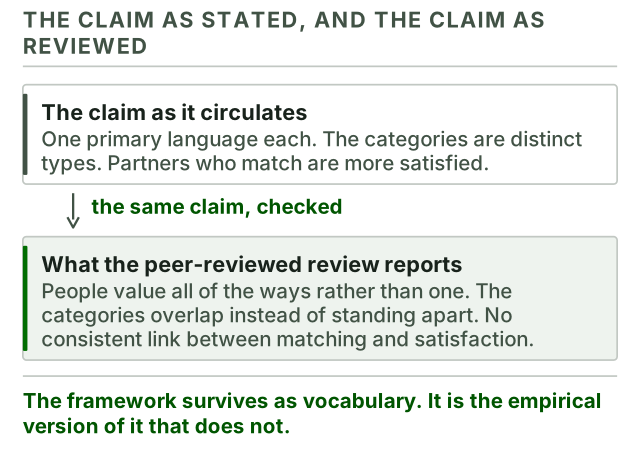
No — and the tests that exist point the other way. When relationship scientists examined the framework, they reported that people value all of the described ways of receiving affection rather than one; that the categories overlap instead of separating cleanly; and that partners matching on a language shows no consistent link with how satisfied they are.
That reading comes from a peer-reviewed review by Emily Impett, Haeyoung Gideon Park and Amy Muise in Current Directions in Psychological Science, set out for a wider audience in the Association for Psychological Science summary of that review. Their proposed replacement image is a balanced diet rather than a single preferred dish.
We state those findings qualitatively and without magnitudes, on purpose. Effect sizes and percentages are the first thing to get garbled in retelling, and a critique that arrives with a mangled figure is easier to dismiss than one that arrives with a plain description.
Separate claims are tangled together here, and it is worth keeping them apart. Whether a primary language exists is a question about structure. Whether the categories are distinct is a question about measurement. Whether matching produces a better relationship is a question about outcome. The framework needs all of them; the evidence supports none of them well.
The outcome claim is the one that makes the idea feel practical, and it is also the one that has been looked for and not found. The honest version of the advice is that attention helps, and attention aimed at what someone actually notices helps more — which no typology is required to say.
Testing a typology is harder than testing a single claim, and that is part of why the question stayed open. A researcher has to show not only that people differ, but that the differences cluster, that the clusters are the ones proposed, and that membership predicts something outside the questionnaire that produced it. Each of those steps can fail on its own, and an idea can flourish in public while failing all of them.
There are limits on the other side too, and a fair critique names them. The work in this area asks people to report on themselves, which is the same instrument the framework uses and carries the same weaknesses. A study of what partners say they prefer is not a study of what actually lands between them over the long run.
What would settle it is the kind of test the framework has never been given: follow couples over time, record what each partner does, and see whether aiming at a stated category outperforms simply paying closer attention. Until something like that exists, the strongest honest statement is that the typology is unsupported rather than disproved in every form.
None of this means the researchers found people to be identical. Preferences differ, obviously and visibly. What they did not find is that the differences arrange themselves into a small set of boxes with one box per person, which is the specific proposition the framework rests on.
Is love language a pseudoscience?
Not in the strict sense, and the label does more harm than good here. Pseudoscience borrows the appearance of research while arranging to stay untestable. This framework never claimed to be research in the first place, it stated its origin openly, and when relationship scientists tested it, it turned out to be perfectly testable — it simply did not hold.
A more accurate description is an unscientific idea in origin with limited validity as a typology, which has since been promoted into evidence by everyone repeating it. The promotion happened outside the book, in quizzes, workplace training, dating profiles and the general habit of citing a familiar framework as a settled fact.
We criticise the argument, not the author. Chapman wrote up something he observed and offered a conversation; he did not run a study and did not present one. The gap between what the book claims and what the culture claims on its behalf is where the annoyance lives.
There is a real cost to the promotion, though, and it is not academic. A category presented as a finding acquires authority in an argument. My language is this, so what you did does not count is a sentence the framework makes available, and it settles a disagreement by classification rather than by either person saying anything specific.
The second cost is what the vocabulary hides. Sorting a complaint into a style makes every shortfall look like a translation error. An unequal share of the housework, one partner’s time being treated as the cheaper time, or care flowing steadily in one direction are not mismatches of mode, and the framework has no way to see them.
There is a third cost, quieter than the other two. The argument about whether the framework deserves the word pseudoscience takes up the space where a better question would sit. Whether an idea is science is a question about its pedigree; whether it helps two particular people describe what they are missing is a question about use, and only the second one can be settled at a kitchen table.
What is the framework still good for?
It is good as vocabulary, which is not nothing. The durable part is the observation that people notice different things, that a partner may give in the way they would like to receive, and that a couple can be generous with each other for years while both feel unmet. Naming that lowers the cost of raising it.
- For example, the sentence I notice time more than I notice presents is checkable. Your partner can agree with it, correct it, or act on it, and none of that requires the list to be a true description of human beings.
- For instance, the same list read as a result — my language is this one — closes the subject instead of opening it, because a label is not something the other person can answer.
- Consider what happens when the two readings collide: a couple can use identical words to start a negotiation or to end one, and the evidence bears only on the second use.
Used that way, the framework is a prompt. Its whole method — work out what registers for you, ask what registers for your partner, say both out loud — survives every objection above, because none of the objections touch it. What fails is the claim that the answer will be one of a fixed set of types.
The safest way to hold it is as a question rather than a result. What did you notice this week that made you feel looked after? is answerable, specific and immune to the measurement problem. What is your language? invites a label, and a label is where the framework stops being useful and starts being an excuse.
Vocabulary has a ceiling, and it is worth naming so the tool is not asked to carry more than it can. Shared words make a difference easier to raise; they do not make anyone willing to act on what they hear. Where one partner has already decided the other’s request is unreasonable, a shared term becomes one more thing to argue about, and no framework is the missing piece there.
We would also keep the framework’s modesty, which is easy to miss. The book asks the reader to check its idea against their own life rather than to accept it. That is the correct instruction, and it is the first thing that disappears when the idea is compressed into a quiz result.
What should you read instead?
Read something that was built to be tested, or built as a method rather than as a taxonomy. The gap the framework leaves is not vocabulary, which it supplies, but any account of what to do when saying what you need is the hard part, and that is where the better books live.
Hold Me Tight is the closest thing to a direct replacement. It works on the same problem, two people missing each other, but it treats the missing as a pattern of reaching and retreating that a couple can learn to interrupt, and it stands on a therapy literature rather than on a category scheme.
A useful filter when choosing the next one: ask what the author would accept as evidence of being wrong. A book built on a method has an answer, because the method was tried, recorded and argued over by people who wanted it to fail. A book built on a taxonomy has none, because a set of categories can absorb any example put to it.
If the sticking point is the conversation itself, our collection of communication books sets out which of them offer a sequence you can follow and which offer only encouragement. That distinction turns out to matter more than any disagreement about categories.
If you want the book on its own terms first, the 5 love languages covers what it claims, where the idea came from, who it fits and how it is criticised, without the science argument spread across this page. The two pages are meant to be read together.
For the wider shelf and how these books contradict each other, the main guide is the place to start. The review behind this page, and every other record we would put a link on, is filed on our sources with the reason it passed.
What this page does not do
Criticism of a popular framework attracts a particular kind of overreach, so here is what we are deliberately not doing.
- We do not declare the idea worthless
- The typology does not hold up. The observation underneath it — people notice different things, and saying so helps — is untouched, and we say that as plainly as we say the rest.
- We do not print effect sizes or percentages
- The review we rely on reports its findings in detail; we report them qualitatively because a figure repeated second-hand is a figure waiting to be wrong. The link is there so you can read the source yourself.
- We do not tell you your language
- No quiz, no score, no result. What registers with you is something to work out with the person you live with, and a website is not a party to that conversation.
- We do not attack the author
- The argument here is about a framework being cited as evidence, which is something readers and repeaters did. We criticise claims, never the person who made them.
- We do not sell anything
- There is nothing to buy here and nothing earned if you buy elsewhere. The single publisher link exists so the title, the author and his stated qualifications can be checked against the source, and it does the job of a footnote rather than a shop window.
One note on how to read all of the above. Nothing here asks a reader to adopt or reject the book; it asks for two questions to be kept apart — where an idea came from, and what weight it can carry. Held apart, the framework is a decent conversational tool with an oversized claim attached to it, which is a duller verdict than either side of the argument wants.
Our own reading, stated once: this is a good conversational tool wearing the costume of a theory. Taken as vocabulary between two willing people, it does honest work cheaply. Taken as a map of human types, it claims ground the evidence does not give it, and that gap is the entire reason this page exists.
Checked: 2026-09.