
| What the book claims | What that claim rests on | Who it tends to fit | Where it is challenged |
|---|---|---|---|
| Patterns first described in research on children have counterparts in adult romantic life. | Adult attachment research that adapted developmental measures to couples. | Readers who want a vocabulary for something they already noticed. | The research describes continuous dimensions; the popular books describe fixed types. |
| Naming your pattern makes a relationship easier to talk about. | Reader experience, and the clinical writing that turns the vocabulary into conversations. | Couples who keep having the same argument in different words. | The same vocabulary is used to label a partner, which no measure supports. |
| Attachment ideas transfer to non-traditional relationship structures. | Later applied writing that extends the framework beyond one couple. | Readers whose situation the older books do not describe. | The extension is argued from the framework, not tested as a separate body of research. |
Attachment theory books are the reading that sits between a body of academic research on closeness and separation, and a reader who has just recognised themselves in a phrase they saw online. They are not one genre. Some are primary research written for other researchers. Some are reviews written for clinicians. The layer that gets recommended is the third kind: popular guides that take the research vocabulary and apply it to dating, marriage and living together.
This page sorts that reading by layer and by question. For each book we say what it covers, who it is written for, and what to hold lightly. What this page does not do is tell you what your attachment style is, or what to do about it. That is a different job, done by people with qualifications we do not claim. Checked: 2026-09.
What is attachment theory, and what do these books cover?
Attachment theory is a body of research proposing that humans have a built-in behavioural system for seeking closeness to a protective figure under stress, and that repeated experience with caregivers builds an expectation about whether closeness will be available. It began as developmental research on children and separation, and was later extended to adult romantic relationships.
The founding statement of it is John Bowlby’s first volume. The Basic Books record, Bowlby’s Attachment and Loss, is where the bibliographic detail here comes from. Know what that book is before you buy it: it argues a case against the prevailing psychoanalytic account of why infants bond, using ethology and observational work. It is dense, it is old, and it is not what a reader asking for attachment reading is looking for first. It matters because everything downstream is arguing with it or building on it.
Between Bowlby and the paperback on the front table of a bookshop sits the empirical work that followed: measures, longitudinal studies, meta-analyses, disputes about how many categories there are and whether categories are the right shape at all. Popular books compress that middle layer into a short passage of background, sometimes less. That compression is where the trouble starts.
So the useful map is by layer:
- The original work. Bowlby, and the observational research that followed him. Written for researchers rather than for general readers, and the reason the vocabulary exists at all.
- The synthesis layer. Peer-reviewed reviews and academic handbooks that summarise what the measures actually show in adults. Free or cheap, harder going, and explicit about what is established and what is still argued over.
- The popular guides. Books written to be applied on a Tuesday. This is what people mean when they ask for attachment theory books, and it is the layer this page spends its time on.
The middle layer is the one readers skip, and it is the one that would save them the trouble. It is where the arguments live: how many patterns there are, whether they are stable across a life or across a single difficult year, whether a measure of how someone talks about their childhood tells you anything about how they behave with a partner on a Wednesday. A reader who has spent time there stops treating any paperback as the final word, which is the correct posture to read one from.
People also arrive at this shelf with different phrasings, and it is worth separating them. Asking for attachment theory books points at the framework itself. Asking for books about attachment styles points at the applied version, the part about dating and partners. The second request is answered by the popular layer, which is why those recommendations converge on the same titles.
None of these layers is dishonest. The problem is only that a paperback’s framing gets quoted as though it were the research finding, and nothing in the paperback stops that.
Which attachment book should you start with?
Start with the book that matches your question, rather than the one at the top of a list. A reader trying to make sense of their dating history wants a different book from a reader who shares a mortgage with someone and keeps having the same fight on Sunday evening. The table below sorts the recommendations by layer, by the reader they suit, and by what to keep in mind while reading.
| Book | Layer | Who it fits | What to hold lightly |
|---|---|---|---|
| Attachment and Loss, Vol. 1 (Bowlby) | Original research | Readers who want the argument at its source and are willing to read academic prose | It is theory-building from the period it was written in; later research revised parts of it |
| Attached (Levine & Heller) | Popular guide | Readers making sense of dating patterns who want the vocabulary quickly | Its categories are cleaner than the underlying measures, and easy to apply to a partner |
| Hold Me Tight (Johnson) | Popular guide, clinical lineage | Couples who want structured conversations rather than a self-description | Written from one therapeutic tradition; the conversations assume both people participate |
| Wired for Love (Tatkin) | Popular guide, clinical lineage | Two people already living together and negotiating daily friction | Leans on brain-science framing that is doing more explanatory work than the evidence requires |
| Polysecure (Fern) | Popular guide, applied extension | Readers in consensually non-monogamous relationships the older books ignore | The extension is argued from the framework rather than tested as its own body of research |
In practice a reader can begin with Attached, not because it is the best book on the shelf but because it is the one written for the question people actually arrive with. If you already know the vocabulary and want something a couple can do together, go to Hold Me Tight instead. If the friction is domestic rather than romantic — schedules, sleep, who handles what — Wired for Love is written closer to that ground. If your relationship structure is not one couple, Polysecure is the only one of these that takes it as the starting case rather than an exception.
It is worth saying what each of these books is actually doing, because the lists that name them do not. Attached takes adult attachment research and converts it into a dating framework, with the recognition experience as its main engine. Hold Me Tight comes out of a therapeutic tradition and is structured as a sequence of conversations for a couple to work through together, which makes it a different object entirely: less a description, more a programme. Wired for Love addresses two people already sharing a life and reaches for brain-science framing to explain daily friction. Polysecure takes the framework somewhere the older books do not go, and its usefulness for a reader outside consensual non-monogamy lies in watching the framework get stress-tested against a case it was not built for.
That difference matters more than any ranking. A reader who wants a description and picks up the conversation programme will find it slow. A couple who wants a shared structure and picks up the description will find themselves with vocabulary and nothing to do with it. Matching the object to the need is the work.
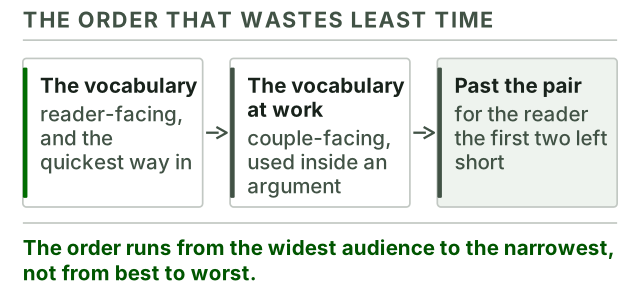
A note on order. Reading the popular guide first is not a mistake, and we would rather a reader finished one paperback than bounced off Bowlby and concluded the whole field was unreadable. The mistake is stopping there and treating the paperback’s tidy version as the state of the evidence.
What is the best book for anxious attachment?
There is no single best book for anxious attachment, and the honest answer is that readers searching that phrase are asking for a description that finally fits and for instructions for changing it. The reading list handles the first request well and the second badly, which is worth knowing before you spend an evening on it.
For the description, Attached is the usual answer and it earns the recommendation. It gives readers language for a pattern they have noticed without having a name for it: the disproportionate attention paid to a partner’s responsiveness, the reading of small silences, the relief when contact resumes. That recognition is the book’s real product.
For the second request, the books are on thinner ice, and so are we. This site recommends reading; it does not tell anyone how to change a long-standing pattern of relating, and where a book claims to, we describe the claim rather than repeat it as advice. A long-standing pattern is work for a qualified professional, not for a chapter and a good intention.
Concrete cases of who gets what:
- For example, a reader whose recent relationships have ended the same way wants a description first. Attached does that plainly, and the recognition alone changes how the next conversation gets framed.
- For instance, a couple where one partner is doing all the reading is better served by Hold Me Tight, because it is built around a sequence both people participate in rather than a self-assessment one person completes and then quotes.
- Consider a reader who mainly wants to stop labelling themselves. The synthesis layer is the better destination there: academic reviews are cautious about categories in a way the paperbacks are not, and reading one can loosen a self-label rather than tighten it.
What none of these books can do is tell you which pattern is yours. A questionnaire in a paperback is not a measure with published validation behind it, and a reader who takes one and walks away with a fixed identity has been given something the research does not support.
Has attachment theory been debunked?
No. The core of it has held up, and the tidy version sold in paperbacks has not. Those are different statements, and a list that answers this question with a flat yes or no has conflated them. What has survived is the observation that people develop organised strategies for seeking closeness under stress, and that those strategies are stable enough to study.
What has been revised is the neatness. The categories readers meet as boxes behave in the data much more like continuous dimensions, with people sitting at points on them rather than inside them. The line from childhood experience to adult relationship behaviour is real but looser than the popular framing implies. And the additional category that developmental researchers added later, for infant behaviour that did not fit the original scheme, has its own contested history within the field.
For a picture of where adult attachment research stands from inside the field, Mikulincer and Shaver’s open-access review in World Psychiatry is the accessible entry point: an open-access review of attachment theory in adults. It is written for clinicians rather than for couples, which is exactly what makes it useful as a calibration check on the paperbacks. The review, the Bowlby volume and everything else linked from this page are recorded on our sources page, each with the date it was checked.
Specific revisions are worth a reader knowing about, all of them qualitative. One is measurement: what looked like membership in a box behaves in the data like a position on continuous scales, so two readers described by the same label can be quite different. Another is stability: patterns are durable but not fixed, and life events move them, which undercuts any reading of a label as a permanent trait. And there is scope: the foundational observational work was done in a narrow set of settings, and the field has kept asking how far the descriptions travel.
None of that adds up to a debunking. It adds up to a framework that is more useful for describing tendencies than for sorting people, and to a popular literature that is running somewhat ahead of what its own footnotes support.
The practical upshot for a reader: treat the categories as a shorthand for a tendency, not as a type of person. The research supports a description of behaviour under stress. It does not support a compatibility chart, a diagnosis of a partner, or a claim that anyone is a fixed kind of person for life.
What do the popular books add and what do they lose?
They add reach and lose precision, and both halves of that trade are real. A paperback that gives a reader a working vocabulary quickly has done something no journal article will ever do. It has also, in the same reading, converted a set of overlapping dimensions into a short list of labels that are easy to apply to other people.
What the popular layer genuinely adds:
- For example, a shared vocabulary between two people who previously had no words for the same recurring disagreement. Naming a pattern is not solving it, but it moves an argument off the question of who is being unreasonable.
- For instance, a structure for conversations that would otherwise never get had. The clinical-lineage books hand couples a sequence and a starting sentence, which is worth more than any amount of accurate theory nobody acts on.
- Such as the simple reframing that a partner’s behaviour under stress might be a strategy rather than a verdict on the relationship. That reframing lowers the temperature of ordinary evenings.
What the popular layer loses:
- The dimensional structure of the underlying measures, flattened into types.
- The caution. Research writing hedges; a paperback that hedged as much would be unreadable, so the hedges come out, and the reader does not learn they were there.
- The distinction between describing a pattern and prescribing what to do about it. Once the vocabulary is in the reader’s hands, the books do not mark where description stops.
The strongest criticism of the popular layer is not that any individual book is wrong. It is that the reading experience produces confidence out of proportion to the evidence, and that confidence gets aimed at a partner who did not read the book and cannot argue back.
What this page does not do
A book guide has limits, and pretending otherwise is how reading turns into amateur assessment.
- We do not tell you your attachment style
- No quiz, no checklist, no reading of your description back to you as a result. The measures that exist were built for research settings, and a paperback questionnaire is not one of them.
- We do not explain how to change a pattern
- Books can describe; changing something long-standing is work with a qualified professional. Where a book claims otherwise, we report the claim and stop.
- We do not diagnose partners
- The misuse this reading invites is applying a label to someone who has not read the book. We will not supply material for that, including compatibility charts between styles.
- We publish no ratings or sales figures
- No star scores, no aggregate review counts, no copies-sold claims. We cannot verify them, so we do not print them, and a number we cannot trace is not evidence of a good book.
- We carry no shop links or affiliate codes
- Nothing on this page pays us if you buy a book. Borrow it, buy it anywhere, or read the open-access review instead. The recommendation does not change.
Where does this leave a reader picking one book?
Pick by the question you arrived with, read one book properly, and then read something from the synthesis layer to calibrate it. That order costs a little more than the usual approach and removes the overconfidence the popular layer produces.
If you want the wider shelf rather than the attachment corner of it, the full relationship-book shelf is the parent page: the layer sorting used here is one instance of the treatment applied there to every title, attachment-based or not. The attachment books above each have their own page with a criticism section, because a recommendation that skips the objections is a sales pitch wearing a cardigan.
If you take only one instruction from this page, make it this: read the popular guide for the vocabulary, then read something from the synthesis layer before you use that vocabulary about another person. The first read is what makes the ideas usable. The second is what stops them hardening into labels, and it is the step reading lists leave out.
One last thing worth saying plainly. Attachment vocabulary has become the default language for talking about closeness, and defaults get overused. Imagine describing a friend’s entire relationship history using only these terms: you would produce something that sounded explanatory and told you almost nothing about the two people involved. The reading is good. The reading is not a theory of everything, and the better books in this list are the ones that say so.