
| What the book claims | What that claim rests on | Who it tends to fit | Where it is challenged |
|---|---|---|---|
| The method behind a couples book matters more than the book's popularity. | The books are reader-facing versions of named therapy traditions, and each tradition treats a different thing as the cause of trouble. | Readers who can describe their problem and want reading that addresses that problem rather than a general one. | Covers and lists do not name the method, so a reader picks by title and lands in the wrong school. |
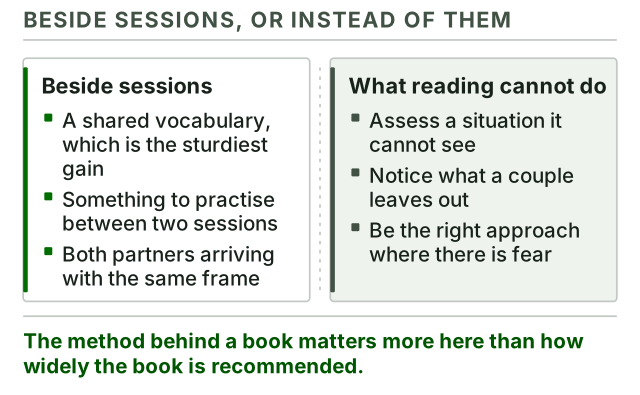
| These books work best beside sessions rather than instead of them. | The books say so in their own opening pages, and the research behind the best-supported methods examined therapy delivered by trained therapists. | Couples already booked in, or waiting for a first appointment, who want something to read in between. | Their packaging markets them as standalone programmes, which is a publishing decision rather than a clinical one. |
| A shared vocabulary is the sturdiest thing a couple gets from reading together. | The named patterns in these books are portable: both partners can use them mid-argument without a therapist present. | Partners who recognise a loop but cannot describe it while it is happening. | A shared vocabulary can also become a way to score points, and none of the books can stop that. |
| Reading cannot assess a situation, and some situations should not be worked on through reading. | Assessment is the part of counseling that requires a person in the room asking questions the book cannot ask. | Anyone deciding whether reading is the right next step at all. | Nothing serious disputes this; the books that ignore it are the ones to be careful with. |
What are books for couples counseling for?
A couples-counseling book is a reader-facing version of a therapy method: it explains what that method thinks goes wrong between partners, and gives the reader a way to see it happening at home. Books for couples counseling are not treatment and were never designed to be, and the good ones say so in their own opening pages.
The phrase “what therapists hand out” describes a practice rather than an endorsement. Counselors give clients reading for ordinary reasons — the session is short, the idea takes longer to explain than a session allows, and a couple who share the vocabulary spend less of the next appointment catching up. What gets handed out therefore tracks the counselor’s training, not a ranking of quality. A counselor trained in emotionally focused work hands out the emotionally focused book, and one trained elsewhere hands out something else entirely.
That has a consequence the recommendation lists leave out. Books handed out by equally competent professionals can give opposite instructions about the same Wednesday evening, because they disagree about what the trouble is made of. One says the argument about the calendar is a protest about whether you matter to each other. Another says it is a habit of escalation that can be interrupted with a practiced move. Another still says neither partner has learned to state a need without an accusation wrapped around it.
None of those is a lie. They are different levels of description, and a reader who does not know which level they have bought will conclude that the book “did not work” when the real mismatch is between the method and the problem. That is what this page is for: to put the method on the label before you start.
We publish no rankings, no ratings and no sales figures anywhere on this site, and our sources page explains why and what that policy costs us. The grouping below is by method, and the order is not a preference.
Which book matches which method?
Match the method to the problem, rather than fitting the problem to whichever title you were handed. The traditions that supply the reading around couples counseling each name a different culprit: the emotional bond, observable conflict behavior, the language of needs, or the structure of desire. The table sets out which book belongs to which.
| Method | The book on this site | What the reading is meant to do | Watch for |
|---|---|---|---|
| Emotionally focused (attachment) | Hold Me Tight | Reframe a repeating argument as a protest about disconnection, then work through a structured sequence of conversations | Applies one lens to every problem, including practical ones |
| Behavioral and observational | Gottman's books for couples | Work on what partners actually do during conflict, plus everyday habits that make conflict less frequent | Reads as a technique manual; the feeling underneath gets less room |
| Needs-based communication | Nonviolent Communication | Separate observation from evaluation, and teach a format for stating a need without an accusation in it | The scripted form sounds artificial out loud until it is practised |
| Structured dialogue | Getting the Love You Want | Slow a hard conversation into turns, so each partner has to reflect back before replying | Built around a theory of childhood echoes that readers can take or leave |
| Desire and eroticism | Mating in Captivity | Explain why closeness and wanting pull in different directions in a settled relationship | A therapist's argument, not a study, though it gets read as the latter |
| Sexual response and context | Come As You Are | Reframe desire as a matter of context and brakes rather than quantity of drive | Popular-science compressions of a large literature |
| Nervous system and couple bubble | Wired for Love | Give partners a set of agreements about how they will handle each other under stress | The brain framing is a simplification of a moving field |
| Pattern and anger | The Dance of Anger | Trace what anger is protecting and how the pattern around it keeps repeating | Written for individual reflection rather than joint work |
The observational and emotionally focused traditions have a research literature behind them, and that is worth stating precisely, because the phrase gets stretched. The observational tradition grew out of laboratory work on couples in conflict, including Gottman and Levenson’s research on conflict and marital breakup, published in the Journal of Personality and Social Psychology. That work studied what couples did and how their bodies responded while they did it. It is the reason the behavioral books read as descriptive rather than inspirational, and we deliberately print no prediction accuracy figure from it, because none has been verified for this site.
The emotionally focused tradition has a trial literature of its own. Its reader-facing book is Hold Me Tight, published by Little, Brown Spark. The one fact that matters for this page is on that publisher’s page: Sue Johnson developed emotionally focused therapy. Her full academic record is set out on our page for the book, and we state nothing about her that the publisher does not.
For the remaining methods, the honest description is that they rest on their authors’ clinical practice. That is not a disqualification — useful clinical writing has never needed a trial to be worth reading — but it changes what a reader should expect. A practice-based book offers a lens that has helped the author’s clients. A trialled method offers a lens plus evidence that the method, delivered by trained people, did something measurable. Our hold me tight page and our Gottman books page each take that distinction apart in detail.
Can a book replace couples counseling?
No, and the better books are the ones that say so first. A book can explain a method, supply shared language, and let a couple arrive at a first session already able to describe their pattern instead of narrating last Tuesday. What it cannot do is the part that requires another person in the room.
Certain things belong to that person specifically. Assessment is one of them: someone asking the questions neither partner thought to ask, including the ones about drinking, money, health and what has already been decided privately. Pacing is another: a conversation that is going badly can be stopped by a professional and cannot be stopped by a paperback. And there is holding one partner steady while the other says something difficult, which is the mechanism these structured conversations quietly assume.
The research point follows from the same gap. Where a method does have supporting studies, those studies examined the therapy as delivered by trained and supervised therapists to couples who signed up for treatment. Partners working through the book at a kitchen table are doing a related but different thing, and the findings do not transfer intact. We say this on every page where a book borrows authority from a trial.
The professional route. If either partner is frightened of the other, or if reading together reliably ends in escalation rather than conversation, that is a situation to take to a qualified professional rather than to a book, and this site is not the place to work out what to do next. This page sorts books by method. It cannot look at your situation, and it will not tell you which treatment to seek.
There is a smaller failure mode worth naming, because it is undramatic and easy to miss. One partner reads, finds the framework convincing, and starts using its vocabulary as a verdict on the other. The book becomes evidence in the argument it was supposed to interrupt. Each method here is vulnerable to that, and the only real protection is reading together, or agreeing that neither of you will use the new words as a label for the other.
What should you read before a first session?
Read something short and descriptive, not a programme you will half-finish. Before a first appointment the useful thing is language for what happens between you — the shape of the loop, the moment it turns — because that is what a counselor asks for at the start of a first appointment and that is the part a couple can struggle to put into words. A method started at home and abandoned is harder to work with than nothing.
- For example, a couple who fight the same fight in different costumes get more from the opening chapters of an emotionally focused book, which describe the loop, than from the exercise sequence at the back, which assumes preparation neither of them has done yet.
- For instance, a pair who do not fight at all and cannot say what is missing are poorly served by any book built for distress. The desire-focused writing on Mating in Captivity and the context-first account on Come As You Are are aimed at that quieter question.
- Consider the case where one partner has already booked the session and the other has agreed reluctantly. A structured dialogue book gives the reluctant partner a defined, finite task — take turns, reflect back — rather than a request to open up on demand.
- Imagine arriving with two different books and two different vocabularies for the same Wednesday. That is worse than arriving with none, and it is a good argument for choosing one method together before either of you starts reading.
Where the trouble is specifically that conversations go wrong — interrupting, escalating, going silent — the reading that helps is the communication set rather than the therapy set. Our communication books page compares those methods against each other, and Nonviolent Communication has its own page for the needs-language approach in particular.
Should both partners read the same book?
Read the same book, at roughly the same pace, or accept that one of you is doing something different from the other. This reading goes wrong when one partner finishes a method book alone and arrives with a completed analysis of the other person. The framework then functions as a verdict, and the partner who has read nothing has no way to answer it except by refusing the whole idea.
Reading together fixes less than it sounds like and still fixes the important part. It puts both people in the same vocabulary, so the words that come out mid-argument mean the same thing to both of them. It also distributes the discomfort evenly: a chapter that stings is easier to discuss when both readers have just been stung by it, and much harder when only one of you has met the material.
Where a partner will not read, the choice is between books written for individual reflection and books written for joint work, and the difference is not decorative. Individual-reflection titles such as The Dance of Anger ask a reader to examine their own pattern without requiring anything from anyone else. Joint-work titles assume two participants and quietly fail without them, which readers experience as the book being wrong rather than as the book being misapplied.
There is a middle option worth knowing about. Rather than a whole programme, both partners read a short section — the part that describes the pattern, not the part that prescribes the work — and agree to discuss it at a set time, when neither of you is already annoyed. Books for couples counseling work in that shape, and stall as a project one person is quietly managing.
The rule that makes the difference between shared reading and ammunition is this: neither partner gets to apply the book’s categories to the other as a description of who they are. The vocabulary is for the pattern between you. Used on a person, it stops being a method and becomes a label, and any book on this page is easy to misuse that way.
Where do these method books fall short?
The shared weakness is that each of them generalises from a narrow room. The same criticisms recur, and each is attributable to something specific rather than to unnamed critics.
The delivery gap. The methods with the strongest support were tested as therapy, not as reading. This is not an outside objection; it is visible in the studies themselves, which describe trained therapists working with couples who volunteered for treatment. A book that borrows the phrase “evidence based” from that literature is borrowing evidence for a different activity.
Clinical observation presented as general rule. The practice-based books draw on the couples who came to that particular author’s practice, which is a self-selected group with the means and the willingness to attend. Writers in this tradition name the source of their material in the introduction and stop naming it by the middle chapters, where the observations have hardened into rules about how relationships work.
One lens, applied everywhere. Each method finds its own cause wherever it looks. The attachment lens reads an argument about the calendar as a protest about mattering. The behavioral lens reads it as an escalation habit. Sometimes it is neither, and the couple is short of money, sleep, or willingness. A reader committed to a single lens will work patiently on the wrong thing.
Both partners are assumed willing. This reading assumes both partners will do the work and stay in an uncomfortable conversation. Where only one is invested, the book converts into a source of blame for whichever partner bought it, and the method has nothing to say about that case.
None of this cancels the category. A couple who pick the method that matches their problem, read it together, and treat it as preparation rather than as treatment get something that is hard to get any other way: a shared, neutral name for the thing that keeps happening between them. That is a real result, and it is the one this category is built to produce.
What this page does not do
A clinical field sits one step away from this page. Everything below is about keeping that step visible.
- We do not recommend treatment
- We describe what books claim and where the claims are disputed. Whether a couple should be in counseling, and with whom, is not a question a reading guide can answer.
- We do not name clinics or clinicians
- No referrals, no directories, no practitioner listings. The only thing we can responsibly compare is published reading.
- We do not sell anything
- Nothing here is a purchase route: no shop buttons, no affiliate codes, no prices, no editions to compare. A publisher page appears only where a claim about a book or its author has to be checkable.
- We do not publish success rates
- No effectiveness percentages, no ratings, no copies sold. Every number on this site must come from a named source with a year, and for these methods we have verified none. See /sources/.
Where should you go next?
Start from the problem you can describe, then follow it to the method. If the same argument keeps returning and neither of you can stop it, Hold Me Tight is the emotionally focused route. If you want observed behavior and practical routines instead, Gottman books sorts that shelf and says which volumes were written for therapists rather than couples. If conversations break down before content is reached, Nonviolent Communication covers the needs-language approach and Getting the Love You Want covers structured dialogue.
For the wider map — every book we cover, with the same questions applied to each — the best relationship books guide is the parent page. Our reading of this category, in a sentence: the method on the label matters more than the name on the cover, and no book here can do the part that needs somebody else in the room.
If none of the methods above matches what you are dealing with, that is worth knowing before you buy anything. Reading is a good tool for a pattern you can already describe and a poor tool for a situation you cannot yet name. Our frequently asked questions page covers the policies behind this guide — no ratings, no quotes without a chapter, no shop links — and the sources page sets out how a claim gets onto this site at all.