
| What the book claims | What that claim rests on | Who it tends to fit | Where it is challenged |
|---|---|---|---|
| Security and desire draw on conditions that pull against each other, and couples are asked to get both from one relationship. | Perel's own clinical practice, written as essay rather than as research. | Long-term couples who describe their relationship as close and flat in the same sentence. | Case material is selected by the person making the argument and cannot be audited by the reader. |
| Domestic life is organised around safety, and the habits that produce safety tend to flatten wanting. | Observation of couples in therapy, plus a cultural argument about how modern couples are asked to be everything to each other. | Readers who want a description of what happened to them rather than a set of steps. | The couples described came to a psychotherapist in a large city, which is a narrow slice of the couples the claim is written about. |
| Distance, separateness and a degree of unfamiliarity are conditions for desire, not threats to the relationship. | A reframing of clinical patterns; the book argues it rather than testing it. | Couples whose problem is sameness rather than conflict. | The same distance the book treats as erotic is treated as avoidance elsewhere in the genre; the book does not resolve the collision. |
| Infidelity has meanings beyond betrayal and can be read as a statement about the self rather than only about the partner. | Case material, later expanded in Perel's book on affairs. | Readers trying to understand a rupture after the fact. | This is the part of her work that draws the sharpest objections, including from clinicians who work with the partner who was not told. |
Mating in Captivity is a book by the psychotherapist Esther Perel that argues that the conditions which make a household feel safe are not the conditions that keep desire alive, and that modern couples are asked to get both from the same person. Readers reach the Mating in Captivity book from different directions: some want a summary of what it claims, and some arrive looking for Esther Perel herself, having heard her somewhere else first. This page is written for both, and it separates what the book argues from what it can demonstrate.
The book carries the subtitle Unlocking Erotic Intelligence, and it is published by HarperCollins, whose listing for this edition describes Perel as a Belgian psychotherapist in practice in New York City who has taught at NYU Medical Center and Columbia University. Those are the credentials we can verify, and they are the ones we use. How we decide what counts as verified is set out on sources.
What is the Mating in Captivity book about?
The book is about why two people who love each other, agree about the important things and have built a life together can stop wanting each other. Perel’s answer is that they did not fail at anything. They succeeded at building safety, and safety is not the material desire is made from. The problem, in her framing, is structural rather than personal.
Elsewhere on the shelf a quiet bedroom is read as a symptom: of poor communication, of unresolved conflict, of stress, of something that broke. This book treats it as a predictable outcome of domestic success. The couple merged their calendars, their money, their friends and their weekends. They know what the other will say before it is said. Every one of those achievements buys security, and each of them removes a little of the distance across which wanting travels.
That reframing is the book’s main gift to a reader. It converts a private failure into a recognisable pattern with a name. A couple who assumed that the flatness meant the relationship was ending get, instead, a description of a tension that long partnerships run into and that nothing in their upbringing prepared them to expect.
The book also has an argument about the era. Perel’s view is that the modern couple is asked to supply what a village, an extended family and a religious community used to supply between them: companionship, security, identity, meaning, and passion, from one household. Load all of that onto one relationship and the last item on the list is the one that gives way first.
There is a second layer to the argument, and it is easy to read straight past on a first pass. Perel is not only describing what happens inside a couple; she is describing what a couple is now expected to be. A partnership that once had to deliver a household, an alliance and a lineage is now also expected to deliver being seen, being understood and being wanted, indefinitely, by one person who is also doing the school run. The book treats that expectation as historically new and rarely examined, and it argues that couples experience the strain of it as a personal shortfall.
That is also why the book reads as unusually calm about a subject the genre treats as an emergency. It does not open with the assumption that a quiet relationship is failing, and it does not promise that the tension can be dissolved. What it offers is a way of holding two true things at once: this person is my safety, and safety is not the same as wanting. A reader looking for reassurance that the flatness is temporary will not find it. A reader looking for an explanation that does not require a villain will.
The way the book is built has consequences. It is an essay, so it moves by argument and case rather than by chapter-by-chapter instruction. And it is written from a consulting room, so its evidence is what a therapist saw and how she interpreted it. Both matter later, in the section on criticism.
What is Esther Perel’s theory?
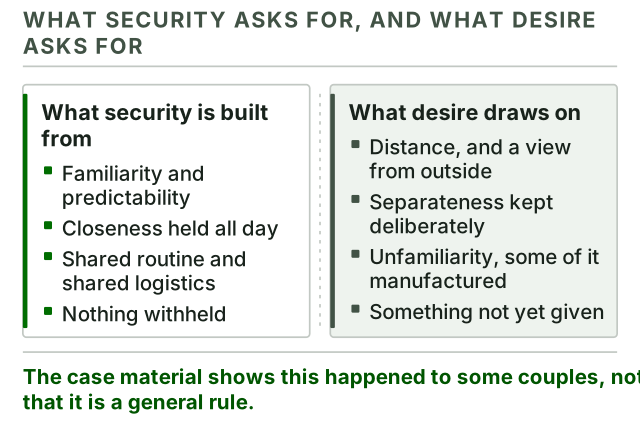
Her theory is that intimacy and eroticism run on opposing needs, and that the tension between them is permanent rather than solvable. Intimacy wants closeness, knowledge and predictability. Desire wants distance, novelty and a part of the other person that stays out of reach. A couple does not choose between them; a couple learns to move between them.
The consequence Perel draws is counter-intuitive and is what the rest of her work develops: separateness is not a threat to a good relationship, it is a precondition for wanting inside one. Watching your partner be competent, admired or absorbed in something that has nothing to do with you does something that no amount of shared time achieves — it briefly makes them a person again rather than a fixture.
- For example, the book keeps returning to the difference between how a partner looks across a kitchen at the end of a long week and how the same partner looks across a room full of other people who do not know them. Nothing about the person changed. The distance did.
- For instance, Perel treats the standard advice to share everything — every worry, every thought, every hour — as a policy with a cost as well as a benefit. Total transparency builds trust and reduces the unknown at the same time, and the second effect is rarely counted.
- Consider a couple who solve their sexlessness by scheduling. Perel’s objection is not that scheduling is unromantic. It is that a calendar entry solves availability, and availability was never the thing that was missing.
Where does this book sit among her other work? It is the earlier of her two books and states the theory; the later one, The State of Affairs, applies the same lens to infidelity and is the one clinicians argue over. Her podcast work carries the same ideas in another form, as recorded sessions rather than as argument. This is the book where the framework is set out plainly, and it is the one we point a reader to when the question is what she actually claims.
A note on quotation. Lines circulate online under Perel’s name that turn out to be paraphrase, podcast fragment or invention. We do not reproduce quotations from copyrighted books, and we do not print a line as hers unless it can be located in a named chapter. The policy, and the reasoning behind it, sits on our FAQ.
Who does the book help?
It helps couples whose problem is sameness rather than conflict. That is a narrow readership, and a badly served one: the shelf is built for people who are fighting, and a couple who never fight and feel nothing have nowhere obvious to go.
- For example, two people who have been together long enough that their weeks are interchangeable, who like each other, who would describe the relationship as good, and who cannot remember the last time either of them was surprised by the other. The book gives that state a name and an explanation that does not require either of them to be at fault.
- Such as a reader who has been told that better communication is the answer, has tried it, communicates well, and finds that the flatness survived the improvement. Perel’s argument explains why: communication trouble and flatness are not the same problem, and the tools for one do not act on the other.
- Imagine a couple in the years when small children set the schedule, who have become excellent colleagues in a domestic operation. The book is unusually clear about that transition, and about the fact that the efficiency which keeps the household running is not neutral toward wanting.
It helps another kind of reader too: the one who wants to understand something that already happened. The book’s chapters on desire, secrecy and the erotic imagination are more useful as an account of a rupture after the fact than as a plan for preventing one.
Who it does not help. Couples in open conflict, where the argument repeats and escalates, will find little here to act on — that is what Hold Me Tight is built for, and its method has a research literature behind it that this book does not have. Readers whose question is about the mechanics of arousal and responsive desire are better served by Come As You Are, which is grounded in sexuality research rather than in clinical essay. Readers who want a structured programme rather than an argument should start with our guide to books for couples counselling, where the entries are sorted by what they ask a couple to do.
What are the criticisms of Mating in Captivity?
The recurring objection is methodological: the book presents clinical observation as a general rule about couples, and its evidence is case material chosen by the person making the argument. Nothing in the book lets a reader check whether the pattern it names is widespread, whether it holds outside the consulting room, or whether the couples described are representative of anyone but themselves.
We hold ourselves to the same standard we apply to books, so we will be plain: we have not found a critical review of this book from a source that meets our verification bar, and we do not link sources we have not opened and read. What follows is therefore set out as arguments a reader should weigh, not as citations. Some of them follow from the book’s own construction; another is a live disagreement inside couple therapy.
The sample is the practice. The couples in the book are people who could afford a psychotherapist, who chose to see one, and who lived in a large Western city. That is a narrow slice of the couples the argument is written about. A claim about what happens to desire in long partnerships needs a wider population than the one that walks through one consulting-room door, and the book does not have access to one.
Observation is presented as rule. The book moves from “here is a pattern I saw repeatedly” to “here is how intimacy and desire work” without the intermediate step that would make the second sentence checkable. Some of what it describes may generalise; some may be an artefact of who seeks therapy. The essay form gives the reader no way to tell the two apart, and the confident register does not signal the difference either.
The treatment of infidelity is the sharpest split. Perel’s insistence that affairs carry meaning beyond betrayal — that they can be about the self rather than only about the partner — is the part of her work that clinicians divide over. The objection from within therapy is not that the observation is false, but that the framing can shade into explanation that lands as mitigation for the person who kept the secret, and that the partner who was not told can end up underweighted in the analysis. Readers should know that the disagreement exists before they take the framing on board.
A collision the book leaves standing. The distance this book treats as erotic is treated elsewhere in the genre as withdrawal to be reduced. Well-regarded books can tell the same couple to close the gap and to protect it. Perel does not reconcile that, and a reader running both arguments at once should notice which problem they actually have before choosing which advice to follow.
Who the book is silent about. The argument assumes a couple with enough security to be bored by it. Partnerships held together by money, immigration status, illness or care obligations appear rarely, and the freedom the book treats as available — to travel, to have separate interests, to keep parts of a life private — is not evenly distributed. A reader whose constraints are material may recognise the description of flatness and find nothing in the prescription that is reachable from where they stand.
The prose does argumentative work. The writing is confident, aphoristic and quotable, which is part of why the book travelled as far as it did. It is also a style in which a memorable sentence can pass for a demonstrated point. Readers who notice themselves agreeing quickly should check whether they are agreeing with an argument or with a well-turned line, because the book gives them no evidence to check it against either way.
None of this cancels the book. What it does well, it does thoroughly: it describes a real and recognisable predicament without treating it as pathology, and it gives a couple language for something they could feel but not say. Read as an argument to think with, it earns its place. Read as evidence about couples in general, it is asked to carry more than it can.
What to read alongside it?
Read it with a book that has a method and a book that has research behind it, because this book supplies neither and does not claim to. The table below is how we would sequence them for a reader who is starting from a quiet relationship rather than a loud one.
| Book | What it gives you | What it does not give you | Start here if |
|---|---|---|---|
| Mating in Captivity | A description and a vocabulary for closeness without wanting | Steps, exercises, or evidence you can check | The relationship is good and flat, and you want to understand why |
| Come As You Are | A research-based account of how desire is triggered and inhibited | A theory of long-term domestic life | The question is about arousal and responsiveness rather than about distance |
| Hold Me Tight | A structured method for repairing recurring conflict, with a research literature behind it | Much on desire specifically | The same argument keeps happening and neither of you can stop it |
The order matters more than the choice. A couple who are fighting should settle the fight before reading a book about eroticism, because the book assumes a stable base it will not help build. A couple who are quiet and safe can start here, and will come to the others with a sharper question. Our full shelf of titles, each one put through this same treatment, is on the relationship books guide.
What this page does not do
A book page can quietly become a shop or a diagnosis. Ours does neither, and here is the specific version of that promise.
- We do not sell the book
- There is nothing here to click and buy: no retailer destinations, no pricing, nothing paid. The lone external link goes to HarperCollins, where the edition and the author bio are on the record.
- We do not print ratings
- Aggregate review scores and print-run claims come from platforms and publicity material nobody can audit. Perel's book is described here by what it argues, never by how it scored.
- We do not quote what we cannot locate
- Text travelling under Perel's name may be paraphrase, podcast fragment or invention. Her argument is therefore set out in our own words, with the chapter named when a line is unavoidable.
- We do not diagnose your relationship
- The book names a pattern. Whether you are inside that pattern is not something a reading guide can decide, and nothing written here is an assessment of you, your partner or your marriage.
- We do not give advice on your sex life
- What Perel argues, and where clinicians dispute it, is the whole of what gets reported. What to do with any of it stays between you, your partner, and a therapist if you want one.