| What the book claims | What that claim rests on | Who it tends to fit | Where it is challenged |
|---|---|---|---|
| The books on this shelf do not share a definition of love, and do not say so out loud. | Reading them side by side: one opens with a feeling, one with a practice, one with a bond formed under stress. | Readers who tried one book about love, found it beside the point, and assumed the genre was the problem. | Publishers present them as one category, and readers who like the genre argue the definitions are complementary rather than rival. |
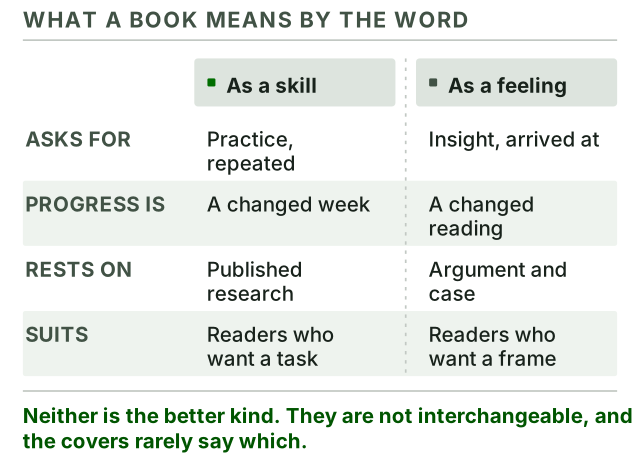
| A book that treats love as a skill asks for work; a book that treats it as a feeling asks for insight. They are not interchangeable. | The structure of the books themselves: exercises and practice on one side, explanation and reframing on the other. | Anyone deciding whether they want something to do this week or something to understand. | Some authors would say the split is false, since understanding is itself a practice; the boundary is blurrier in the reading than in a table. |
| The attachment-framed books rest on published research; the essayistic ones rest on argument, and both can be read honestly if you know which is which. | Attachment titles cite a research literature that exists and can be checked; the essays make a case and stand on it. | Readers who want to know what a claim is standing on before they act on it. | Citing research is not the same as being supported by it, and popular books compress findings in ways researchers dispute. |
| Books that sort love into named categories are the most memorable and the most disputed part of this shelf. | Categories travel well in conversation, which is why they spread; the same categories are where reviewers concentrate their objections. | Readers who already met a category at a dinner party and want to know how seriously to take it. | A review published by the Association for Psychological Science reports that people value all the categories rather than one, and that the categories overlap. |
What do these books mean by love?
They mean different things, and the disagreement is not decorative: a book that means “a feeling to be understood” gives you an explanation, a book that means “a practice” gives you something to do on Tuesday, and a book that means “a bond that behaves in predictable ways under stress” gives you a mechanism. Choosing badly is enough on its own to make a reader give up.
A non-fiction book about love is a work of popular psychology, clinical writing or essay that argues for a specific account of what love is and how it behaves, rather than telling a love story. That definition is what separates the shelf described here from fiction, and it is the first filter worth applying to any list of the best books about love.
The first family treats love as a feeling with causes. These books explain where the feeling comes from, why it arrives unevenly, and why the same relationship can be experienced by each partner as a different event. The reward is recognition; the risk is that recognition feels like progress when nothing has changed yet.
The second family treats love as a practice. Erich Fromm’s The Art of Loving is the sharpest version, arguing that people treat love as a matter of finding the right object rather than developing a capacity, and that this is why so much effort goes into being chosen and so little into learning anything. bell hooks’s All About Love makes a related argument in a different register, insisting that love is better understood as something people do than as something that happens to them.
The third family treats love as an attachment bond. These books borrow from research on how adults seek closeness and react when it is threatened, and they are the mechanical ones of the three: the promise is that behaviour which looks irrational becomes legible once you see what the bond is protecting. That research line has a checkable origin in the paper that carried attachment theory into adult romance, which is where the framing entered popular writing in the first place.
The families also disagree about what counts as evidence, which matters more than it sounds. An attachment-framed book points outward at studies. A practice book points at the reader’s own conduct and asks whether the description fits. An essay points at the culture and argues. A reader who wants proof and picks up an essay concludes the genre is soft; a reader who wants a way of seeing and picks up a research summary concludes it is cold. Both are choosing the wrong shelf, not meeting a bad book.
There is something else worth knowing before choosing: whether the book is written to one reader or to a pair. Books about love are marketed as if any of them could be read by two people at once, and part of this shelf is written in the second person to someone thinking alone. That is not a defect, but it changes what happens when the book arrives in a household, and it is one reason a recommended title stalls halfway.
Family membership is not announced on the cover, and the blurb borrows the vocabulary of all three at once. That is the gap this page is trying to close: naming the definition each book works from, so a reader can tell before the first chapter whether the book is answering the question they brought to it or a neighbouring one that merely sounds the same.
Which book about love should you read?
Read the one whose definition of love matches the question you actually have. The table sorts the main non-fiction titles by what each argues love is, who each one is written for, and the objection worth carrying into the reading, so that the choice happens before the first chapter rather than after the last.
| Book | What it argues love is | Who it fits | Where it is contested |
|---|---|---|---|
| Attached | An attachment system: closeness-seeking that behaves predictably under threat | Readers dating, or trying to explain a pattern they keep repeating | Its typology is easy to apply to a partner as a label rather than to a pattern between two people |
| Hold Me Tight | A bond maintained by emotional responsiveness, repairable through named conversations | Couples who want a method rather than an explanation | Written as a method, so readers who skip the conversations get a description of therapy and not the use of it |
| Mating in Captivity | Two appetites in tension: the security of closeness against the distance desire needs | Long-term partners who feel affection intact and desire flattened | Built from clinical practice, not from tested findings, and presented as an argument rather than evidence |
| The 5 Love Languages | A set of preferred expressions that must be matched to register as care | Readers who need shared words for an argument they keep having wordlessly | The categories overlap, and reviewers report people value all of them rather than one |
| The Art of Loving | A capacity developed through practice, not a stroke of luck in finding someone | Readers who want an argument rather than a programme | It is essay and assertion; it offers no evidence and does not pretend to |
| All About Love | An ethic and an action, judged by what a person does rather than what they feel | Readers interested in how culture shapes what love is allowed to look like | The definitional move is deliberate and demanding; readers wanting practical steps can find the register hard to use |
| Come as You Are | Desire understood in context rather than as a fixed quantity a person has | Readers whose question is really about wanting, not about affection | Written for one reader; its subject is a body and a history, not a couple |
Start with Attached if what you want first is vocabulary, and expect to unlearn part of it later. Levine and Heller describe adult closeness as a system whose behaviour is predictable, which explains fast and travels faster; that portability is how the terms escape the book and end up sorting people. Their publisher’s record is where we check who wrote it, and the shelf around it sits on our attachment theory books page.
For a reader whose affection is intact and whose wanting is not, Mating in Captivity is the entry here that takes the question head on: what becomes of desire once love is secure. Next to the attachment titles on this table it is the odd one out, because its basis is consulting-room experience rather than a research line. That is a real basis and a bounded one, which makes the book a lens to think with, not an instruction.
The objection to The 5 Love Languages is also the reason it earns a row: its definition of love is unusually narrow, counting only what arrives in a form the receiver recognises. Narrowness is what makes it usable in an argument and what makes it a target, and the target practice is on are love languages real.
Two people, not one, is what Hold Me Tight assumes, and that assumption is what separates it from every other row. It makes the bond argument the attachment titles make, then aims it at a couple rather than at a dating history, and hands it over as a sequence of named conversations to be held rather than a case to be followed. On this table it asks the most of a pair and offers the least to somebody reading by themselves.
The essays sit at the other end. Fromm and hooks are not trying to hand anyone a technique, and neither offers a way to check their claims; what they offer is a definition strong enough to argue with. That is a real product. A reader who leaves All About Love disagreeing with its insistence that love is an action rather than a feeling has still been forced to say what they think love is, which is more than the practical titles ask of anyone.
Anyone whose real question is about wanting rather than about affection is the reason Come as You Are has a row here: those two questions are easily answered with the wrong book. Emily Nagoski’s subject is the conditions around desire, not an amount of it, and she addresses one reader with a body and a history — which is worth knowing before the book is handed across a kitchen table.
Which of these hold up, and which have aged?
The essays have aged best and the categorising books have aged worst, which is the reverse of what their reputations suggest. An argument about what love is stays readable long after publication because nothing in it depends on a finding; a framework that sorts people into named types is exactly the kind of claim later readers and researchers come back to test.
- For example, the Association for Psychological Science review of the love-languages literature found the categories overlapping rather than exclusive, readers valuing all of them rather than living inside one, and no reliable gain in satisfaction where partners were matched up on them. That does not empty the book out; it turns a model of people into a prompt for a conversation.
- For instance, Fromm’s central complaint reads as though it were written about a dating app: that the effort goes into becoming desirable and not into becoming capable of loving. The book is old and the observation has not weakened, because it was never attached to a measurement in the first place.
- Consider the gender-essentialist wave of relationship writing, of which Men Are from Mars, Women Are from Venus is the best-known example. Its explanatory move — treat men and women as two categories with different wiring — is the part reviewers now reject, while the practical suggestions it made about timing and phrasing are the part readers still quote.
The attachment-framed books sit in between. The underlying research is real and continuing, but popular books compress it, and compression is where the disputes start: a research literature describing tendencies becomes, in a paperback, a set of types with names that people apply to their partners at dinner. Reading the book and the research as two different objects is the honest way through that; the sources page says which records this page may cite and which claims we decline to repeat.
“Holding up” here means something specific: the claim can still be stated in the author’s own terms and still describes something a reader recognises, without needing the decade it was written in as an excuse. By that test, arguments about attention, effort and what people owe each other survive well, and claims about how a category of person behaves survive badly. That pattern is consistent enough across the shelf to use as a buying rule, if this were a page that recommended buying.
One more thing ages badly across the whole shelf: the promise. A book written to convince a browser overclaims in the first chapter and qualifies in the last, so a reader who stops early leaves with the overclaim. Reading the final chapter early is a cheap way to find out what the author actually thinks the book can do.
Why are there no novels on this page?
Because this guide covers non-fiction, and mixing the two would make the list useless for the question it is trying to answer. A novel about love and a book arguing about what love is do different work: one gives you an experience to sit inside, the other gives you a claim you can agree or disagree with, and only the second can be checked against anything.
That boundary is a scope decision, not a verdict on fiction. Readers can learn more about love from novels than from any book on this table, and nothing here disputes that. What we cannot do is compare a novel and a clinical argument on the same axis without producing a list that misleads on both counts.
- Imagine the lists merged: a book arguing that desire needs distance, sitting next to a novel in which a couple falls apart beautifully. There is no shared criterion, so the ordering would come down to taste dressed up as judgement.
- Such as the recurring request for the top romantic books: it is a real question with a real answer somewhere, just not here. We answer the scope question once on our FAQ page and keep this page for the books that make arguments.
The rest of the map, including the collections built around specific situations rather than specific definitions of love, starts on the main guide. If your question is really about sustaining a relationship rather than understanding love, the books for couples to read together page sorts the same shelf by a different criterion.
What can a book about love not do?
It cannot tell you whether the relationship you are in is the one being described, and that is the limit worth naming before you start. Every book here works by generalisation, and the moment its account is applied to a specific evening, a specific silence or a specific person, a reader is doing interpretation the book cannot supervise.
Smaller limits follow from that. A book cannot know what it has left out of your situation, and it cannot notice when its framework is being used to win an argument rather than to understand one. Where a couple wants structured help with something a paperback plainly does not reach, the professional route exists for that, and we would rather say so than imply a reading list covers it.
What this page does not do
A list of books about love is normally built to move copies. This one earns nothing from a sale, which changes what it can honestly say.
- We do not sell these books
- Nothing here is a purchase route: no retailer or PDF links, no affiliate codes, no prices, no buy buttons. Where a publisher page appears, it confirms who wrote the book and nothing else.
- We do not rank them
- The table sorts by the definition of love each book uses. A ranking would imply we know which definition fits your relationship, and we do not.
- We do not print sales figures or ratings
- Copies sold, chart placings, averaged reviews and star scores are marketing material rather than evidence. Our sources page explains how that rule works here.
- We do not quote passages
- Summaries here are in our own words. We do not reproduce text from books under copyright, and we do not attribute lines to authors who did not write them.
- We do not diagnose
- Nothing on this page describes you or a partner. The books make general claims; matching them to a real relationship is the reader's judgement, not ours.
The short version: decide whether you want love explained, practised or mapped, then take a book from that column and another from a different one, so they disagree in front of you. The argument between the books is where the value on this shelf actually sits.