| What the book claims | What that claim rests on | Who it tends to fit | Where it is challenged |
|---|---|---|---|
| A recurring argument is a protest about disconnection, not a dispute about the subject on the table. | Attachment theory extended to adult partners, and Johnson's own clinical work developing emotionally focused therapy. | Partners who fight about logistics, apologise, and then have the same fight again. | The frame is applied across the book's range of couple problems, including ones with practical rather than emotional causes. |
| Couples get stuck in named negative cycles, and the cycle is the enemy rather than either partner. | Patterns Johnson describes from watching couples in therapy sessions across her clinical practice. | Readers who can already feel the loop starting and cannot describe it while it happens. | Naming a cycle in a calm chapter is easier than catching it mid-argument without a therapist in the room. |
| Working through the seven conversations in order changes how a couple reaches for each other. | The reader-facing form of a structured therapy that has been tested in clinical trials. | Two people who both want to do the work and can hold an uncomfortable conversation without it escalating. | The trials tested the therapy delivered by trained therapists, not the book read alone at a kitchen table. |
| Emotional responsiveness is the ingredient that keeps love alive, ahead of communication technique or compatibility. | The attachment tradition, which treats a partner's availability as the organising fact of the relationship. | Couples who have tried rule-based communication advice and found it did nothing for the feeling underneath. | It is a single-lens account: money, illness, unequal workloads and plain incompatibility get little room. |
What is the book Hold Me Tight about?
Hold Me Tight is a popular-psychology book by Sue Johnson that rewrites a couples therapy for readers, arguing that repeating arguments are protests about emotional disconnection rather than disagreements about the thing being argued over. The Hold Me Tight book is the reader-facing form of a clinical method, and that lineage explains both its strengths and its limits.
The credentials behind it are checkable. On the publisher’s page for Hold Me Tight, Johnson is described as a Distinguished Research Professor at Alliant International University and a professor at the University of Ottawa, a member of the Order of Canada, and the developer of emotionally focused therapy. Little, Brown Spark is the imprint. Those are the facts we will use about the author, and we will not add to them.
The structure of the book is unusual for the shelf. The opening part makes the case that adult love is an attachment bond and that the fights couples have are bids for reassurance in disguise. The longer part that follows is a course: seven conversations, each with transcripts of couples working through them and exercises for the reader.
The engine of the opening part is what Johnson calls the Demon Dialogues, her name for the negative cycles couples repeat. She names them Find the Bad Guy, where both partners are looking for someone to blame; the Protest Polka, where one partner pushes for contact and the other withdraws from it; and Freeze and Flee, where both have stopped pushing at all. Other frameworks describe overlapping patterns under different names, and Johnson’s terms are her own.
What the book does for readers is move the location of the problem. The argument is no longer about who is unreasonable about the dishes. It is about a question neither partner is saying out loud, which Johnson frames as: are you there for me, do I matter to you, will you come when I call. Read that way, a raised voice is a signal rather than a fault.
That move is the whole book, and it is worth being clear that it is a claim and not a finding. Johnson’s case for it rests on attachment theory plus clinical work watching couples in a therapy room. The therapy has been studied. The specific proposition that any given argument in your kitchen is an attachment protest is an interpretation the reader has to try on and test.
What are the seven conversations in Hold Me Tight?
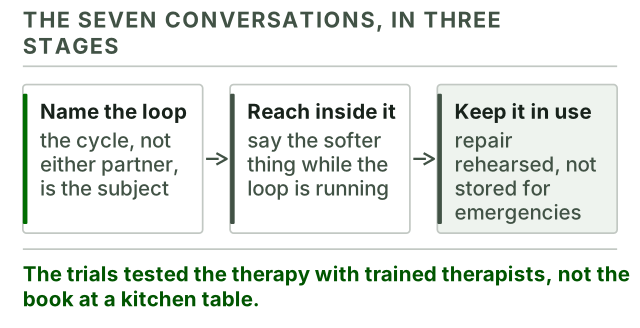
The seven conversations are a sequence, not a menu: each one assumes the couple has done the previous one. They run from recognising the cycle, through the raw spots that drive it, to repair, sex and touch, and the maintenance work afterwards. Names below are the book’s own; the exercises belong in the book and we do not reproduce them here.
| Conversation | The book's name | What it is meant to do |
|---|---|---|
| First | Recognising the Demon Dialogues | Get both partners to see the repeating cycle as the shared problem instead of each other |
| Second | Finding the Raw Spots | Trace the sore places underneath the cycle: the old fears about mattering to someone that sit under it |
| Third | Revisiting a Rocky Moment | Replay one specific argument slowly enough to see where each partner lost the other |
| Fourth | Hold Me Tight: Engaging and Connecting | The core conversation of the book: asking directly for reassurance and responding to the ask |
| Fifth | Forgiving Injuries | Address the moments that broke trust and that keep getting reopened in later arguments |
| Sixth | Bonding Through Sex and Touch | Connect physical intimacy to emotional safety rather than treating it as a separate department |
| Seventh | Keeping Your Love Alive | Turn the work into deliberate habits, on the assumption the cycle will return |
The Hold Me Tight conversation is the one the book is named after and the one everything else is built around. It asks each partner to say the vulnerable thing directly, and asks the other to answer it without defending themselves. Johnson’s argument is that couples cannot get there cold, which is why the preparation conversations come first.
The closing conversations are the easiest to skip and are the reason the book is longer than its idea. A couple who can name their cycle and still cannot get past an old betrayal has run into Forgiving Injuries, not a failure of the method. Bonding Through Sex and Touch is the section a reader can be tempted to skip, and Keeping Your Love Alive is the one that treats relapse as expected rather than as proof that nothing worked.
A Hold Me Tight summary will give you this list, and the list is genuinely useful for deciding whether the book is for you. What a summary cannot carry is the material that makes the method work: the session transcripts, where you watch a couple fail at a conversation and then get it, and the exercises, which are slow on purpose. Readers who take the list and skip the practice end up with a vocabulary for their fight and no new ability to interrupt it.
Is EFT evidence based?
Emotionally focused therapy is one of the couple therapies with a published clinical trial literature behind it, and that is worth stating precisely rather than loosely. Where a popular relationship book rests on its author’s own practice, this one rests on a method that other researchers have tested and written about in peer-reviewed journals.
The theoretical base is older than the therapy. Johnson builds on the argument John Bowlby made in Bowlby’s original attachment work, issued under the Basic Books imprint: behaviour organises itself around whether a key figure is available and responsive, and losing access to that figure produces protest before it produces withdrawal. Johnson’s contribution was to treat adult partners as each other’s attachment figures and to build a therapy that works on the bond rather than on communication skills.
Some qualifications belong next to the phrase “evidence based”, and the book does not supply them. The first is the setting: trials test the therapy, delivered by therapists trained and supervised in it, to couples who signed up for treatment. Reading the book at your kitchen table is a different intervention, and its results are not what was measured.
The second is who does the studying. In any therapy literature, early trials can be run by the people who developed the method and believe in it. That is normal and it is not fraud; it is also a reason to treat the earliest findings as promising rather than settled, and to look for work by researchers with no stake in the outcome.
The third is who was studied. Trial samples are volunteers, and a couple that volunteers for couples therapy is a couple where both partners agreed to turn up. A couple where one person has already left emotionally, or where the trouble is money, caregiving or illness, is not the couple those samples describe, and not the couple the book’s examples describe either.
We do not print effect sizes, success rates or comparison figures anywhere on this site, because we publish no number we have not traced to a named source and a year. Our sources page sets out that rule and what it costs us. The qualitative statement survives it: the method behind this book has been tested, and the book is entitled to say so.
What are the criticisms of Hold Me Tight?
The strongest objection is that the book applies one lens to every couple and finds that lens everywhere. Others follow from how the book is used rather than what it says.
The attachment frame is universalised. Johnson reads recurring conflict as a protest about availability, across the range of cases in the book. Some conflicts are that. Others are about an unequal division of domestic work, a job that eats evenings, a chronic illness, or two people who want different lives. A reader who accepts the frame completely will convert a structural problem into an emotional one and then work on the wrong thing, patiently.
A book is not the therapy it describes. The conversations were designed with a trained therapist managing the room: slowing the pace, stopping an escalation, holding one partner steady while the other says something hard. Two tired people at home have none of that. Johnson acknowledges the difference and still packages the material as a self-help course, and the gap between the tested delivery and the paperback is the most practical criticism of the book.
It assumes both partners are willing. The method needs two people who will do the exercises and stay in the conversation when it gets uncomfortable. Where only one partner is invested, the book quietly becomes a source of blame for the reader who bought it, which is the opposite of what it intends.
It is not the right book where someone is not safe. The approach asks partners to make themselves vulnerable to each other and to stay in emotionally exposing conversations. Where one person is frightened of the other, or is being harmed, that instruction is wrong. Johnson notes that the approach is not for those situations. Readers in them need a different kind of help than any relationship book, including this one, can give.
The tone divides readers. The register is warm, emotionally direct, and heavy on the language of tenderness. It can read as the first relationship writing that sounds like how love actually feels, and it can read as too much, in which case the book gets put down early. That is taste rather than a flaw, and it is worth knowing before starting a book whose method depends on following it through.
None of that cancels the book. What it does is take a couple from you are the problem to the cycle is the problem, and then hand them a structured way to work on the cycle. Couples who fight the same fight, who both want it to stop, and who can be honest in a slow conversation are the readers this book was built for, and it is the book on our shelf that is built for them.
What this page does not do
A clinical method stands behind this book, and a reading guide has to be careful not to borrow its authority.
- We do not sell the book
- No affiliate links, no shop buttons, no prices, no star ratings. The publisher's page is linked so the record is checkable, and that is the only reason it is there.
- We do not reproduce the exercises
- The conversations are named here and described in general terms. The transcripts and the exercises are the book's method and belong inside it, not in a summary of it.
- We do not recommend treatment
- We describe what a book claims and where the claim is disputed. Whether a couple should be in therapy, and which kind, is not a question a reading guide can answer.
- We do not publish effectiveness figures
- No success rates, no effect sizes, no copies sold. Every number on this site has to come with a named source and a year, and for this method we have not verified one. See /sources/.
Who is it for, and who should read something else?
It is for a couple who keep having one argument in many costumes, who both want it to stop, and who will do slow work in the right order. It is a bad fit for a reader who wants a framework to think with, and a worse fit for someone reading alone about a partner who has not agreed to any of this.
For example, a couple who fight about the calendar every Sunday and cannot say why an unshared plan lands as a slight will recognise themselves in the opening conversation. That recognition is the first thing the book delivers, and it does not require agreeing with attachment theory.
For instance, a reader who has already tried rule-based communication advice — take turns, use these sentence openers, do not raise your voice — and found that it produced polite conversations that changed nothing will find this book working a layer beneath that, on what the raised voice was asking for.
Consider the opposite case: one partner reads the book, finds it convincing, and asks the other to do the Hold Me Tight conversation on a Tuesday evening. The material assumes shared preparation, and when it is sprung on someone who has not read the earlier conversations, it can produce the very cycle it was meant to interrupt.
Imagine a reader whose real question is why a good, calm relationship has gone flat rather than loud. This book is built for distress, and a couple with no fight to interrupt will find much of the sequence aimed at a problem they do not have.
Where to go next depends on what this book left unfinished. If you want the wider set of methods and how they differ, our hub on books for couples counseling puts this one next to the alternatives with the same questions applied to each. If the attachment idea was the interesting part and you want it as a way of understanding yourself rather than a course of work, Attached is the shorter book, with a dating focus and weaker foundations under its typology. If the question is which attachment book to start with at all, attachment theory books is the sorted shelf. And if what you actually need is language for the argument while it is happening, communication books covers the titles built for that specific job.
Our reading of this one, in a sentence: a demanding book with a sturdy foundation under it, and one that is easier to buy than to finish.