
| What the book claims | What that claim rests on | Who it tends to fit | Where it is challenged |
|---|---|---|---|
| Adult romantic behaviour runs on an attachment system, not on willpower or dating tactics. | The research line from Bowlby's attachment work to studies that treated romantic love as an attachment process. | Readers who have been told they are needy or cold and want a less moralising account of it. | The research describes tendencies that move with the relationship; the book presents them as settled traits. |
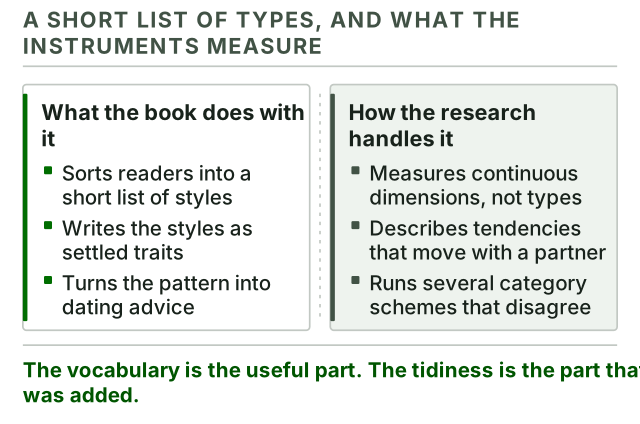
| Readers can be sorted into a short list of named attachment styles. | Questionnaire measures used in adult attachment research, simplified into reader-facing categories. | People who need vocabulary before they can describe what keeps going wrong. | Researchers working with the same instruments treat attachment as continuous dimensions, and even the category schemes in the literature disagree with each other. |
| The familiar chase-and-withdraw loop is produced by a pairing, not by one difficult person. | Observational and self-report work on couples under conflict. | Readers who behave one way with one partner and unrecognisably with another. | The book still writes one half of the pairing as the harder person to be with, which its own logic does not require. |
| Knowing the pattern should change who you date and how early you say what you need. | The authors' clinical and editorial judgement, not a tested programme. | Readers making decisions about a new relationship rather than repairing a long one. | This is the part of the book with the least evidence behind it and the most confidence in its voice. |
What is the book Attached actually about?
Attached is a popular-psychology book by Amir Levine and Rachel Heller that takes adult attachment research and rewrites it as a guide to dating and early relationships. It argues that the way a person reaches for closeness, or backs away from it, is a describable pattern rather than a character verdict.
On the publisher’s page for Attached, Levine is described as an associate professor of clinical psychiatry at Columbia University Medical Center who trained in molecular neuroscience under Eric Kandel, and Heller as holding an M.A. from Columbia in social psychology, working with families and couples in private practice. Those are the credentials behind the book, and they are worth knowing before the argument starts.
The structure is simple and part of the appeal. The opening chapters make the case that adults have an attachment system at all. A questionnaire then sorts the reader into a named style. The middle of the book describes what happens when styles meet each other in a relationship. The last stretch is advice: how to read a new partner, what to ask for, when to stop waiting.
The argument leans on ideas the authors return to throughout. One is what they call the dependency paradox: that people who can rely on a partner tend to act more independently, not less, so needing someone is not the weakness dating culture treats it as. Another is that the frustrating loop where one partner pursues and the other retreats is a property of the pair, not a fault in either person.
The questionnaire deserves its own note, because it is the part readers carry away and the part that does the damage in transit. It is a short self-report instrument, adapted for a general audience from the measures used in research, and it produces a label rather than a score. Answer it on a bad week and it will say something different from what it says on a calm one, which is a feature of the underlying constructs and not a flaw the book invented.
Read as a chapter heading, the label is useful. Read as a result, it is doing work the instrument cannot do. That distinction does not survive the book’s afterlife on social media, and it is the thing to hold on to while reading.
That idea about the pair rather than the person is what makes the book read as a relief. It moves the question from what is wrong with me to what happens between us, and it does that in plain language, which is not the register this shelf of the bookshop is written in.
What does Attached claim, and what is that claim based on?
The claim is that the attachment system studied in children keeps operating in adult romantic life, and that it explains more about dating than compatibility or communication technique do. That lineage is real, and it is the strongest thing the book has.
The starting point is John Bowlby’s work, set out in the foundational attachment theory volume published by Basic Books: children organise their behaviour around the availability of a caregiver, and that organisation is a strategy, not a mood.
The bridge to adults came later. Cindy Hazan and Phillip Shaver’s paper in the Journal of Personality and Social Psychology, romantic love conceptualized as an attachment process, proposed that adult partners can be described with the same framework, and it is the study that made the whole adult-attachment field possible. Attached sits downstream of it.
Between Bowlby and the adult work sits Mary Ainsworth’s observational research, which turned an idea about caregiving into something a researcher could code and compare. That is the step that made attachment an empirical field rather than a theory about infancy, and everything Attached leans on descends from it. The book gestures at this history quickly; the collection page for attachment theory books takes it slowly.
What the book adds is not evidence but arrangement. The research it draws on measures attachment with questionnaires that place a reader along dimensions: more or less anxiety about a partner’s availability, more or less discomfort with closeness. Attached converts those positions into membership in a category, and a category is much easier to write a chapter about than a position on a scale.
That conversion is the hinge of every argument about this book. It is what makes it readable, and it is what critics point at. The authors are not hiding it; they say plainly that they simplify. The trouble starts when readers meet the simplification without the sentence that admits it, which is what happens second-hand.
There is also a question of register that no summary captures. The book is written in the voice of a clinician who has watched the same conversation play out and has run out of patience with the way it gets explained. That voice makes it briskly readable, and it also makes assertions land as findings. A reader who cannot hear the difference between an observation from practice and a result from a study will finish the book believing they have read more evidence than they have.
For example, the book’s account of a partner who goes quiet after a good weekend is a real, documented pattern in the literature on avoidance. The book’s implication that this makes the partner an avoidant, permanently and across relationships, is a step the literature does not take.
Who does Attached actually help?
It helps readers who keep landing in the same relationship and have no words for the shape of it. Vocabulary is the product here, and vocabulary is genuinely useful.
For instance, someone who has long been told they are too intense, and who has believed it, finds a different account: not a defect, but a strategy that fires hardest when a partner’s availability is unclear. That reframe changes the questions a person asks about their own history.
Consider a reader on the other side of the same loop, the one who feels crowded and cannot explain why closeness arrives as pressure. The book gives that reaction a name that is not an accusation, which is the harder half of writing about relationships.
For example, a person who has just started dating after a long relationship ended can use the book as a set of questions rather than a filing system: does this person tell me when they will call, what happens when I say something needs to change, how do we both behave when the answer is not immediate. Those questions survive the book’s flaws.
It also helps readers who are trying to explain themselves to someone else. Having a shared word for a pattern lowers the temperature of a conversation that otherwise starts with an accusation, because it moves the subject from motive to mechanism. That is a modest benefit and a real one, and it does not require either person to believe the typology is exact.
There are situations where it helps least. Readers in a long, established partnership will find the dating advice irrelevant, and are better served by books written for repair rather than selection. Readers who want to know how firm the science is will find the book uninterested in its own uncertainty, and should read the review literature instead.
What are the criticisms of Attached?
The central criticism is that the book sells categories where the research offers dimensions, and that readers use those categories on other people. The rest follows from it.
Start with the measurement objection. In the adult attachment literature, styles are positions in a continuous space, not boxes with walls. Kim Bartholomew and Leonard Horowitz’s model of adult attachment is itself built on underlying dimensions rather than on boxes, and the fact that respected schemes in the field carve the same space differently tells you the carving is a convenience, not a discovery.
The next objection is about stability. Mario Mikulincer and Phillip Shaver’s open-access review of attachment theory in adults in World Psychiatry treats a person’s position as something maintained rather than owned: it is held in place by what a partner keeps doing, and it can be revised when that changes. A style, on that account, is a reading taken at a moment. Attached writes it as a fixed trait.
Another objection is the one with practical consequences. Because the book hands the reader a typology and a questionnaire, it invites diagnosis of a partner from a distance, on evidence no clinician would accept: a slow reply, a cancelled plan, a quiet week. The research does not support classifying another adult from the outside, and the book’s own material is about patterns between people rather than verdicts on one of them.
There is a narrower version of the same objection, about the avoidant position specifically. Across the book, the reader who pulls away is written as the harder person to be with, while the reader who pursues is written as asking reasonable questions. The framework does not require that asymmetry: if the loop belongs to the pair, neither half of it is the problem half. The review literature describes avoidance as a strategy for regulating distress, with its own logic and its own costs — a colder and fairer description than the one the reader is handed.
A further objection is tonal. The advice sections are more confident than their evidence. Guidance about which partners to keep dating rests on the authors’ clinical judgement, which is legitimate as judgement and is not the same thing as the studies cited in earlier chapters. A reader cannot tell from the page where one ends and the other begins.
A last objection is about what the framework crowds out. Reading a relationship exclusively through attachment makes everything else look like noise: money, distance, illness, unequal workloads, whether partners actually like each other’s company. Those shape what happens between partners as well, and a book with one lens will always find its own lens in the evidence. Attached is not unusual in this; it is simply better organised, which makes the effect stronger.
A fair defence exists, and the book has earned it. Simplification is what popular writing is for, the authors do not pretend to be publishing research, and readers who would never open a journal article now know that attachment research exists. The criticism is not that the book simplified. It is that the simplification travels further than the caveats do.
What this page does not do
Attached describes a research field that pulls hard toward self-diagnosis. That pull is what the limits below are for.
- We do not sell the book
- No affiliate links, no shop buttons, no prices, no star ratings. The publisher's page is linked so the record is checkable, and that is the only reason it is there.
- We do not hand out attachment homework
- How to change a pattern, what each style is like day to day, which style suits which: none of that is on this page. It is a different subject and other guides own it.
- We do not diagnose anyone, including you
- A questionnaire in a trade book is not an assessment, and a style is not a condition. We describe what the book claims and where the claim is disputed.
- We do not print sales figures
- Copies sold, languages, chart positions: those are publisher marketing copy, they are not evidence of anything, and this site does not repeat claims it cannot source. See /sources/ for how that rule works.
What should you read next, and what does the summary leave out?
Read the book before any summary of it, because the summary keeps the part worth arguing with and drops the part that makes the argument land. An Attached book summary preserves the taxonomy and the questionnaire, which are the most portable and least defensible elements, and loses the case material, the hedging, and the tone of a clinician describing patterns rather than sentencing people.
A practical test for any second-hand version: does it keep the book’s own hesitations? The text says plainly that the categories are simplifications and that the questionnaire is a self-report snapshot rather than an assessment. Retellings drop those sentences, because they weaken the promise that made the retelling worth clicking, and a reader who never meets them has no way to know the book itself was less certain than its summary.
That is why second-hand versions of this book are harsher than the book. Strip the examples and what remains is a sorting hat, which is the version that circulates in dating conversations and the version the criticism is actually aimed at.
What the book does not cover is worth naming, so nobody goes looking for it here. It has little to say about repair after real damage, and almost nothing about relationships that are working and simply feel dull. Those readers are being served by a different shelf, and the recommendation to read Attached anyway is one of the ways a useful book gets oversold.
Where to go afterwards depends on what the book left unfinished.
If the question is what to do inside a relationship rather than which relationship to choose, Hold Me Tight covers the same emotional territory with a method built for partners already committed to each other, and with a therapy literature standing behind it.
If the pairing dynamic was the interesting part, Wired for Love stays with couples and adds a physiological layer, though it comes with its own confident vocabulary and should be read with the same caution.
If the standard monogamous frame does not describe your situation, Polysecure applies attachment thinking to consensual non-monogamy, and it is the book in this group written for readers the others assume away.
For the wider set, including how these books disagree with each other, the collection page for attachment theory books is the place to start, and our sources page sets out the standard a publisher page or a research record has to meet before it is linked here.
The honest summary of the summary: Attached is worth reading, worth arguing with, and not worth quoting at a partner. Take the vocabulary, leave the verdicts.