| What the book claims | What that claim rests on | Who it tends to fit | Where it is challenged |
|---|---|---|---|
| Separating an observation from an evaluation changes what the other person hears. | The author's account of his own mediation and conflict work, written up as a teachable sequence. | People whose first sentence in a disagreement is already a verdict about the other person. | Practitioners note that the separation is far harder to hold under pressure than the examples suggest. |
| A complaint can be an unmet need stated as an accusation, and it can be restated. | Case scenes from the book, offered as illustration rather than as study data. | Readers who can feel that something is wrong but reach for blame because it is the nearest available word. | The vocabulary of needs is not neutral; deciding what counts as a need is itself contested. |
| A request is different from a demand, and only a request leaves the other person free. | The book's own distinction, tested by what happens when the answer is no. | Couples stuck in a loop where every ask arrives with a consequence attached. | The distinction is easy to claim and hard to prove from the inside; a demand can be phrased impeccably. |
| The method can be learned and practised deliberately, like a language. | The book's structure: components, examples, exercises, and repetition. | People who want a concrete alternative sentence rather than general advice about listening. | The learned phrasing sounds conspicuous, and can be used to police how a partner speaks. |
Nonviolent Communication is a book by Marshall Rosenberg, published by PuddleDancer Press, which sets out a named method for saying difficult things: describe what happened without evaluating it, name the feeling, connect it to a need, and end with a request the other person can actually say yes or no to. The Nonviolent Communication book is short, repetitive on purpose, and asks more of the reader than it appears to on a first read.
The arc of reading it is familiar, and both halves of it are fair. Readers finish the first chapters thinking the idea is obvious. Then they try it in a real argument and discover that the obvious part was the theory, and that the difficult part is holding the sequence for one sentence while someone they love is upset with them.
This page sets out what the book proposes, what the four components are, where the method has room to work and where it does not, and the objections raised against it — including the ones raised by people who teach it.
What is the Nonviolent Communication book about?
The book is about the judgement hidden inside ordinary sentences, and about a deliberate way of speaking that takes it out. Its central claim is that what people say in conflict is an evaluation of the other person wearing the clothes of a description, and that once the evaluation is removed, what remains is a want that could have been said directly.
Rosenberg presents this as a method rather than as a mood. The book is organised as components, worked examples and exercises, and it repeats the same shape across contexts — home, workplace, school, mediation — until the pattern is easy to recognise. That repetition is the book’s teaching device and also the thing readers find tiring; the point is that a sequence practised once is not learned.
The method is presented as arising from the author’s own conflict and mediation work rather than from a research programme, and the book is candid about this. There is no evidence chapter, no trial, no comparison against another approach. What there is instead is a long set of scenes in which two people talk past each other, and one intervention repeated with variations. We describe the book on those terms because those are the terms it sets for itself.
The book’s other quiet argument is about what people are doing when they blame. It reads a complaint as information that has been badly packed: something the speaker wanted, converted into a statement about the other person’s character, and then delivered as a charge. Unpacking it is presented as unglamorous work, and the book’s promise is correspondingly modest. It does not offer agreement, resolution, or a partner who changes. It offers a version of the sentence that has a better chance of being answered rather than defended against.
That modesty is easy to miss, because the method arrives with a vocabulary around it and a following that speaks it fluently. Read narrowly, as a way of noticing what you were about to say, it asks nothing of anyone else in the room. Read expansively, as a whole vocabulary a household is meant to adopt, it makes a demand of everyone in the house, and the friction the method attracts comes from the second reading rather than the first.
It is also worth being clear about what the book is not. It is not couples therapy, not a treatment, and not a protocol we hand out. Our own use for it is descriptive: this is what a well-known method claims, this is what it costs to use, and this is where people report it breaking down. The standard a page has to meet before it appears here is set out on our sources page.
What are the four main components of Nonviolent Communication?
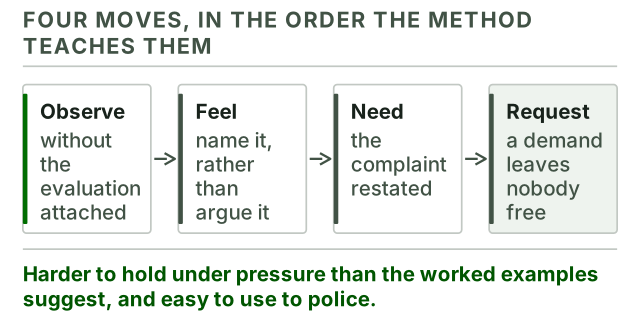
The four components are observation, feeling, need and request, and the book insists on that order. Each one is defined against a near neighbour that people reach for instead: observation against evaluation, feeling against thought, need against strategy, request against demand. The work of the method sits in those distinctions, not in any special vocabulary.
The numeral is part of the framework’s name, in the same way that a book’s chapter count is: it describes how the author organised the material, and nothing more.
| Component | What the book asks for | The near miss it warns about |
|---|---|---|
| Observation | Describe what happened in terms another person could verify. | An evaluation stated as a fact: 'you never', 'you always', 'you were rude'. |
| Feeling | Name what you felt, in one word if possible. | A thought about the other person dressed as a feeling: 'I feel ignored', 'I feel manipulated'. |
| Need | Say the underlying need the feeling points to. | A strategy: naming one specific action as though it were the need itself. |
| Request | Ask for one concrete, present-tense, doable thing. | A demand: an ask that carries a penalty if the answer is no. |
The observation step does the heavy lifting, and it is also the easiest one to skip. The book draws a line between what a camera would record and what the speaker concluded from it, and it makes the case that the second thing, delivered as though it were the first, is what makes the other person defend themselves rather than answer.
- For example, “you left the plates in the sink again” is a description someone can agree with, while “you don’t care what this place looks like” is a verdict about the person, and the conversation that follows is about the verdict.
- For instance, “I feel unappreciated” reads as a feeling and is actually a claim about what someone else did. The book would push the speaker back to what they felt — tired, small, alone — and forward to what they wanted, which is where the conversation can go somewhere.
- Consider a request stated as “you need to be more considerate”. Nobody can do that on Tuesday. The book asks for the version that can be done on Tuesday: a specific act, at a specific time, that the other person is free to decline.
The last of those is where the method has its sharpest edge. In the book’s terms, an ask is only a request if you can hear no without the temperature changing. That test is uncomfortable, because a reader can discover that asks they thought were requests were demands with good manners on top.
One way readers get the sequence wrong is by treating it as a script to be recited rather than four questions to be answered privately before speaking. The four components can be run silently, and the sentence that comes out afterwards can sound like normal speech. Read that way, the objection about stilted phrasing falls away.
Who does NVC actually help?
It helps people whose difficulty is the opening sentence. If your arguments go wrong before either of you has said anything specific, because what comes out first is a summary judgement of the other person, this book gives you something concrete to say instead. That is a narrow use, and it is a real one.
- For example, a reader who notices that every difficult conversation at home starts with the word “you” and ends with both people defending their character. The method interrupts that at the only point where interruption is cheap: before the first sentence.
- For instance, someone who has been told they are hard to raise things with, and who genuinely cannot hear the difference between how they say things and how it lands. The four components give them an external check that does not depend on their own ear.
- Consider a parent and an adult child who have the same argument every visit. The value here is not warmth; it is that a specific, declinable request produces a different kind of answer than a general complaint about how the visits go.
It helps less than readers hope in certain situations. One is a relationship where speaking carefully is not the missing ingredient — where the words are already fine and what is missing is time, or interest, or a fair division of the work. Another is any situation where one person is not free to say what they want without cost. A method that runs on honest self-disclosure assumes both people can afford honesty, and that assumption is not always true.
There is also a question of who has to read it. One person practising the four components can change how a conversation opens, and that is genuinely available without the other person ever seeing the book. What one reader cannot do is supply the other person’s needs from the outside; that half of the sequence only exists in the other person’s mouth. For books built for two readers rather than one, our couples therapy books list is the better starting point.
One more thing worth knowing before you start: the book is best used slowly. Its structure invites skimming, because the four components can be written on an index card and the rest looks like illustration. Read that way, the outcome is predictable: the card is memorised, nothing changes, and the method gets blamed. The scenes are the argument, in the same way that case material carries the argument in books of this kind, and the card is only a reminder of what the scenes taught.
What are the criticisms of Nonviolent Communication?
A recurring criticism is that the method sounds like a method. Trained practitioners acknowledge this themselves: the formatted sentence is audible to the person receiving it, and being addressed in a recognisable technique can feel like being handled rather than being talked to. The book’s own examples read as stilted on the page, and that is where the objection begins.
Another objection concerns what the format can be used for. A vocabulary designed to reduce blame can be turned into a new way of assigning it, in which the argument shifts from the issue to whether the other person phrased their sentence correctly. Coaching a partner on their wording mid-argument is a power move whatever vocabulary it borrows, and it is this version that the method’s detractors have in mind.
A further objection is about power, and it is the serious one. The sequence assumes two people who are both able to say what they feel and both able to decline a request. Where that symmetry is missing — where one person’s answer has consequences the other’s does not — a method that asks the less-powerful party to speak in feelings and needs can make things worse rather than better. Mediators and facilitators who work with unequal parties raise this limit, and the book is thinner on it than the situation deserves.
There is also an evidential objection. The book argues from the author’s practice and from illustrative scenes; it does not present controlled research, and we are not going to manufacture an evidence base for it. Compare that with the approach behind Hold Me Tight, where a clinical research literature sits alongside the book. The difference does not make the method wrong. It means the confidence with which it is recommended is borrowed, not earned.
A quieter objection is aimed at the culture rather than the text. Around the book sits training, certification and a shared idiom, and a reader can meet the idiom long before they meet the argument. Inside a group that speaks a method fluently, a deviation from it can be heard as a failure of goodwill, which is precisely the judgement the method was written to remove. That is a fair thing to hold against the phenomenon; it is not, in fairness, an argument against the book.
We also want to name what the criticisms are not. None of them shows that the four distinctions are false, and none of them comes with a measurement, ours included. They are objections about range and about use: where the method applies, what it costs socially, and what it quietly assumes about the room it is spoken in. Anyone who tells you the method has been disproved is overstating the case in the same direction as the people who say it always works.
Where the book still earns its place: as the clearest available description of the difference between a description and a verdict, and between a request and a demand. Those distinctions survive every objection above, and a reader can take them out of the book and use them without adopting the phrasing, the vocabulary, or the movement that has grown around it.
What to read alongside it?
Read it alongside one book about what happens underneath the words, because Nonviolent Communication deliberately stays at the level of the sentence. It tells you how to say a hard thing; it says relatively little about why the same conversation goes wrong between the same two people every time.
Our broader shortlist of communication books sets out which titles cover which part of that problem, and where they overlap. If what you want next is the emotional pattern under the argument rather than the phrasing of it, Hold Me Tight is the usual next step. If the recurring fight is about effort and what counts as care, the argument in The 5 Love Languages is aimed at that specific mismatch, criticism and all. The whole shelf, title by title, is laid out on the main guide.
Reading them alongside each other also makes the shape of each one visible. One book gives you a sequence for a sentence, another gives you a name for the pattern, and neither is the whole picture. Anyone who tells you a single relationship book covers both is selling something.
What this page does not do
Nonviolent Communication is a named method with training, certification and a following attached to it. Here is what we leave out on purpose.
- We do not teach the method
- We describe what the book proposes and where it is disputed. The exercises, the worked dialogues and the practice material belong to the book, and we do not reproduce them or present the sequence as our own protocol.
- We do not link to the publisher on this page
- Our standard is one external link to the publisher's own page for the book. For this title the page we found did not load when we checked it, so we name the publisher in text and link nothing rather than send you to a dead address.
- We do not print the author's credentials
- Our rule is that qualifications come from a verified publisher or peer-reviewed page and nowhere else. We could not verify one for this book, so this page describes the work and not the titles attached to the author.
- We do not sell the book, rank it, or rate it
- There is nothing to buy here and nothing to click through to a shop. We also print no sales figures and no review averages, because none of that has been verified for this title.
- We do not treat a communication method as treatment
- Reading is not therapy. If what is happening at home has run on without moving, or if anyone's safety is involved, that belongs with a professional rather than with a book or with a guide like this one.
Our own reading, stated once: Nonviolent Communication is a strong idea in a demanding package. The distinctions at its centre are worth having permanently. The full sequence is worth practising if your conversations break in the first sentence, and worth leaving on the shelf if they break somewhere else.
Checked: 2026-09.