| What the book claims | What that claim rests on | Who it tends to fit | Where it is challenged |
|---|---|---|---|
| Anger is information about a relationship rather than a flaw in the person feeling it. | The author's clinical practice and the family-systems tradition she writes from. | Readers who have been told, or have decided, that their anger is the problem to be managed. | The reframe says little about what to do when the anger is disproportionate to the situation. |
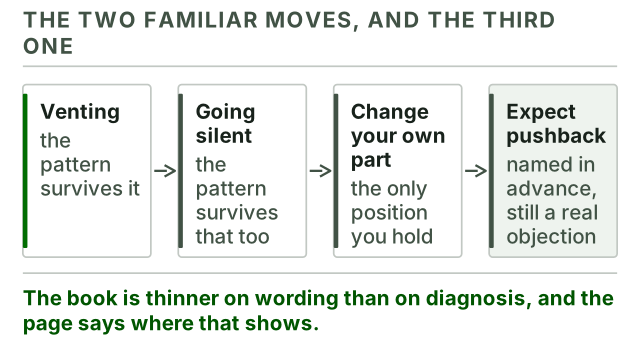
| Venting and silence are equally ineffective, because both leave the arrangement intact. | Case description, presented as clinical observation rather than as research findings. | People stuck between blowing up and swallowing it, and getting the same week either way. | Naming a false choice is easier than describing the other option, and the book is thin on wording. |
| Couples and families settle into repeating positions, such as pursuer and distancer. | Family-systems theory, stripped of its academic apparatus for general readers. | Readers who can see the loop but keep explaining it as the other person's character. | The positions are described as tendencies, with no account of when the description fails. |
| A reader who changes their own part of the pattern changes the pattern. | The systems premise that a relationship is a set of moves, not a set of personalities. | Anyone who cannot get the other person into a conversation, let alone a therapist's room. | It places the work on whoever reads the book, who may already be carrying more of the arrangement. |
| The people around you will push back when you change position, and that is expected. | The author's clinical account of what she calls countermoves. | Readers who read a change as failure the moment the household gets colder. | Framed as predictable, the pushback can be dismissed rather than heard as a real objection. |
Anger read as information rather than as a character flaw: that is the whole argument, and the rest of the book is what follows from it. The Dance of Anger is a self-help book by Harriet Lerner about what anger in a close relationship is signalling, and about why the responses that come first leave everything exactly as it was. Someone looking up the dance of anger book tends to arrive with one complaint: they have tried being calm and they have tried being direct and neither one changed anything.
The book’s title is doing real work. A dance has steps, partners and a form that repeats, and that is how Lerner asks the reader to see a recurring fight. What follows takes the argument apart, names the patterns it turns on, and weighs the objections it has drawn. This site runs no shop, and the material standing behind every page is catalogued on the sources page. Checked: 2026-09.
What is the book The Dance of Anger about?
It is about anger as a message rather than a malfunction. Lerner’s starting position is that anger in a close relationship is telling you something about the arrangement you are living in: what you are carrying, what you have agreed to without agreeing, what has quietly become your job. Treating the feeling as the problem, she argues, means never reading the message.
From there the book takes apart the two responses already in a reader’s repertoire. There is the outburst, which discharges the feeling and produces an argument about the outburst instead of about the thing. There is silence, which protects the peace at the cost of the reader’s own position. Both feel like doing something. Neither changes the arrangement, and the same week comes round again.
The alternative Lerner describes is a change of position rather than a change of volume. That means working out what you actually want to be different, saying it clearly and without a case for the prosecution, and then holding your side of the new arrangement while the relationship adjusts around it. The publisher’s page for the book, held by HarperCollins UK, carries the full title with its subtitle, which names the intended readership plainly.
Underneath the practical writing sits family-systems thinking, and it is worth naming because it explains the book’s shape. In that tradition, a relationship is a set of moves that keep each other going, not a collection of personalities. The book inherits both the strength of that idea and its limit: it is very good at describing loops, and deliberately uninterested in deciding who started one.
It is also worth saying what the book is not, because the title suggests the opposite. This is not an anger-management text. There are no calming routines, no rules for arguing fairly, and no promise that the feeling will get smaller. Lerner’s interest runs the other way: the anger is treated as reliable information, and the work is deciding what to do with what it tells you.
The book also compresses badly, which matters for anyone arriving from a summary. Its case can be stated in a paragraph, and the paragraph is unremarkable. The work is done by the household scenes piling up until a reader sees their own week in one of them, and that recognition is what a summary discards.
What patterns does the book name?
Chiefly pursuing and distancing, alongside overfunctioning and underfunctioning, and each is a position in a loop rather than a description of a person. Lerner’s point in each case is that the halves produce each other, which is why arguing about who is at fault inside the pattern never gets anywhere.
Pursuit and distance describe what people do when tension rises. One person moves toward contact, wanting to talk it through now, and reads the other’s retreat as indifference. The other moves away, needing room, and reads the approach as pressure. Each response makes the other more likely, so the harder one pursues the further the other goes.
- For example, a partner who follows the other from room to room to finish a conversation, meeting shorter and shorter answers, until both of them are certain the other one is the unreasonable half. Lerner’s move is to stop asking which of them is right and start asking what each is doing to keep the loop running.
- For instance, a reader who has become the one who remembers the appointments, notices the problems and raises them, opposite someone who has stopped noticing because it is covered. That is the overfunctioning and underfunctioning pair, and the book’s uncomfortable observation is that competence on one side keeps producing absence on the other.
- Consider the adult child who calls a parent every week, manages the mood of the call, and hangs up angry every time. The book treats the anger as accurate information about an arrangement that was never negotiated, and asks what the reader would change about their own half of the call rather than what the parent should finally understand.
The metaphor has an edge to it that readers can miss. Calling the pattern a dance is not a way of saying it is nobody’s fault. It is a way of saying that both partners are competent at it, that each has learned the other’s next step, and that a fight this well rehearsed will not be interrupted by a better argument. That is why the book keeps returning the question to whoever is holding it.
Another idea in the book is the countermove: what happens when someone changes position. Lerner describes the pushback that follows a change of behaviour, not as sabotage but as a system’s ordinary attempt to restore its shape. Her practical warning is that the discomfort peaks after the change, which is the point at which a change is easiest to read as a mistake.
Who does The Dance of Anger help?
It helps the reader who can feel the pattern but cannot see it, and who has been treating their own anger as the thing to apologise for. If your account of the situation is entirely an account of the other person’s behaviour, this book is designed to interrupt that, and it does the job in a register that is warm rather than scolding.
It suits people who cannot get anyone else to the table. Because the argument is that a reader’s own change of position changes the pattern, the book is usable by a reader acting alone, without a partner’s cooperation and without a therapist’s room. That is its most practical feature and the reason it has stayed in print.
It suits readers who want to understand before they act. Exercises are not the form here, and there are no scripts. What there is instead is a way of looking at a repeating fight that makes the next one legible while it is happening, which some readers find more useful than a set of lines to deliver.
Reading it with a partner is possible but not the design. The book speaks to one reader, and its suggestion is that you change your own half of the pattern without waiting for agreement about whose half is worse. Couples who read it together may find the useful conversation is not about the book at all, but about which of them recognised which position.
It suits some readers badly. Anyone who wants wording will find the book gestures at what to say and then moves on. Anyone in a relationship where one person controls the money, the housing or the reader’s safety needs help this book does not offer, and its calm advice about holding a new position assumes a room where holding one is possible. And anyone hoping for anger management in the ordinary sense has the wrong book, because Lerner is not trying to reduce the feeling.
What are the criticisms of The Dance of Anger?
The strongest criticism is that the book diagnoses well and prescribes thinly. A reader can finish it able to name their loop and still unable to say a single new sentence in it. The gap between seeing a pattern and changing it is where the book is thinnest.
Its age is another issue, and it is honest to say so. The book belongs to an earlier era of household writing, and the household it pictures shows it: the division of labour, the assumed shape of a family, the absence of anything resembling how couples argue by text now. The underlying pattern description travels well. The furniture around it does not.
Another criticism concerns its address. The subtitle names women as the readership, and the book’s examples and framing follow from that. Both things are true at once. The choice was deliberate and useful, because the expectation that anger be softened before it is spoken falls unevenly. It also means other readers spend the book translating, and that some of them put it down early for reasons that have nothing to do with the argument.
A further objection is about the evidence, and it applies to the whole shelf rather than to this title alone. The patterns are presented as clinical observation, drawn from practice and written up as description. They are not offered as findings from a study, and no measurement sits behind them. That is not concealment on the author’s part, but it does mean the ideas should be held as a useful way of looking rather than as an established account of how relationships work.
One more objection is worth putting carefully. A framework that explains resistance in advance can be used to dismiss it. If pushback from the people around you is described as an expected countermove, a reader can stop distinguishing between a system adjusting and a person raising a fair point about the change. Lerner does not recommend that reading. The text allows it, and it is the failure mode we would watch for.
In fairness: nobody presented this as research, and grading it as failed clinical writing applies a yardstick the author never picked up. It was written to give an ordinary experience a shape, in language its readers could use, and on that job it still works. Take the pattern description, treat the household scenes as period detail, and speak to a professional before you act on anything where your safety is in question.
What to read alongside The Dance of Anger?
What this book leaves out is wording, so the useful companion is a book made of sentences. The rows below are ordered by what you might need next rather than by merit, and carry no scores.
| Read alongside | What it adds | What it will not do |
|---|---|---|
| Set Boundaries, Find Peace | Plain sentences for stating a limit once the pattern is visible | Explain why the pattern keeps returning |
| Books about communication | A described method for asking directly instead of hinting or escalating | Function as a script when a household is in crisis |
| The wider canon | Every well-known title on the shelf, read the same way | Tell you which book is best |
Which companion you need turns on what the book left in your hands. If it gave you a clear view of the loop and no idea what to say inside it, the page on Set Boundaries, Find Peace is where to go next. If the missing part is how to ask for something without building a case first, the books about communication in relationships collection is where that question belongs. If you want the whole shelf read the same way, start at the canon guide.
What we leave out here
Our account of Lerner's book, and what we refuse to do with it.
- No anger techniques from us
- We describe what the book argues about anger. We do not hand out breathing routines, calming scripts or rules for arguing, and we do not offer advice about your relationship in our own voice.
- No types of anger
- Lists of anger types circulate widely and we found no verified source behind them, so this page has none. If we cannot attribute a framework, we leave it out.
- No commerce on this page
- We take no cut of a sale, print no prices and publish no star averages or sales figures. Our reasons sit on the editorial policy page.
- Paraphrase, not quotation
- Nothing on this page is presented as Lerner's exact words. Where we set out her argument, we set it out in ours.
- No qualifications claimed for the author
- The publisher's page confirms the title and Lerner's name, and nothing else on it was readable to us, so we assert nothing about her training.
Where this page fits: it sits inside the canon guide this site is built around, where each title gets a page of its own and the same scrutiny as the one beside it. Checked: 2026-09.