
| What the book claims | What that claim rests on | Who it tends to fit | Where it is challenged |
|---|---|---|---|
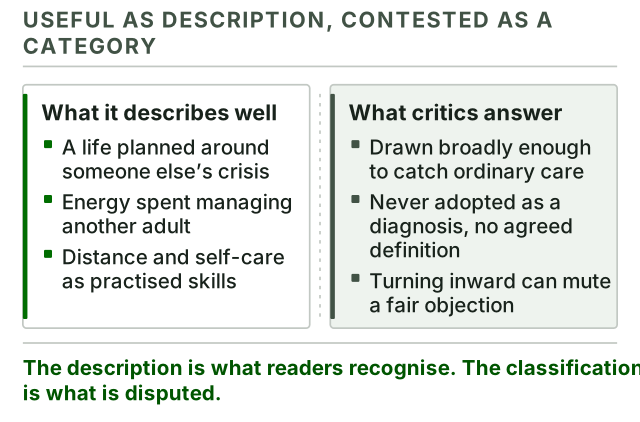
| Organising your life around another person's problems is a pattern in its own right, not just devotion or bad luck. | The author's own account and the recovery-movement writing she came out of. | Readers whose week is planned around someone else's crisis and who have no name for that. | Critics say the pattern is described so broadly that ordinary care fits inside it. |
| The way out starts with the reader's own attention, not with further effort aimed at the other person. | Family-group practice around addiction treatment, put into plain language for a general readership. | People whose energy goes into managing another adult's behaviour, and who are exhausted by it. | Where someone is being harmed, turning the focus inward can read as advice to stop objecting. |
| Detachment and self-care are skills that can be practised rather than moods that arrive. | Recovery literature, presented as guidance rather than as research findings. | Readers who want something to do on a Tuesday, not a theory. | The book offers no way to tell healthy distance from giving up on a relationship. |
| Codependency names a recognisable pattern rather than a loose figure of speech. | Clinical folklore of the chemical-dependency field, not a diagnostic classification. | Readers who feel less alone once a pattern has a name. | Clinicians and academic critics note it was never adopted as a diagnosis and has no agreed definition. |
Codependent No More is a popular self-help book by Melody Beattie about people whose attention, time and mood are organised around another person’s problems, and about what happens when that person turns the attention back on themselves. The Codependent No More book is not offering a theory. It is offering a name for something a reader may have been doing for years without calling it anything.
The book earned its place in the canon by supplying that name to a general readership, and it has been argued about ever since for the same reason. Below is a reading of the argument itself, of the recovery tradition standing behind it, and of the objection clinicians have kept making to the whole category. Nothing here is for sale, no publisher pays us, and each record we relied on is set out on our sources page. Checked: 2026-09.
What are the main points of Codependent No More?
The book makes one central argument and then restates it in practical form after practical form: that when your life is organised around managing another person, the work you can actually do is on your own side of the relationship. Everything else in the book — detachment, self-care, saying what you want plainly — follows from that single move.
The pattern it describes is behavioural rather than emotional. Beattie writes about the mechanics of a day: who is monitored, whose mood sets the weather, which decisions get postponed until someone else is calmer. She is interested in the reader who has become an unpaid manager of another adult, and in the strange fact that the managing does not work and does not stop.
From there the book teaches a small set of practices. Detachment, in its vocabulary, means letting go of the outcome without letting go of the person. Self-care means treating your own needs as real rather than as something to get to once the crisis passes. Directness means saying what you want in a sentence instead of arranging conditions in which the other person might guess it.
What the book does not offer is a mechanism. There is no model of how the pattern forms, no research programme behind it, and no attempt to distinguish between the reader who is exhausted by a relative’s drinking and the reader who is simply conscientious. That absence is the source of both its reach and its trouble: a description this general takes in the reader without distinguishing them, which is why recognition comes easily and why critics say the recognition proves nothing.
Detachment is the term that carries the misreading, and the book is partly responsible. It does not mean coldness, silence or leaving. In Beattie’s use it means declining to carry the consequences of another adult’s choices while staying in the room as a person rather than as a supervisor. The distinction is easy to state and hard to hold, and the book keeps circling it because there is no rule that settles it in advance.
The other recurring move is the inventory of what the reader wants. The book keeps returning to prompts pointed away from the other person: what would you do this weekend if nobody’s mood had to be managed, what have you stopped asking for, what do you actually think about the situation rather than what would keep the peace. It reads as simple to the point of being obvious, and it stops feeling obvious the moment someone tries to answer.
There is also a claim about relief that deserves naming, because it is where the book’s tone comes from. Beattie writes as someone reporting from the inside rather than examining from above, and the promise underneath the practices is that the exhaustion lifts when the reader stops treating another person’s behaviour as their own project. That promise is the reason the book has stayed in print, and it is also the reason it should not be read as a description of what will happen.
Read as a summary, the book compresses badly. State the argument and you have a paragraph; the value sits in the small domestic scenes piled one on another, and a summary drops those first. Anyone arriving from a summary page has the argument and none of the recognition, and recognition is the whole product here.
Where does the idea of codependency come from?
The word came out of addiction treatment, not out of academic psychology. In the family groups that grew up around Alcoholics Anonymous — Al-Anon above all — counsellors and members noticed that the people around a drinker developed patterns of their own, and the chemical-dependency field began giving those patterns a label. Beattie wrote from inside that world, and her book carried the label out of it.
That lineage explains the book’s texture, and we state it as history rather than as endorsement. The vocabulary of surrender, of taking your own inventory, of one day at a time, belongs to the twelve-step tradition. So does the assumption that recovery is ongoing rather than finished, and that the useful company is other people in the same position. A reader who has no interest in that tradition can still use the book, but they will be reading a translation of it rather than a neutral text.
The lineage also explains a limit. The original setting was specific: a household reorganised around someone’s drinking. The book generalises that setting to relationships of every kind, which is a step the evidence does not carry, and it is the step critics keep returning to.
It matters, too, that the tradition was built for people with no other help available. The family groups formed because treatment went to the drinker and nobody else in the household was offered anything. That origin gives the book its best instinct, which is to take the other people in the room seriously as people with a situation of their own, and its worst habit, which is to treat every household as a version of that one.
One historical point is worth keeping straight, because it changes how the book reads. The concept was clinical folklore before it was popular writing. It was never derived from research, and it did not pass through the process by which psychiatric categories are proposed, tested and adopted. It travelled from treatment centres into paperbacks and from paperbacks into everyday speech, gathering confidence at each stage.
Who should read Codependent No More?
Read it if the description above already sounds like your week, and if you want plain practical prose rather than an explanation. The book is at its best for a reader who has been quietly carrying a situation and has never heard anyone describe the carrying itself.
- For example, someone whose evenings are spent working out which version of a family member will come through the door, and who has stopped making plans because plans keep getting cancelled by somebody else’s crisis. The book’s first service is telling that reader the monitoring is a pattern, not a personality.
- For instance, a reader who has tried every reasonable way to get another adult to change, has become extremely good at it, and is worn out. Beattie’s insistence that the effort belongs on the reader’s own side is genuinely useful here, and it is the part that stays with a reader afterwards.
- Consider the reader who wants instructions rather than analysis. The chapters are short, repetitive and practical, and the repetition is deliberate. If you have bounced off books that spend a chapter on theory before offering anything to do, this one will suit you.
It also helps to know what kind of reading experience this is. The tone is warm, direct and unembarrassed, closer to a letter than to an argument, and it assumes the reader is tired rather than curious. Readers who want a book to make a case will find the repetition maddening; readers who want company will find it the point. Neither reaction is a misreading.
There are readers it suits poorly. Anyone who wants the research behind a claim will find none. Anyone in a household where somebody is being hurt needs a different kind of help than a book about detachment. And anyone inclined to read themselves into every description will find a diagnosis here that the book cannot actually issue, which is the failure mode we care most about and the reason this page carries no checklist.
The honest reading position is somewhere between the two. Take the description, use it to notice what your days are shaped around, and leave the label on the shelf.
What are the criticisms of the codependency idea?
The central criticism is that codependency was never a diagnosis and does not behave like one: it has no agreed definition, no accepted way of measuring it, and no boundary that keeps ordinary care outside it. Clinicians and academic writers have made that case since the concept became popular, and it applies to the whole category rather than to Beattie’s prose in particular.
Several lines of objection are worth separating.
The conceptual objection comes first. If a description is broad enough to include the attentive partner, the adult child of a demanding parent and the person who simply likes being useful, then it is not distinguishing anything. Critics in the addiction-treatment field itself made this point early: a term that covers everyone in a family covers nothing.
Then there is a political objection, and it comes from feminist writers on the recovery movement. Their argument is that caretaking is trained into women by everything around them, and that converting a socially produced role into a personal disorder moves the problem into the wrong place. On this reading the book asks the person doing the caring to examine themselves while the arrangement that produced the caring goes unexamined.
The practical objection is the one we think readers should hold on to. Advice to detach does not distinguish between a relationship that is merely wearing and a situation where someone is being harmed. In the second case, a book that turns the reader’s attention inward can quietly work as an argument for putting up with things. Beattie does not say that. The reading is available anyway, and it is the risk of any text that treats the reader’s own response as the only variable.
A further objection is about what the word did after it left the book. Once codependency entered everyday speech it became a way of describing anyone who cares more than the speaker thinks reasonable, and then a way of dismissing them. That drift is not Beattie’s argument, but any book that hands a single word to a general readership takes on some responsibility for how it gets used, and this one has travelled as a label into conversations where the book itself was never opened.
There is a defence worth putting fairly. The book never claimed to be science, and reading it as a failed clinical text judges it against a standard it did not set. It was written for people who had no language and no help, in the register those readers could use, and it did that job. The reasonable position is neither to treat it as a diagnosis manual nor to throw it out for failing to be one.
None of this makes the book worthless. It remains useful for exactly what it did first: giving an unglamorous experience a name and a set of things to try, for a reader who had neither. Take the recognition, treat the label as loose talk rather than a category, and get a professional view before making any decision that involves somebody else’s safety.
What to read alongside it?
Pair it with a book that supplies what it lacks: a mechanism, a vocabulary for asking, or a practical account of limits. Nothing below is ranked and no scores are published here; the sequence is only where to go next.
| Read alongside | What it adds | What it will not do |
|---|---|---|
| Set Boundaries, Find Peace | A contemporary, secular vocabulary for limits, without the recovery framing | Explain how the pattern formed |
| Nonviolent Communication | A described method for asking plainly instead of managing someone indirectly | Serve as a script where a household is in crisis |
| A wider codependency reading list | Alternatives to Beattie, including more careful clinical accounts | Settle whether the concept is sound |
Which pairing matters most turns on what you were left holding. If it gave you a name and nothing to do, a book about limits is the next one. If it gave you the resolve to stop managing someone and no idea what to say instead, a described method for asking is more useful than more resolve. If it gave you a label you are now applying to yourself daily, the best next step is not another book at all.
Those pages live here: our reading of Set Boundaries, Find Peace and our page on Nonviolent Communication, which describes that method without teaching it as ours. The parent collection, books about codependency, is where the selection question belongs if you want alternatives to Beattie rather than a verdict on this one. If your interest is really in what a therapist would work on, our list of books for couples counseling is the better door.
What this page does not do
A reading of one recovery-movement classic, and the rules this site works under.
- No self-assessment
- There is no checklist here and there never will be. Codependency is not a diagnostic category, and a quiz that behaves like one would be doing something the concept cannot support.
- No advice about another person
- We do not tell readers how to handle someone else's drinking, spending or moods. We describe what a book claims and where it has been challenged.
- Nothing for sale
- No retailer links, no prices, no copies-sold claims, no star averages. The editorial policy page sets out why.
- No invented quotations
- Everything attributed to Beattie here is paraphrase. Quotation marks are used only where a writer had the book open at a chapter they can name.
- No credentials we cannot verify
- We hold no verified publisher record for this title, so no qualification is stated for its author and no publisher page is linked from this site. Cover copy is not a record.
Where this page fits: it is one entry in the reader’s guide to the relationship-book canon, which gives a book its own page and reads it against the same short set of headings you see in the table above. Checked: 2026-09.