
| What the book claims | What that claim rests on | Who it tends to fit | Where it is challenged |
|---|---|---|---|
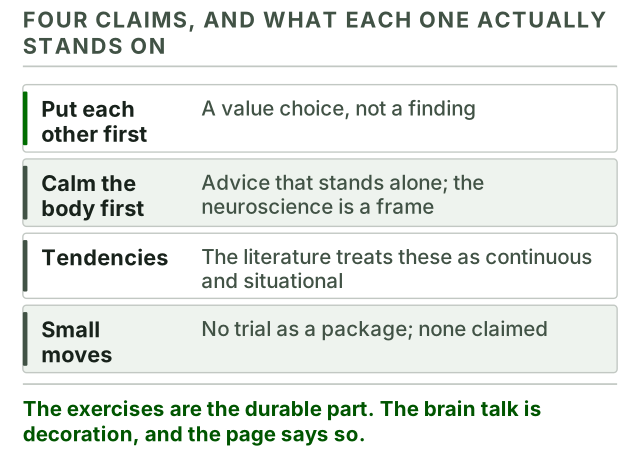
| A couple works best when both partners agree, out loud, to put each other first and to protect each other in public and in private. | Tatkin's clinical practice with couples, written up as principles rather than as a tested programme. | Partners who keep relitigating the same fight because nothing was ever actually agreed. | An agreement to prioritise a partner is a value choice, not a finding; the book presents it with the certainty of a result. |
| Conflict escalates because bodies react faster than reasoning does, so partners should manage arousal before they manage content. | General stress and threat-response research, summarised for a lay reader rather than cited study by study. | Couples whose arguments go wrong in the opening moments and stay wrong. | The book's brain vocabulary decorates advice that stands on its own; reviewers call the neuroscience a frame, not evidence. |
| Partners fall into recognisable relational tendencies — how much closeness feels safe, how quickly someone withdraws. | Adult attachment research, compressed into the book's own memorable labels. | Readers who want a shorthand for a pattern they can already feel. | The underlying literature treats these tendencies as continuous and situational; renaming them as types makes them look like fixed kinds of person. |
| The work happens in small, repeatable moves: how partners greet, part, argue and go to sleep. | Practice-derived exercises the book sets out step by step. | Couples who want something to do this week rather than a theory to discuss. | There is no independent trial of these exercises as a package, and the book does not claim one. |
What is the book Wired for Love about?
Wired for Love is a book by Stan Tatkin for couples who are already together and keep having the same argument. Its subject is not compatibility and not choosing a partner. It is the set of rules two people operate by when one of them is upset.
On the publisher’s page for Wired for Love, New Harbinger lists the author as Stan Tatkin, PsyD, MFT, and gives the book its full subtitle: how understanding your partner’s brain and attachment style can help you defuse conflict and build a secure relationship. That subtitle is a fair summary of both the promise and the argument about it.
The book’s structure is unusual for the shelf. Instead of chapters organised around problems — money, sex, in-laws — it is organised around principles, each followed by exercises that a couple does together. The tone is instructional throughout. Tatkin writes like someone giving directions, not like someone making a case.
The book carries its argument on a small core. Tatkin asks partners to establish an explicit agreement about mutual protection, which he calls a couple bubble. He also argues that conflict is largely a matter of physical arousal, so the moment to intervene comes earlier than the argument itself — in the opening moments, in tone and posture, before anyone has said anything worth answering.
Everything else in the book is downstream of those ideas. The greeting routines, the rules about never threatening the relationship during a fight, the insistence on going to bed at the same time: each is presented as a small mechanism for keeping the agreement intact when nobody feels like honouring it.
The book also borrows from adult attachment research and gives the borrowed tendencies its own short labels. That vocabulary is memorable and portable, and it is also where the criticism starts.
What is a couple bubble?
A couple bubble is a spoken agreement that partners take priority for each other, and that neither will use the security of the relationship as a bargaining chip. It is a rule set rather than a mood, and Tatkin’s point is that it has to be said out loud to exist at all.
For example, a partner who hears their spouse criticised at a family dinner says something in the room rather than apologising for them afterwards in the car. The bubble is not a feeling of loyalty; it is the choice about which of those two things happens.
For instance, a couple agrees that neither of them announces a major decision to a friend, a sibling or a colleague before the other has heard it. Nothing about that is romantic. It is scheduling, and Tatkin treats it as scheduling.
Consider the book’s signature rule: that the words maybe we should just end this are off the table during an argument, permanently, because a relationship where the exit is reopened whenever an argument starts cannot be a place either person relaxes. Whether that rule fits every couple is arguable. What it does is make the agreement testable — either it was said or it was not.
A couple bubble is also defined by what it excludes, and that part is easy to skip. It is not a demand that partners agree about everything, not a rule against outside friendships, and not a claim that the relationship outranks every other obligation a person has. It is narrower: a named set of moments, such as public disagreements, bad news, and the opening of a fight, where the two of them are agreed in advance about whose side each is on. Tatkin’s argument is that couples who leave those moments unnegotiated end up negotiating them every time they occur, at the worst possible moment and with the outcome in doubt.
The physiological half of the argument does similar work. Because bodies escalate faster than arguments do, the book pushes intervention earlier: face each other, get close enough to read an expression, lower the volume before addressing the content. The instruction is simple, and it does not require the reader to accept any particular account of what the nervous system is doing.
Who does Wired for Love help?
It helps couples who are committed, functional and stuck in a loop — people who do not need convincing that the relationship is worth keeping and do need something specific to change on Tuesday.
It is unusually good for readers who dislike relationship books. The emotional vocabulary is minimal and the book does not ask anyone to describe their childhood. The exercises are short, physical and slightly awkward, which suits partners who would rather do something than discuss something.
It helps partners who negotiate badly because they never finish a negotiation. Turning vague expectations — you should have backed me up, you always tell your sister first — into stated terms converts a recurring grievance into an agreement that can be kept or broken. That is a real gain and it does not depend on the book’s science being right.
It helps least in situations it was not built for. Readers who want to understand attachment research rather than apply a version of it will find the treatment thin and should start with the collection page for attachment theory books. Readers who are single, or deciding whether to stay, are reading the wrong book entirely — Attached is written for that question. And readers whose difficulty is emotional distance rather than escalation will get further with Hold Me Tight, which has a therapy literature standing behind its method.
There is also a fit question the book does not raise about itself. Its rules assume partners with roughly equal say in the relationship. Where that is not the case, an agreement about priority and protection can be recited by one partner and enforced against the other, which is not what the book is proposing but is what its language allows.
What are the criticisms of Wired for Love?
The main criticism is that the neuroscience is decoration. The advice would stand without it, and attaching brain vocabulary to ordinary relationship guidance makes the guidance sound settled in a way the underlying research does not license.
This is a general complaint about popular psychology and it lands here with particular force, because the brain is in the subtitle. The framing invites a reader to believe they have been told how partners work at a mechanistic level. What they have actually been given is a metaphor with instructions attached, and the instructions are the part that earns its place.
Another objection concerns the typology. The book compresses adult attachment tendencies into a set of vivid labels and then uses them as though they described kinds of people. Mario Mikulincer and Phillip Shaver’s overview of adult attachment in World Psychiatry puts the weight somewhere the brain chapters never reach: on what a partner’s response is taken to mean, and on the expectations laid down by earlier answers to the same question. Arousal alone shows none of that. Wired for Love keeps the fast bodily half of the picture and lets a label carry the rest, which is exactly what makes the label easy to aim at someone else.
A further objection is about verification. The exercises come from clinical practice and are offered as principles, not as a programme with published trials behind it. That is an honest position and the book does not pretend otherwise, but it means a reader cannot tell which recommendations have been examined by anyone outside the author’s own practice. The distance between this book and the couples-therapy literature is worth knowing before recommending it as though the two were equivalent; the couples therapy books page sets out where that line falls.
A last objection is tonal, and readers split on it. Tatkin writes in imperatives. Some couples find that a relief after a shelf of books that explain feelings without ever saying what to do. Others read the same pages as prescriptive about how a partnership should be arranged — the sleeping arrangements, the greeting rituals, the ban on certain sentences — and reasonably decline.
There is a further gap, and it is a gap of scope rather than an error. The book says very little about what to do when the agreement is broken repeatedly by the same person for the same reason. It assumes two partners who want the bubble and keep failing at it under stress, which is a real situation but not the only one. Readers whose situation is one-sided will find the instructions still technically applicable and quietly useless, and the book does not send them anywhere else.
A defence is available and the book has earned part of it. Explicit agreements do beat implicit expectations, and there is nothing in the criticism above that touches the instruction to settle your terms in advance. The complaint is about the packaging: a modest, sensible proposal about negotiation arrived wearing a lab coat it did not need.
What this page does not do
Wired for Love hands the reader instructions, and instructions invite a particular misuse. Here is where this page stops.
- We do not sell the book
- The New Harbinger page is here so the title, subtitle and author line can be checked against the publisher's own record, and for no other reason. This page carries no purchase route and no paid placement.
- We do not explain attachment styles as types of people
- Tatkin's labels are described only where the criticism needs them. What each one supposedly looks like day to day, and which pairs with which, is a taxonomy question this page stays out of.
- We do not turn the exercises into advice from us
- We describe what Tatkin asks couples to do and where the reasoning is disputed. We do not tell anyone how to run their relationship.
- We do not print sales figures
- How widely the couple bubble has travelled says nothing about whether it works. Print runs, editions and chart placings are marketing, and unsourced numbers do not appear here. See /sources/ for that rule.
What should you read next?
Read the exercises before the explanation, because the exercises are the durable part and the explanation is what dates. A summary of this book keeps the couple-bubble slogan and drops the step-by-step instructions, which inverts the book’s actual value.
If the pairing dynamic was the interesting part and you want the research it descends from, Attached covers the same territory with more attention to where the ideas came from, and with its own habit of overselling categories.
If what you need is a way back to each other rather than a rule set, Hold Me Tight is built for that, and its method has been examined outside its author’s own practice.
If a couple is not the shape your life is in, Polysecure carries the same attachment ideas into consensual non-monogamy, and it addresses a reader the rest of this shelf writes past.
For the wider set and how these books contradict each other, start with attachment theory books. And our sources page shows the records behind the citations above, along with the kinds of claim this site leaves out.
The short version: take the agreements, keep the greeting routines, and hold the brain chapters at arm’s length. The book is more useful as a negotiating manual than as an explanation.