| What the book claims | What that claim rests on | Who it tends to fit | Where it is challenged |
|---|---|---|---|
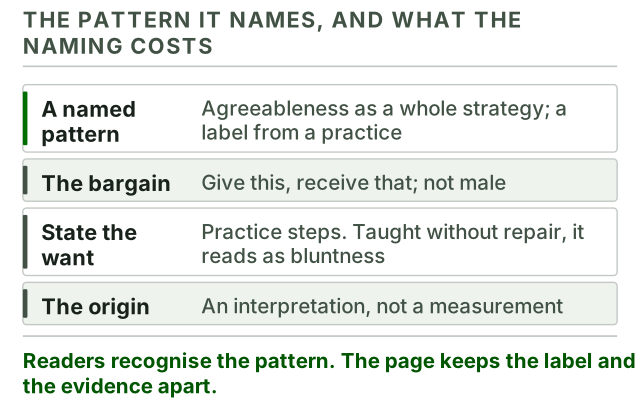
| Some men seek approval so consistently that agreeableness becomes their whole strategy. | Glover's own clinical practice with men and couples, written up as case description. | Readers who cannot say what they want out loud and are surprised by their own resentment. | The pattern is presented as a named condition; it is a label from a practice, not a diagnostic category. |
| Unspoken deals — give this, receive that — quietly run the relationship. | Repeated scenes from counselling rooms, described rather than measured. | People who keep score privately and then feel cheated when nobody pays out. | Nothing about the mechanism is specific to men, though the book frames it that way throughout. |
| Recovery comes from stating wants directly and tolerating the other person's reaction. | Exercises at the end of each chapter, in the recovery-literature format the book borrows. | Readers who want practice steps rather than an explanation to think about. | Directness taught without repair skills reads to some readers as permission to be blunt. |
| The pattern has roots in how boys learn that needs are a burden. | Glover's developmental account, offered as interpretation of his caseload. | Readers looking for a story that makes their own behaviour legible. | The developmental claim is the least supported part of the book and the most confidently written. |
No More Mr Nice Guy book is Robert A. Glover’s self-help title about men whose default setting is agreeableness, and about what happens to a person who spends his time managing other people’s reactions instead of saying what he wants. It is short, blunt, structured like recovery literature, and it has travelled far past the audience it was written for.
That travel is the reason this page exists. The book people argue about online is not quite the book on the page. What Glover wrote is a counselling-room description of a habit; what circulates is a slogan. We separate the two here: what the book claims, what that claim rests on, who it fits, and where it is fairly criticised. Checked: 2026-09.
What is the No More Mr Nice Guy book about?
It is about approval-seeking as a life strategy in men, and about the resentment that builds underneath it. Glover’s argument is that constant accommodation is not generosity: it is a way of buying safety and affection without ever risking a direct request. The book names that pattern, traces where he thinks it comes from, and asks the reader to practise saying things out loud.
The label he uses — Nice Guy Syndrome — is his own, coined inside a private practice. It is not a category in any diagnostic manual, and the book does not claim it is. We flag that early because the vocabulary is medical in tone and readers absorb tone faster than caveats.
The structure is plain. Chapters describe a facet of the pattern, then close with exercises Glover calls breaking-free activities: small assignments in stating a preference, refusing a request, or noticing the impulse to smooth something over. That format comes from recovery literature rather than from research writing, and knowing this in advance changes how you read the claims. It is a practitioner writing up what he saw, not a review of evidence.
The scope is wider than the title suggests. The pattern is followed out of the living room and into work, friendship, money and sex, on the argument that a man who cannot make a request at home is unlikely to be making one at his desk. That breadth is part of why the book keeps being passed around: readers arrive for the relationship chapters and recognise themselves in the career ones.
What the book is not, is a description of any partner’s behaviour. Glover keeps the attention on the reader throughout, which is unusual for the genre and worth saying plainly, since the title attracts an audience expecting to be told the problem is elsewhere.
The publisher’s page for No More Mr Nice Guy describes Glover as holding a doctorate in marriage and family therapy and writing from clinical practice. That is the only place we take his credentials from, and the reasoning behind that rule sits on our sources page.
What does the book mean by a covert contract?
A covert contract is an unspoken deal: I will do this for you, and in return you will do that for me — except the terms were never said aloud, and the other person never agreed to them. The book treats this as the engine of the whole pattern, because it explains the part that is hardest to account for from the inside: how giving turns into bitterness.
The mechanism is unglamorous once you see it. A request is felt but not spoken. A favour is performed instead. The favour is silently invoiced. When the invoice goes unpaid, the giver does not feel disappointed in the ordinary way; he feels betrayed, because in his head there was an agreement.
- For example, a man spends a Saturday reorganising the kitchen his partner mentioned in passing, long ago. He has not asked for anything. By evening he is short with her over something unrelated, and could not explain the connection if asked. The contract was: I do the kitchen, you notice me.
- For instance, a reader who never says he does not want to go to a colleague’s birthday, goes, is quietly unpleasant all evening, and drives home in silence. The refusal happened. It just happened in a form nobody could respond to.
- Consider the long-running version: agreeing to everything, keeping a private ledger of concessions, and eventually announcing that the relationship has always been unfair. The partner hears an accusation about a deal she was never offered.
This section works on the reader because the pattern is embarrassing to admit and easy to recognise. Glover’s contribution is not that resentment exists; it is that he gives the reader a name for the specific move — substituting a favour for a request — and makes it difficult to keep doing it unconsciously.
Two honest caveats. Nothing in the mechanism is male, however consistently the book writes it that way; anyone who over-functions and under-asks will find their own behaviour in these chapters. And naming a covert contract is not the same as dismantling one. The book asks for directness, which is the correct instruction and the difficult one.
Who does this book help?
It helps readers who cannot locate the source of their own resentment and have never made a plain request in their adult life. The value is descriptive rather than clinical: it hands over language for a habit the reader has been performing without seeing it. Recognition is what the book is built to produce, and it is the part that does the work.
It also helps a narrower group: people who want assignments rather than analysis. The exercises are concrete, uncomfortable in a productive way, and cheap to try. Say what you want about dinner. Decline something this week. Notice the urge to apologise for having a preference.
- Imagine someone who agrees to every request at work and at home, believes he is easy to live with, and cannot understand why he feels used. The book’s early chapters answer that question in plain terms, without asking him to interpret himself first.
Who it fits badly is worth saying too. Readers whose relationship difficulties involve fear, coercion or safety need something other than a book about assertiveness, and this one does not pretend to that territory. Readers who want an evidence review will be frustrated: there is none. And readers already inclined to blame their partner will find that the book keeps turning the attention back on them, which is to its credit.
There is also a reader the book serves indirectly: the partner of someone who behaves this way, who is thanked for things she did not ask for and blamed for a deal she never signed. She will not find advice here — the book is not written to her — but she will find the mechanism described, which is the piece that was missing.
One practical note about how to read it. The chapters are short and the tone is confident, and that combination makes it easy to swallow whole in an evening. The book rewards slow reading: take an exercise, run it for a while, and notice what the resistance to it feels like. Read at speed, the book becomes a personality label to wear rather than a habit to change.
What are the criticisms of No More Mr Nice Guy?
The strongest criticisms are about framing, evidence and reception, in that order. None of them retire the book; they change how it should be read. We state them as arguments about the text, with the source of the objection named, and we do not attach any research finding to this section that we have not verified.
The gender framing is doing work the argument does not need. The behaviour Glover describes — over-giving, unstated terms, indirect refusal — is not male behaviour, and readers who are not men recognise themselves in it too. By writing the pattern as a condition of modern manhood, the book turns a general dynamic into a gendered identity, and the identity is stickier than the insight. This objection comes from the text itself: the case descriptions do not require the gender claim that frames them.
Clinical tone, no clinical base. The book reads like an account of a disorder — a named syndrome, causes, stages, recovery — while resting on one practitioner’s caseload. Glover does not present controlled evidence and does not claim to. The criticism is not that his observations are worthless; it is that the writing borrows the authority of diagnosis without the apparatus, and readers reasonably mistake confidence for support. Where the developmental account gets strongest — how boys supposedly learn that their needs are unwelcome — the support is thinnest.
The reception has become part of the book. Since publication it has been adopted by online men’s communities that read it as a manual for dominance rather than a manual for honesty. That adoption is observable in how the title gets used, and it is a fair criticism of the book’s effects even though it is not what the pages say. A reader coming from those communities finds permission there for a stance the author does not argue for.
Directness without repair. The practical instruction — state what you want, tolerate the reaction — is sound and incomplete. Nothing in the exercises teaches what to do when a direct request lands badly, and some readers convert assertiveness into bluntness and call it recovery. Their partners experience a change of behaviour with no change of consideration.
The childhood account is a story, not a finding. The book explains the pattern by way of boyhood: a father absent or unavailable, a mother whose moods had to be managed, an early lesson that having needs makes you a burden. It is a coherent story and it may fit a given reader well. It is still an interpretation of a caseload, offered in the register of established fact, and a reader who adopts it wholesale ends up with a tidy account of his childhood that nobody has checked.
The word “nice” is carrying too much. Conflating kindness with people-pleasing is rhetorically effective and conceptually sloppy. A person can be genuinely considerate without running a covert contract, and the book’s vocabulary makes that harder to say than it should be.
Who the book still serves, criticism included: the reader who recognises the pattern and needs a starting vocabulary for it. Take the description seriously, take the prescriptions as one practitioner’s suggestions, and take the online version of the book as no part of it.
What this page does not do
Writing about a book with this reputation carries obligations. Here are ours.
- We do not sell the book
- No shop links, no affiliate links, no prices, no editions to compare. The outbound link on this page goes to the publisher's own page, and nobody pays us for it.
- We print no sales or rating figures
- Copies sold, chart positions and review averages are publisher and retailer marketing, not verified facts, so they do not appear here or anywhere else on this site.
- We quote nothing we cannot source
- Every description of the argument is our own paraphrase. We do not reproduce passages or exercises, and we do not put words in the author's mouth to make a point land.
- We do not diagnose readers
- Nice Guy Syndrome is a label from a private practice, not a condition. A page cannot tell you whether it applies to you, and we will not pretend a checklist could.
- We do not give the book's advice as ours
- Where Glover instructs, we report that he instructs. Assertiveness practice is his prescription; this site describes books rather than issuing homework.
What should you read alongside it?
Read it next to something that supplies what it leaves out: a repair skill, a boundary framework, or a more honest account of its own evidence. The book is strongest as a description and weakest as a programme, so the useful companions are the ones that carry a programme.
| Book | What it adds | Who it suits |
|---|---|---|
| Set Boundaries, Find Peace | A vocabulary for limits, and scripts for holding one after the other person reacts | Readers who can name the request but fold the moment it meets resistance |
| Models | The same men's-audience territory written with less certainty about causes | Readers who want the dating context without the syndrome framing |
| Our reading guide for men | A wider shelf, with the criticism attached to each title | Readers deciding what to pick up next |
Set Boundaries, Find Peace is the direct complement: Glover tells you to say the thing, and Tawwab’s book deals with the hour after you say it. Models occupies neighbouring shelf space with a different temperature — useful mostly as a comparison of how two books address the same reader.
A pairing worth naming as a warning rather than a recommendation: reading this book alongside online commentary about it. The commentary supplies certainty the text does not have and a target the text does not name. If you want the argument, take it from the pages.
For the broader shelf, our reading guide for men sets this title against the others aimed at the same audience, and the main reading guide places it in the wider set of books about relationships. What this page will repeat about a book with this reputation, and what it will not, is set out on our sources page.
The short version: read the description, argue with the prescription, and ignore the reputation.