
| What the book claims | What that claim rests on | Who it tends to fit | Where it is challenged |
|---|---|---|---|
| Attachment security does not depend on a relationship being exclusive. | The adult attachment literature, which describes security as responsiveness and availability rather than as an arrangement. | Readers already in an open or polyamorous relationship who keep being told the structure itself is the problem. | The research this rests on was built pair by pair; extending it to a network is an argument the book makes, not a finding it reports. |
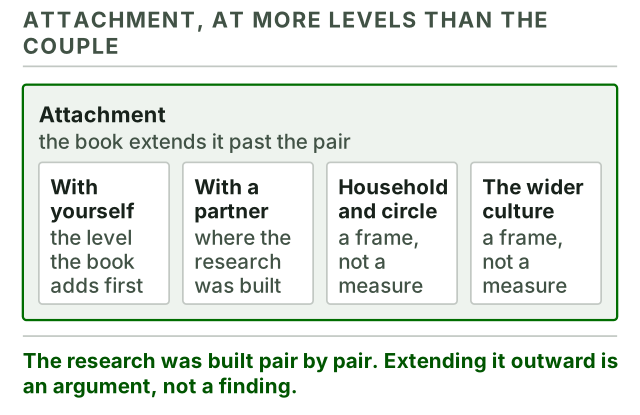
| Attachment happens at more levels than the couple: with yourself, with a partner, with a household and local circle, and inside the wider culture. | Fern's nested model, described on the publisher's page for the book, adapted from ecological thinking about human development. | Readers whose difficulty is not really with a partner but with having no context that treats their arrangement as ordinary. | The wider levels are a useful frame rather than a measured mechanism, and the book does not mark where the frame stops being evidence. |
| Security between partners can be built deliberately, through named practices repeated over time. | Fern's practice as a psychotherapist, organised into the set of strategies she calls HEARTS. | People who want something to do on a Tuesday evening, not a category to belong to. | The practices have not been tested as a programme; they are clinical judgement presented in an orderly list, which reads as stronger than it is. |
| Earlier attachment injuries surface faster when a relationship structure changes. | The author's clinical observation, drawn from clients who came to her already in non-monogamous relationships. | Readers who opened a relationship and were surprised by the intensity of what followed. | A therapist's caseload is a self-selected group, and people who found the same transition uneventful never appear in it. |
What is the book Polysecure about?
Polysecure is a book by Jessica Fern, published by Thornapple Press, that applies adult attachment thinking to consensual non-monogamy: how people build a sense of safety with each other when a relationship is not exclusive, and what makes that safety fall apart. The Polysecure book is written for the reader a general attachment title has left out of its examples.
The starting move is a refusal. Fern declines the common framing in which wanting security and wanting more than one relationship are treated as a contradiction to be resolved by picking one. Her argument is that security is produced by what partners actually do for each other, and that exclusivity is one arrangement among several in which that can happen or fail to happen.
On the publisher’s page for Polysecure, Fern is described as a polyamorous psychotherapist, and that is the whole of what the record supports about her background. This site does not add credentials it cannot check, so the book is read here as informed practice rather than as a research report.
The book divides cleanly. The opening part is explanation: what attachment means, why it does not require monogamy, and how the author’s nested model places a relationship inside a household, a community and a culture that either make it ordinary or make it strange. The later part is practice, organised as a named set of strategies Fern calls HEARTS.
The nested model is the part that travels furthest beyond the book’s own audience. Fern’s argument is that a relationship does not sit in a vacuum: it sits inside a household, a circle of friends who either mention it or carefully do not, an extended family, and a wider culture with a default script. Each of those layers either supplies steadiness or quietly withdraws it, and a pair can be doing everything right between themselves while a layer above them keeps the whole arrangement provisional.
That is a useful thing to have named, and it is also where the book’s evidential footing changes without warning. The inner layer, what partners do for each other, has a long research literature behind it. The outer layers are a frame borrowed from ecological thinking about human development, and a frame is a way of organising attention rather than a measured mechanism. The book does not mark the transition, so a reader has to mark it themselves.
That structure matters for how the book should be read. The explanatory part leans on a real literature and is careful with it. The practical part leans on the author’s judgement, and it is written with the same steady voice, which makes the seam hard to feel while reading.
What does Polysecure propose in practice?
It proposes that security is built by small, repeated acts of presence and repair, not by promises about the future. The practical part of the book turns that into a set of named behaviours: being genuinely present with a partner, showing pleasure at their arrival, tuning to their state, keeping rituals, and turning back towards each other after conflict.
The last element of the scheme is the one readers underestimate: attachment to yourself. Fern treats a person’s own capacity to notice and settle their own state as part of the same system, which keeps the book from reading as a manual for extracting reassurance from other people.
-
For example, the rituals element is deliberately unglamorous. A standing Thursday call that happens whether or not there is news to report does more for a partner’s sense of availability than a rearranged weekend after a bad week, because availability is inferred from the pattern and not from the size of the gesture.
-
For instance, the repair element asks what happens in the hours after a disagreement rather than during it. A partner who returns, names what went wrong and stays in the room is doing the thing the attachment literature actually measures; the eloquence of the argument itself is not the part that registers.
-
Consider the nested model applied to something small. Partners can be steady with each other and still feel unsafe because nobody in the household, the extended family or the paperwork of their lives treats the relationship as real. Fern’s point is that this is not a couple problem and cannot be solved by better communication between the partners alone.
What the book does not supply is a negotiation manual. There are no agreement templates, no scripts for the conversation that opens a relationship, and no timetable. That absence is deliberate, and it will frustrate a reader who arrives expecting logistics.
Who does Polysecure help?
It helps readers who are already in a non-monogamous relationship and have found that every available book assumes they are not. The book’s first service is being addressed to them at all; its second is refusing to treat their difficulty as evidence that the arrangement was a mistake.
- Imagine a reader who opened a long relationship, expected the hard part to be jealousy, and instead found themselves unable to sleep the night a partner was away. Fern’s framing gives that reaction a mechanism rather than a verdict, and points at what the other person could do differently on the following Tuesday.
It also helps another group the title does not advertise: monogamous readers who want an account of security that is about behaviour rather than about categories of person. Strip the non-monogamous examples and the practical part describes people learning to be reliable for each other.
Another group gets less attention than it deserves: readers who are the newer partner in an existing relationship, and who arrive with no household, no shared paperwork and no obvious place in anyone’s family. Fern’s layered account gives that position a description rather than leaving it where the surrounding literature does, as a complaint about coming second.
It helps least elsewhere. Readers who want to know whether to open a relationship will not find the answer here, because the book starts after that decision. Readers who want the research rather than an application of it should go to the literature directly. And readers who are looking for a structured method with trial evidence behind it are asking this book for something it never claims to have.
For a general introduction to the adult attachment ideas Fern assumes you already have, Attached covers that ground, with the caveats that page sets out. For the same emotional territory inside a committed pair, Hold Me Tight has a therapy literature standing behind it that Polysecure does not have and does not pretend to.
What are the criticisms of Polysecure?
The central criticism is that the book carries a body of research about pairs into a setting the research has not studied. Adult attachment work grew out of studies of a single relationship, and the move from a pair to a network is an argument Fern makes rather than a result she reports.
The lineage is easy to check. Hazan and Shaver’s 1987 paper in the Journal of Personality and Social Psychology is the study that extended attachment theory to adult romantic relationships, and it did so by describing what happens inside a couple. Mario Mikulincer and Phillip Shaver’s attachment perspective on emotion regulation in World Psychiatry holds that shape too: the question it models is who a frightened adult turns towards, and the answer it models is singular. Whether such a system divides across several people, ranks them, or works to some other logic entirely is a question that literature leaves open, and Fern’s move past it belongs to her rather than to the research.
Another objection is about where the book’s evidence comes from. Fern writes from her practice, and a caseload is a self-selected group: it contains people who sought therapy and not the people for whom the same transition passed without incident. Presenting patterns drawn from that group as descriptions of how non-monogamy generally goes overstates what a practice can show. The book is open about its clinical sourcing; the objection is that the writing does not slow down where the sourcing changes.
A further objection is about language. The book runs dense with terms, and the practical scheme comes with an acronym, which makes the ideas portable and also makes them easy to perform. A reader can acquire a vocabulary for what is happening in a relationship and mistake that fluency for a change in what either partner does. Naming a pattern is the beginning of the work, and carefully named patterns are unusually good at feeling like the end of it.
There is a further point that is less a criticism than a limit. Because the book is written to defend a structure against a hostile default, it spends little time on the cases where the structure itself is the wrong fit for a particular person at a particular time. That is a fair editorial choice given who the book is for, and readers should know the balance is deliberate.
None of that makes it a weak book. For a reader in a non-monogamous relationship who has been handed nothing but couples material and disapproval, Polysecure takes the situation seriously on its own terms, and the practical part is specific enough to act on this week. Take the practices, hold the extension loosely.
What this page does not do
Non-monogamy draws advice-seeking from one side and moralising from the other. This page answers neither.
- We do not sell the book
- The Thornapple Press page appears here so that Fern's name, the title and the publisher can be checked against the record, and for nothing else. There is no purchase route on this page and no paid placement behind any link.
- We do not advise anyone on relationship structure
- Whether to open a relationship, how to negotiate one, what to agree with whom: none of that is on this page. We describe what a book argues, not what you should do.
- We do not define polyamory vocabulary
- Community terms and their shades of meaning belong to a glossary, not to a book review. What appears here is only what is needed to follow Fern's argument.
- We do not print sales figures or ratings
- Copies sold, chart positions, review averages: publisher marketing copy and aggregate opinion, neither of which is evidence about a book's claims. See /sources/ for how that rule works.
Where does Polysecure sit among the other attachment books?
It sits at the applied end, furthest from the research and closest to a reader’s week. That is both its value and the reason it should not be the first attachment book anyone reads: Fern assumes the vocabulary and spends her pages on what to do with it.
The comparison worth making is with the confidence of the writing. The familiar move in popular attachment writing is to convert dimensional research into categories of person, then advise from the category. Polysecure declines that trade, treating security as something produced between people and therefore changeable, which stays closer to how the literature itself describes it.
Where it takes on risk is elsewhere. It extends a dyadic literature to networks, and it presents clinical practice in the orderly form of a scheme. Those are different debts from the ones the better-known books carry, and a reader who knows which debt a book is carrying reads it better.
For how these books disagree with each other, and which one answers which question, the collection page for attachment theory books lays them out side by side. For the physiological version of the same argument about couples, Wired for Love is the neighbouring title, and it comes with its own vocabulary problem. And our sources page writes down the test every citation here had to pass, and names the sorts of claim we will not carry.
Checked: 2026-09.