| What the book claims | What that claim rests on | Who it tends to fit | Where it is challenged |
|---|---|---|---|
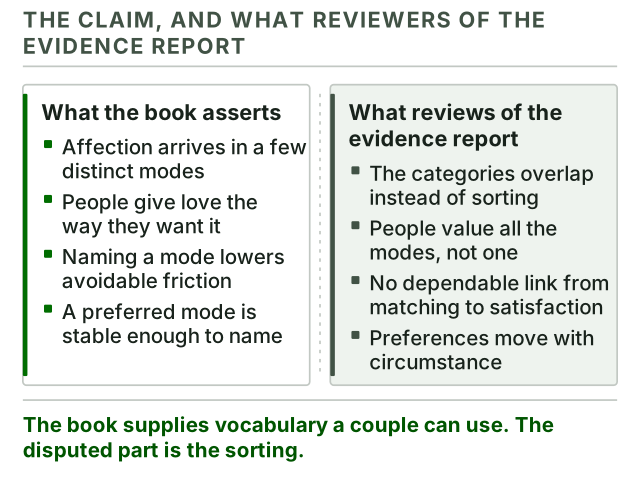
| Affection is expressed and received in a small set of distinct modes. | Patterns the author drew out of his own counselling practice, written up as a framework. | Couples who keep arguing about effort without ever agreeing on what effort would look like. | Relationship researchers report that the categories overlap rather than sorting people cleanly. |
| People tend to give love in the mode they most want to receive it. | Case material from the author's practice, presented as description rather than as a study. | A reader whose efforts keep getting reported back as not landing. | Hard to separate from ordinary attentiveness, which needs no framework at all. |
| Learning a partner's preferred mode reduces avoidable friction. | The book's counselling anecdotes and its recommended conversation. | Partners who want one concrete thing to talk about this week. | A review of the research finds no dependable link between partners matching on languages and how satisfied they are. |
| A preferred language is stable enough to be worth naming out loud. | The book's profile exercise, offered as a starting point for discussion. | Readers who find it easier to negotiate with a shared word on the table. | Preferences shift with circumstance, and a fixed label can turn into an excuse for not stretching. |
The 5 Love Languages is a relationship book by Gary Chapman which argues that affection is expressed and registered in a small set of modes and that couples miss each other when they give in their own mode instead of their partner’s. The 5 Love Languages book is a standard gift between couples, which is exactly why it deserves a careful reading rather than a recommendation.
Two things are true about it at once, and a write-up that picks only one of them misleads. The book gives couples a usable word for a mismatch they can feel but cannot name, and that service is real. It also carries an authority it never earned: the five categories are read as though a body of research sat underneath them, and none does.
What follows is the book on its own terms: the argument Chapman makes, the room the categories were counted in, the reader it suits, and the objection it cannot answer. The longer argument about whether the framework holds up as science lives on are love languages real; here we stay with the book itself.
What is the five languages of love book about?
The book is about a mismatch in how affection is sent and how it is noticed. Chapman’s argument is that each person has a mode that registers most strongly with them, that partners tend to give in their own mode by default, and that two people can spend years being generous in parallel without either of them feeling met.
The five modes he names are words of affirmation, quality time, receiving gifts, acts of service and physical touch. The names come from the book itself, and they are a framework, not a finding — the numeral in the title is part of a book title, not a measurement of anything. The official page for the book lists the same five and identifies Gary Chapman as the author, a PhD who has run marriage and family seminars and radio programmes.
Structurally, the book works as description followed by a request. Its body is given over to scenes from counselling in which two people describe the same marriage in incompatible terms, then asks the reader to do one specific thing: work out what registers for you, work out what registers for your partner, and say both out loud. That request is the entire method, and it is the part that survives every criticism the framework attracts.
What the book does not do is diagnose anybody, predict anything, or claim a mechanism. There is no theory of why the modes exist, no account of where a preference comes from, and no evidence section. The absence matters later, when we get to the criticism, because the case against the framework is aimed at claims the book never made and readers supplied on its behalf.
One more feature of the book is easy to miss on a first read: the scenes end with somebody being asked a question rather than being told an answer. The counsellor in these pages does not hand out verdicts about who is neglecting whom. He gets each partner to describe what they notice, and the framework arrives afterwards as a way of holding the two descriptions side by side. Read in that order, the categories are scaffolding for a conversation, not a result the conversation is meant to produce.
Where did the five categories come from?
The categories came out of one counsellor’s practice, not out of a research programme. Chapman describes noticing the same complaints repeating across years of sessions with couples, sorting them into groups, and finding that the groups settled where the book’s title says they settled. That is the origin, and the book is straightforward about it.
This is worth stating plainly because the framework gets cited as though it came from a study. It did not. It came from clinical pattern-spotting written up for a general readership, which is a legitimate way to produce a useful idea and a poor way to produce a verified one. That is true of the relationship books we cover generally, and we say so on each page rather than letting the difference disappear.
The counting is also less solid than the title suggests: a category system derived by sorting complaints could have been drawn with the lines in other places. Treat the number in the title the way you would treat the chapter list of any book — an organising choice by the author, not a boundary found in nature. What that choice does to the framework’s standing is argued out on are love languages real.
None of this makes the observation wrong. People plainly do differ in what they notice, and a practitioner sitting with couples is describing something real. The error is upgrading an observation into a taxonomy, and then treating the taxonomy as an explanation of a person.
The honest summary is that the book reports something a practitioner noticed and offers it for readers to test against their own lives. Read as an invitation, that holds up. Read as a verified account of how affection works in people generally, it is doing work it was never built to do, and neither the author’s practice nor the book’s structure supports the weight.
Who does the book actually help?
It helps couples who are stuck in an argument about effort. The recurring situation is one partner working hard and hearing that it does not count, and the other partner feeling neglected while surrounded by evidence of care. The book gives both of them a way to describe that without either one being the villain.
- For example, a partner who shows up as the person who fixes the car, handles the paperwork and keeps the house running, and who hears “you never show me anything” as an insult to the work itself. The book lets that be a mismatch instead of an accusation.
- For instance, a couple who have argued about the same anniversary ever since — one of them wounded that nothing was bought, the other baffled because they took the whole day off. Naming the modes does not settle who was right; it stops the argument being about character.
- Consider a reader who genuinely does not know what they want more of, only that something is thin. The categories work as a menu to react to, and reacting is easier than inventing.
The mechanism is unglamorous: the book supplies vocabulary, and vocabulary lowers the cost of raising a subject. A person who can say “I notice time more than I notice gifts” has said something specific and answerable. Without the phrase, the same person is left with “you don’t care”, which is neither.
It also helps that the book’s request is small enough to act on in an evening. There is no programme, no course to complete, no requirement that both partners buy in first. One person reading it can start a conversation that the other person can join, and that low threshold explains its reach.
Who it helps less: anyone hoping to be told what is wrong with their partner. The framework is easy to weaponise as a label — my language is X, so this is what you owe me — and used that way it hardens a couple’s positions instead of loosening them. If a partner’s needs are being overridden rather than misread, no vocabulary settles that, and a book is the wrong instrument.
A question readers put to us: does it do anything if only one of you reads it? Partly. One person can change what they give, and can ask a better question than “what’s wrong” — both are available without the other partner ever opening the book. What one reader cannot do alone is find out what registers for the other person. That answer only exists in their mouth, and guessing it from a category is how the framework goes wrong.
The book also lands differently depending on what is already strained. Couples in a lull, or worn down by logistics, are where it does its best work, because the missing ingredient really is attention and the vocabulary makes attention easier to aim. Couples in open conflict are better served by something that addresses the fight itself first; the modes can wait until the two of them can hear each other at all.
What is the strongest criticism of the five love languages?
The strongest criticism is that the categories do not behave like types. Relationship scientists who went looking for that structure did not find it: what they report is people who value all five ways of receiving affection, categories that run into one another, and no dependable payoff from partners matching on a language.
That reading traces back to a review in Current Directions in Psychological Science by Impett, Park and Muise, restated for non-specialists at the Association for Psychological Science. The evidence is argued out in full on are love languages real; the consequence for a reader of this book is narrow. The list works as a set of things worth noticing, and stops working the moment it is used to sort a person into one of them.
A second objection is about what the label does once a reader adopts it. A preference stated as an identity — this is my language — can turn into a standing excuse for not stretching towards what a partner needs. The framework was written to prompt generosity and is put to work licensing the opposite.
A third is about context. Sorting a disagreement into modes puts the whole problem inside a matter of style, and some problems are not about style. An unequal share of the household work, one partner’s time being treated as the cheaper time, or a relationship where care flows one way are situations the vocabulary can quietly disguise, because it renders every shortfall as a translation error.
A fourth objection is aimed at the machinery around the book rather than the book itself: a reader meets the quiz, the merchandise and the spin-off editions before they meet the argument. That is fair to hold against the phenomenon, and not against the original text.
Every record this page leans on is named on sources, together with the standard we hold a publisher page to before we will link one. That page argues the science; this one stays with the book.
Where the book still earns its place: as a conversation opener between two people who already want to reach each other and lack the words. That is a narrower claim than the one on the cover, and it is one the criticism does not touch.
What does a summary of the book miss?
A 5 Love Languages summary reproduces the list and drops everything that makes the list work. What gets cut is the counselling material — the long, specific scenes of two people describing the same marriage incompatibly — and those scenes are where a reader recognises themselves. The list on its own is a quiz result; the scenes are the argument.
Summaries also flatten the book’s tone into instruction. Read whole, it is closer to a counsellor thinking aloud than to a manual, and it repeatedly concedes that a couple has to work out the particulars themselves. Compressed, it turns into a set of directives the book does not actually issue, which is one reason the framework is remembered as more prescriptive than it is.
The other loss is the caveats. Chapman’s own hedges — that a preference can move, that the modes run together, that naming one is a beginning rather than a conclusion — are the first casualties of compression, and their absence is exactly what produces the rigid version researchers then have to argue against.
If you want the short version, take this one: notice what registers with you, ask your partner what registers with them, and expect both answers to be untidy. Everything else in the book is illustration. What no summary can supply is the recognition that comes from reading a scene that sounds like your own kitchen, and that recognition is the reason the book keeps being passed along.
A summary is also where the criticism gets lost. Read whole, the book invites you to check it against your own life; read as a stack of bullet points, it arrives as a fact about human beings, and that version is the one people then defend or attack. Whatever you take from the framework, take it with the qualification attached.
For contrast, Men Are from Mars, Women Are from Venus does something structurally similar with a different sorting rule, and Nonviolent Communication drops categories altogether in favour of a sequence for saying hard things. Reading any two of them together makes the shape of each one visible. Where this book sits among the others is set out on books about communication in relationships and, for long partnerships, on best books on marriage. The whole canon, title by title, is laid out on the main guide.
What this page does not do
The 5 Love Languages sits in the middle of a large merchandising operation, which makes a page about it an easy place to sell something. Here is what we leave out on purpose.
- We do not sell the book or link to shops
- There are no affiliate links, no prices and no buy buttons anywhere on this site. The one external link to the publisher exists so you can check the title and the author against the source, not so you can check out.
- We do not print sales figures or ratings
- Copies sold, languages published in, star averages and review counts are publisher marketing or aggregate noise. None of it is verified here, so none of it appears here, on this page or any other.
- We do not tell you your love language
- No quiz, no scoring, no result. Working out what registers with you is a conversation to have with the person you live with, and a website is not a party to it.
- We do not treat the framework as a diagnosis
- The categories are an author's organising device, not a description of your personality and not a way to explain what your partner is like. We use them as vocabulary and nothing more.
- We do not decide whether a book is worth your time
- This page describes the framework, its origin and the objection to it, and then stops. Whether a copy of this particular book belongs in your house is a judgement about your house, which is why there is no rating at the top of the page.
Our own reading, stated once: as a book this one is better than its reputation and smaller than its cover. Two people who already want to reach each other can pick up its vocabulary in an evening and get something real for the trouble. The taxonomy printed on the front is a different product, and it is the part to leave behind when you hand a copy on.
Checked: 2026-09.