| What the book claims | What that claim rests on | Who it tends to fit | Where it is challenged |
|---|---|---|---|
| Adults are drawn to partners who echo the caretakers of their childhood. | A psychodynamic reading of clinical work with couples, written up for general readers. | Someone who keeps ending up in the same argument with different people and wants a frame for it. | The mechanism is an interpretation, not a measurement, and it explains a choice far better after the fact than before it. |
| Conflict in a couple is a sign of the relationship doing its work, not of the wrong match. | The book's stage model of romance, disillusion and deliberate partnership. | Partners who have started reading their friction as proof they should not be together. | The same reading can keep people in arrangements that are draining rather than developmental. |
| A structured dialogue — mirroring, validating, empathising — changes what a couple can hear. | The exercise as taught in the book and in Imago workshops. | Couples whose arguments end in interruption rather than in disagreement. | The turn-taking can feel artificial in practice, and the structure only holds if both partners keep to it. |
| Couples can do this work themselves, guided by the book. | The book is written as a course, with exercises meant to be done at home. | Readers who want practice rather than theory, and who have a willing partner. | The exercises assume a level of safety and goodwill the book does not check for. |
Getting the Love You Want is a relationship book by Harville Hendrix which argues that adult partner choice is shaped by unfinished business from childhood and that couples can work with that through a structured dialogue. The Getting the Love You Want book is the text that put Imago therapy into general circulation, and it is read today for the exercise at its centre rather than for the theory that frames it.
Those are two different books bound together, and it is worth separating them before you start. There is a developmental argument about why you fell for this particular person, which is interpretation offered with the confidence of a finding. And there is a practical course in how to talk when talking has stopped working, which stands on its own whether or not you accept the argument.
Below: the argument the book makes, the mechanics of the dialogue it teaches, the household it was written for, and the part of it that is contested. We describe the method; we do not teach it as ours, and we have no connection to any Imago training or workshop.
What is the core message of Getting the Love You Want?
The core message is that you did not choose your partner at random, and that the friction between you is predictable rather than proof of a mistake. Hendrix’s argument is that people are drawn to someone whose emotional climate rhymes with the one they grew up in, and that the qualities that first attracted them are entangled with the ones that later grate.
From there the book describes a sequence. Early romance runs on a projection that neither person can sustain. Disillusion follows, and with it the arguing about who changed. What Hendrix proposes as the next stage is a partnership entered on purpose, in which each person takes on the work of stretching towards what the other actually needs rather than waiting to be understood.
The word imago is the book’s name for the composite picture of caretaking a person carries into adulthood without having assembled it deliberately. It belongs to a psychodynamic tradition of explanation, and the book presents it as machinery rather than as one available reading. Keeping that distinction in view is what careful reading requires here.
The practical consequence of the theory is the part that matters. If the friction is structural, then neither partner is the problem to be solved, and the useful question stops being who is wrong and becomes what does this person need that I find hard to give. That reframing is available to a reader who rejects every developmental claim in the book.
Structurally the book is a course rather than an essay. The argument is laid out first, then the reader is handed a sequence of exercises and told, in effect, to stop reading and go and do them with the other person. That design explains both its reputation and where it falls flat: readers who treat it as a book about relationships finish it with a theory, while readers who treat it as a workbook finish it with a practice.
What is the Imago dialogue?
The Imago dialogue is a turn-taking structure that slows a conversation down until each partner has been heard before either replies. One person speaks about something that matters to them. The other does not answer it, defend against it, or improve on it. They mirror it back, check that they have it right, and only then move on.
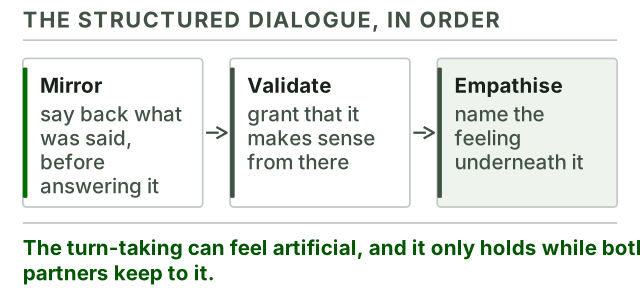
The steps, in the book’s own vocabulary, run mirroring, validating, empathising. Mirroring is repeating back what was said in the speaker’s terms. Validating is saying that the account makes sense from where the speaker sits, which is not the same as agreeing with it. Empathising is naming what the speaker is likely feeling and letting that stand without correction.
What the structure removes is the reflex to answer. Arguments in couples can consist of two people delivering rebuttals to sentences they have not finished hearing, and the dialogue makes that mechanically difficult. That is a modest and specific claim, and it is the one part of the book that transfers cleanly to readers who want nothing to do with the theory.
It also fails in predictable ways. The structure only holds while both people keep to it, and the moment one of them answers instead of mirroring, the exercise collapses into the argument it was meant to replace. The phrasing can feel stilted at first, which is the price of any procedure that overrides a reflex, and the awkwardness matters less than whether the pair agreed in advance to finish the round.
We describe the sequence rather than reproducing the scripts. The exercises belong to the book, they are meant to be worked through in order, and a paraphrase of the steps on a website is not a substitute for the pacing and the examples that make them land.
| Book | What it asks of you | The reader it is built for |
|---|---|---|
| Getting the Love You Want | Take turns in a fixed structure: mirror, validate, empathise, without replying in between | Couples who interrupt each other more than they disagree |
| Hold Me Tight | Trace the repeating loop between you and name what you need underneath it | Couples who can already talk but keep landing in the same place |
| Nonviolent Communication | Rebuild a single sentence: observation, feeling, need, request | Readers working on their own half of a conversation |
Who does the book help?
It helps couples who are still willing and no longer effective. The recurring situation is two people who care, who argue in circles, and who have each concluded privately that the other one is not listening. The dialogue gives them a procedure to use when goodwill alone has stopped producing conversations.
- For example, a couple whose disagreements turn into a race, because each of them begins assembling a reply before the other has finished the first sentence. The structure interrupts that habit without either of them having to be the reasonable one.
- For instance, a reader who has noticed the same complaint following them from one relationship to the next and wants a frame for it that is neither self-blame nor a verdict on their partners. The book supplies a frame; whether it is the right one is a separate question.
- Consider a partner who is tired of being told they are defensive and would like a setting in which not defending themselves is the actual instruction rather than a criticism. The turn taking makes that a rule of the exercise instead of a demand from the other person.
Because the exercises are meant to be done together, this is one of the titles that works better read in company than in private, and our notes on books for couples to read together cover how to divide that up without one person becoming the teacher. Reading it alone is still possible; what is not possible alone is the dialogue itself, which needs a second person who has agreed to the rules.
Who it helps less: anyone reading it alone in the hope of moving a partner who never agreed to the exercise. The exercises need both people, and the theory in the wrong hands becomes a way of explaining a partner to themselves. Where raising a subject at all does not feel safe, the book is the wrong instrument and a professional is the right one.
What are the criticisms of Imago?
The main criticism is that the evidence behind the approach is thin relative to how confidently it is presented. Imago has a training and workshop apparatus, and we were not able to find independent outcome research on it that met the sourcing bar we use on this site. We do not cite what we cannot open and check, so we cite nothing here, and readers should treat the approach as clinically popular rather than as empirically established.
The second objection is about the developmental claim itself. That adults select partners who reproduce the unfinished business of childhood is a psychodynamic interpretation, and interpretations of that family share a known weakness: they account for an outcome after it has happened more comfortably than they predict one in advance. The book states the mechanism as fact. A reader is entitled to hold it as one story among several.
The third is about what the frame licenses. If conflict is the relationship doing its work, then persistent unhappiness reads as progress, and that reading can keep someone committed to an arrangement that is simply draining them. The book’s stage model contains no test for telling the two apart, and it needs one.
A fourth objection is aimed at the ecosystem rather than the text. The method arrives with certified practitioners, weekend workshops and a training pathway, and the book functions as the entrance to all of it. That is not itself an argument against the ideas. It does mean a reader is being introduced to a business as well as to an approach, and it is worth knowing which one you are reading at any given moment.
A quieter limitation is who the book pictures. The default reader is a couple in a long partnership with a shared household and a shared history, and the examples are built for them. Readers whose situation has a different shape are left translating as they go, and the exercises assume an amount of uninterrupted time together that a household may not have to give.
What survives all of this is the dialogue. A turn-taking structure that stops people replying before they have listened does not require the developmental theory to be true, and it is the part of the book that practitioners from other traditions have quietly absorbed.
What to read alongside it?
Read it next to a book with a stronger research record and a different account of the same trouble. Hold Me Tight treats a couple’s repeating fight as a cycle to be mapped and interrupted, and the approach behind it has been studied in a way Imago has not. Put side by side, the two make each other’s assumptions visible.
For the sentence-level version of the same problem — how to say a difficult thing so it can be heard — Nonviolent Communication drops couples theory entirely and works on a single utterance. Readers who find Imago’s turn-taking too ceremonial sometimes get on better with that, and our wider shelf of books about communication in relationships sets out the range.
If you arrived here looking for reading to bring into or alongside counselling, the sub-hub for that is books for couples counseling, which lists what each approach asks of a couple and says plainly where a book stops being enough. Which publisher pages we will open, and why this one carries no outward link, is explained on sources.
One last note on summaries. Condensed versions of this book keep the theory and drop the exercises, which reverses the value: the theory is the part a reader should hold at arm’s length, and the exercises are the part that needs the book’s pacing to work. If you take a short version away from this page, take the practice, not the explanation.
What this page does not do
Imago is a method with a training business attached, and the book doubles as the entrance to it. Here is what we leave out on purpose.
- We do not sell the book or link to shops
- No affiliate links, no prices, no buy buttons, anywhere on this site. We describe what a book argues so you can decide whether to find a copy, and the finding is your business, not ours.
- We do not link a publisher page we could not verify
- Our rule is that an external link has been opened and checked against the title and author before it ships. We could not confirm one for this title, so this page names the book in prose and links nothing outward.
- We do not print the author's credentials
- Qualifications on this site come from a verified publisher page and nowhere else. Without one, we name the author and stop there, rather than repeating biography copied from other write-ups.
- We do not reproduce the exercises
- The dialogue is summarised here in our own words. The scripts, the sequence and the worked examples belong to the book, and lifting them would be both a copyright problem and a poor version of the thing.
- We do not recommend a therapy
- We describe approaches and what they ask of a couple. Which one suits your situation, and whether a book is the right starting point at all, is a decision this site is not in a position to make.
- We do not rate books or print sales figures
- No stars, no rankings, no copies-sold numbers. Those figures come from marketing or from aggregate noise, and none of them tells you whether a book will be useful to the two people in your house.
Our reading, stated once: the theory is the weakest part of this book and the reason it is remembered, while the dialogue is the strongest part and the reason it is still used. A reader who takes the exercise seriously and the mechanism sceptically gets the book’s value, and that is an unusual way to recommend a book, which is why we say it plainly rather than at the end of a rating.
Checked: 2026-09.