
| What the book claims | What that claim rests on | Who it tends to fit | Where it is challenged |
|---|---|---|---|
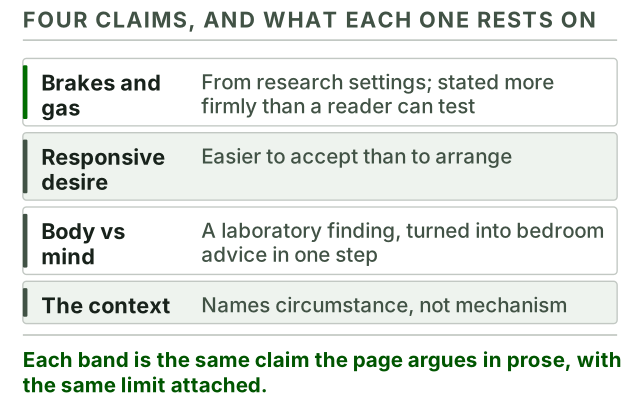
| Sexual response runs on an accelerator and a set of brakes, and people differ in how sensitive each one is. | The author's summary of the dual control model as it is used in sex research; presented as her reading of that literature, not as her own finding. | Readers who have been treating a low-key accelerator or a busy brake as a defect. | A model borrowed from research settings is stated in the book with more confidence than a general reader can test at home. |
| Desire is often responsive — it arrives after arousal and context, rather than before them. | Clinical and research accounts of responsive desire, restated for a general reader. | Readers who assumed that wanting has to come first, and read its absence as a verdict. | The reframing is easier to accept than to arrange for, in households where the context is not adjustable. |
| Arousal in the body and desire in the mind do not always agree, and the mismatch is ordinary. | Laboratory work on arousal non-concordance, summarised by the author. | Readers who have been reading their own body as evidence about their feelings. | The move from a measured laboratory finding to advice about a bedroom is a long step, and the book takes it quickly. |
| The useful question is not what is wrong with you, but what your context is doing. | The book's own framing, argued through its garden metaphor. | Readers who arrived with a self-diagnosis and leave with a description of circumstances. | The metaphor names the problem without supplying a mechanism, and some readers want the mechanism. |
Come As You Are is a popular-science book by Emily Nagoski about how sexual response works, written for a general reader and arguing that context, rather than some fixed amount of drive, explains what people quietly worry about in their own bodies. The Come As You Are book is written for a reader who has already reached a private verdict about themselves, and it spends its length arguing that the verdict was made with the wrong evidence.
This page describes what the book claims, what those claims rest on, which reader it is written for, and where the argument has been pushed back on. We are not restating the book as our own advice: everything clinical here belongs to the author, and we say so each time. Checked: 2026-09.
Nagoski’s qualifications are the ones her publisher states: a doctorate in health behaviour with a concentration in human sexuality from Indiana University, a master’s in counselling, clinical training at the Kinsey Institute Sexual Health Clinic, and a teaching role at Smith College. That matters for reading the book, because it is written in two registers at once — a researcher summarising a literature, and an educator trying to get a reader to stop grading themselves.
What is the book Come As You Are about?
The book is about the gap between how sexual response actually works and what readers have been told to expect of it. Nagoski’s argument is that the ordinary range of human response is wider than the cultural script allows, and that private distress comes from measuring an ordinary body against a script it was never going to match.
The structure follows that argument. The early chapters set out a model of how arousal and desire operate; the middle chapters deal with stress, context and what the author calls the cultural messages a reader absorbed without consenting to them; the later chapters turn to what can be adjusted. The publisher’s own summary describes it as a guide to the science of sexual wellbeing, and the book is at its most confident in the descriptive chapters rather than the prescriptive ones.
Its sourcing habit is worth naming. Where it summarises a body of research, it says that it is summarising, and it points at the work. That habit is also what makes it fair to examine the compressions: a book that shows its working invites you to check it, and that invitation is part of what it offers.
The register shift is worth expecting, because it is where readers divide. The descriptive chapters read like a patient briefing on a research field, with the hedges kept in. The chapters that follow read like a teacher addressing a specific reader who has been unfair to herself, and they are warmer, more direct and less hedged. Both registers are honest about what they are. A reader who wants only the first will find the second insistent; a reader who came for the second will skim the first and lose the sourcing that makes the book worth trusting.
One clarification, because searches conflate them. This is a book about sexual wellbeing, not a couples-therapy manual and not a relationship-repair programme. It has things to say about partnership, but the unit it works on is one person’s understanding of their own responses. If what you want is a method two people follow together, that is a different shelf, and we point at it further down.
What are the key takeaways from Come As You Are?
The argument rests on the dual control model, responsive desire, and arousal non-concordance. Each is presented as the author’s reading of existing research rather than as her own discovery, and each is aimed at replacing a self-judgement with a description of how a system behaves.
The dual control model. Nagoski describes sexual response as running on an accelerator that notices reasons to be interested and a brake that notices reasons not to be. People differ in how sensitive each part is, and the differences are ordinary rather than diagnostic. Her practical point follows from that: a sensitive brake is not answered by pressing harder on the accelerator. It is answered by finding out what the brake is responding to.
Responsive desire. The book distinguishes desire that shows up on its own from desire that arrives after arousal and context have already started — after touch, attention, safety, an unhurried hour. Nagoski’s argument is that the responsive pattern is common and unremarkable, and that reading it as an absence of wanting is a mistake about sequence, not evidence about a person.
Arousal non-concordance. The book reports laboratory work showing that what a body registers and what a person actually wants can disagree, and argues that the body’s reaction is better read as recognition of something sexually relevant than as endorsement of it. It is the section that asks a reader to re-read their own evidence about themselves.
The ideas are not a sequence of steps, and reading them as one misreads them. They are a single change of question. Instead of asking how much desire a person has, each of them asks what the person’s system is responding to — the accelerator asks what it is noticing, the brake asks what is in the way, and non-concordance asks which signal you are treating as the verdict. The answers differ per person, which is why the book resists producing a programme and why some readers finish it wanting one.
- For example, the book’s reframing of a low-key accelerator is not “your desire is broken” but “your accelerator notices fewer things, so more of the noticing has to be arranged” — the same behaviour, described as a setting rather than a fault.
- For instance, on the brake side, the argument is that unfinished work, an unresolved argument at breakfast, or a room that does not feel private are not distractions from desire. In this model they are inputs to it, and they are doing exactly what a brake does.
- Consider the garden metaphor that runs through the book: you were handed a plot with particular soil and a particular climate, and the useful question is what grows there, not whether it matches the neighbour’s plot. It is a good picture of the argument, and, as the criticism section notes, a picture is what it stays.
Who does the book help?
It helps readers whose main question is about themselves rather than about a technique — people who arrived believing they were defective and who benefit from being handed a description of circumstances instead. It helps least where the circumstances the book asks you to change are the ones you have the least control over.
The starting position it speaks to is a recognisable one: someone who has been comparing themselves to a script — spontaneous, frequent, uncomplicated — and losing. The book’s value for that reader is not a set of instructions. It is the removal of a false comparison, and the vocabulary to say what is happening instead.
- Such as a reader who has spent years measuring themselves against a partner’s timetable and concluding that the difference between them is a defect in one of them, when the book’s model would describe it as two differently calibrated systems in one household.
- Imagine a reader whose body has responded in a situation they did not want, and who has carried that as evidence about their own character. The non-concordance chapter is written for exactly that reader, and it is written to land as a relief.
There is a second audience the book serves less obviously: partners. Read as an explanation rather than as a set of demands, it gives a couple language for a difference that otherwise gets argued about as a grievance. That said, it was written to be read alone, and readers looking for a joint method will find our couples counselling reading list closer to what they want.
Whether it is worth reading, plainly: yes if your question is about yourself, no if your question is about technique. The book’s return comes early, when the false comparison comes off, and it flattens in the practical chapters. A reader who stops after the descriptive chapters has taken the part that was going to help them, and there is no shame in reading it that way.
Who it does not fit: a reader wanting a protocol with steps and a timeline; a reader whose situation is medical and needs a clinician rather than a book; and a reader outside the audience it addresses, which is women in relationships with men. The book acknowledges the last point. It is still a limit on how far the reading travels.
What are the criticisms of Come As You Are?
The criticisms are about reach rather than about honesty: that findings established in research settings are extended into everyday advice, that the central metaphor describes a situation without supplying a mechanism, that the literature summarised is selected as well as reported, and that the reframing can arrive as reassurance a reader has no way to act on.
A note about our sourcing first, because it changes how much weight the rest of this section carries. Our verified source list holds the publisher’s record for this book and no peer-reviewed critique of it. What follows is argument about the book’s structure, made by us, and it is not a report of anyone else’s published finding. We would rather say that than attach a critic’s name we cannot show you.
From the laboratory to the bedroom. Non-concordance is measured under controlled conditions, with instruments, on volunteers who agreed to be measured. The book moves from that to how a reader should interpret their own night, and that is a long step taken quickly. The direction of the advice is defensible; the confidence of the translation is what invites argument.
The garden as a metaphor, not a mechanism. The image is memorable and it does real work against self-blame. What it does not do is tell you which lever to pull. A reader who accepts that their plot has its own soil still has to work out what that means on a Tuesday with children asleep down the corridor, and the book’s answers there are thinner than its diagnosis.
Selection inside the summary. Any popular book compressing a research field decides what to include, and areas that remain contested inside sex research can read, in compressed form, as settled. The book is careful about this; careful is not the same as neutral, and a reader should hold the summaries as one researcher’s account of the field.
Context is easier to name than to change. The practical chapters ask a reader to arrange conditions — rest, privacy, unhurried time, a lower-stress week. For readers with shift work, small children, illness or money pressure, that is a description of what they do not have. The reframing still removes a false verdict, which is worth something. It just does not remove the constraint.
The advice-voice problem is ours, not the book’s. A book about sexual wellbeing gets quoted as instruction rather than read as description, and we take the same care here: nothing on this page is guidance about anyone’s sex life. Where a claim is clinical, it belongs to Nagoski and to the research she cites, and it is reported here as hers. The full record we work from is on our sources page, and Scribe’s own description of the book sits on its listing for this edition.
Reception outruns the text. The ideas have travelled past the book, and the versions that circulate — a slogan about brakes, a half-remembered line about gardens — are looser than anything Nagoski wrote. That is not the author’s fault, and it is the main reason we describe the argument at length here instead of restating the summary a reader already met somewhere else.
Who it is still useful for, criticism included: readers who need the false comparison taken away before anything else can be looked at. That is a real service, and the objections above do not undo it.
What this page does not do
A book about sex attracts advice-shaped writing. Here is the line we hold on this page.
- We do not give sexual advice
- Every clinical statement here belongs to Nagoski or to the research she summarises. We report her argument about accelerators, brakes and context; issuing it as instruction is not our role, and we are not qualified for it.
- We do not diagnose anything
- Nothing on this page can tell you whether your own accelerator or brake is doing something unusual. A question about health belongs with a clinician, not with a page about a book.
- We do not sell the book
- You will not find a retail link, a price or a paid arrangement anywhere in this text. The single outbound link points at Scribe, so the author and the edition can be checked.
- We do not publish sales or rating numbers
- Chart placings, copies-shifted claims and star averages come from marketing departments and from platforms nobody can audit. They fail the standard we apply, so they appear nowhere beside this title.
- We do not quote passages we cannot place
- An argument described here is paraphrased, with the chapter it comes from named. Sentences set in quotation marks with Nagoski's name attached are not something this page prints.
What should you read alongside it?
Read it alongside a book that works on the couple rather than on the individual, because that is the gap this one leaves open by design. Nagoski’s subject is one person’s understanding of their own responses; the arguments about what happens between two people are made better elsewhere, and the two readings do not contradict each other.
Mating in Captivity is the natural companion and the natural disagreement. Esther Perel’s argument starts from the couple and from the tension between closeness and desire, where Nagoski starts from the individual system and its context. A reader who finds the context argument true but insufficient will find the other half of it there.
Hold Me Tight sits further from the subject and closer to the machinery of a relationship: it treats recurring arguments as signals rather than faults, and it comes with a research literature attached to its method. If what surfaced while reading Nagoski was a conflict pattern rather than a question about response, that is the better next book.
For the wider shelf — where each of these books sits, what it claims and where it has been argued with — start from our guide to the best relationship books, and for the clinical end of the shelf, our couples counselling reading list groups the titles that describe a method rather than a perspective.