| What the book claims | What that claim rests on | Who it tends to fit | Where it is challenged |
|---|---|---|---|
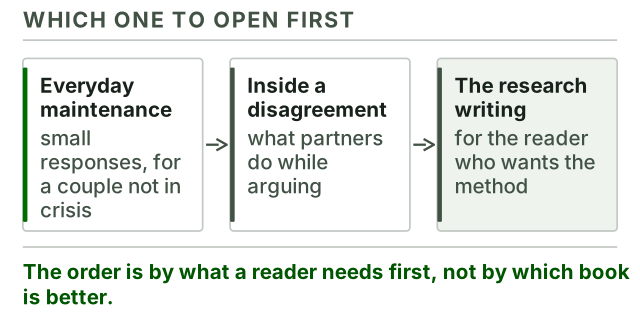
| How couples behave during a disagreement carries more information about the relationship than what they disagree about. | Observational studies in which couples were recorded and coded while they talked through a point of tension. | Readers who want a description of their arguments that is behavioural rather than psychoanalytic. | The coding was done on volunteer couples in a lab setting, which is not where everyday arguments happen. |
| Stable relationships are built mainly out of small everyday responses, not out of grand gestures or resolved conflicts. | The observational work plus the follow-up interviews that tracked couples over time. | Couples who are not in crisis and want maintenance rather than repair. | The popular books state it as a rule for everyone; the underlying samples were narrower than the phrasing suggests. |
| Recurring disagreements between partners tend to persist unresolved, and the useful skill is managing them rather than settling them. | Longitudinal observation of the same couples returning to the same subjects over time. | Anyone who has been told that a good relationship means agreement. | Therapists outside the method argue that some disagreements are structural, and that managing them well can quietly mean one partner absorbing them. |
| Which couples will separate can be identified from how they interact. | The prediction studies that made the research famous, including Gottman and Levenson's work on conflict, physiology and later dissolution. | Readers interested in the research itself rather than in advice. | Methodologists have objected that a model built and evaluated on overlapping samples describes those couples rather than forecasting new ones. |
Which Gottman book should you read first?
Start with one of the popular guides written for couples, and treat the rest of the shelf as optional. A search for the best Gottman book returns a list that spans research monographs, therapist manuals and short practical books, and the useful opening move is to work out which of those kinds you are actually holding.
The Gottman books are a corpus of popular guides, clinical volumes and co-authored collaborations built on the same body of observational research into how couples behave while they disagree. It is one method, packaged again and again, and the packages are aimed at very different readers.
| Book | Group | Who it is written for | What it gives you |
|---|---|---|---|
| The Seven Principles for Making Marriage Work (with Nan Silver) | Popular guide | A couple wanting a single general book | The main framework plus questionnaires and exercises |
| Why Marriages Succeed or Fail | Popular guide | Readers who want the research reasoning first | The observational case, with less instruction and more argument |
| What Makes Love Last? (with Nan Silver) | Popular guide | Readers whose live question is trust or betrayal | The trust material set out at book length |
| Eight Dates (with Julie Schwartz Gottman and co-authors) | Collaboration | Partners who will do something together | A sequence of structured conversations with prompts |
| The Love Prescription (with Julie Schwartz Gottman) | Collaboration | A reader who wants something short and daily | Small everyday actions rather than a framework |
| Fight Right (with Julie Schwartz Gottman) | Collaboration | Couples whose problem is the shape of their arguments | Conflict repair as the single subject |
| And Baby Makes Three (with Julie Schwartz Gottman) | Collaboration | Partners becoming parents | The transition to parenthood, a single situation only |
| The Marriage Clinic | Clinical volume | Practitioners | The method as therapy, with assessment and session structure |
| The Science of Trust | Clinical volume | Practitioners and unusually patient readers | The theoretical account behind the trust material |
| What Predicts Divorce? | Research volume | Researchers | The studies themselves, in academic form |
| The Mathematics of Marriage (with co-authors) | Research volume | Readers with a modelling background | The formal models built on the observational data |
The table is the answer to the question, and the rest of this page explains the groups. Popular guides are written to be applied at a kitchen table. Clinical volumes are written for someone who has clients and needs a session structure. Collaborations narrow the method to a single situation — new parents, conflict, trust, a short routine — and are best read after you already know the framework they compress.
Another sorting rule, for anyone standing in front of a list of titles with no idea which is which. A popular guide announces its audience on its opening page and organises itself around what you should do. A clinical volume opens with assessment and refers to the reader as the person in the room who is not in the relationship. A research volume has a methods section. Any of them can carry a warm cover and a subtitle about love, so the cover is not the signal.
Some practical notes before the shelf, because they save readers money and time. The popular books cover the same ground: read one, and the next will feel like a rerun with different examples. And the research volumes are not harder versions of the guides — they answer different questions, and a reader who wants advice will find them beside the point.
What does The Seven Principles for Making Marriage Work cover?
It is the general-purpose book of the corpus: a set of named principles for keeping an ordinary relationship in working order, each with questionnaires and exercises attached, written for couples rather than for practitioners. It is also the book the rest of the popular list assumes you have read, which is the main reason to start there.
The publisher’s record for this one is checkable, which is not true of every relationship book we cover. The Penguin Random House listing gives the authors as John Gottman, PhD, and Nan Silver, the imprint as Harmony, and the edition as revised. Those are the author facts we will use, and we will not add to them.
Structurally the book works in sequence. The opening part argues from the observational research: what the studies watched couples do, and which of those behaviours turned out to travel with relationships that lasted. The later part turns that into named principles, each with a self-assessment and a set of exercises meant to be done rather than read.
We describe the book here as a book. We do not walk through the principles themselves, and we do not reproduce the questionnaires or exercises — that material is the product, it only works in sequence, and lifting it out of the book is both a copyright problem and a bad reading experience.
That is also what a Seven Principles summary cannot carry. Summaries preserve the names, because names are what compresses well. What they drop is the part that changes anything: the self-assessment that tells you which principle is actually your weak one, the worked examples, and the exercises that ask a couple to keep doing the same small thing. A reader who has only the summary has the vocabulary and none of the practice, and may not notice the difference until an argument.
Two situations leave a reader disappointed by it. In the first, one partner is reading alone while the other has signed up for none of it: the exercises assume both people are willing, and the solo reader ends up with a sharper description of a problem they cannot work on. In the second, a couple is in acute distress, where a general maintenance guide is the wrong instrument and the book does not claim otherwise. And where one person is frightened of the other, no relationship book on this shelf, including this one, is the right thing to reach for.
The honest limitation of the book, separate from the criticisms further down, is its register. It is confident, prescriptive and organised like a programme. Readers who want an argument they can push back on will find the earlier and more discursive popular book, Why Marriages Succeed or Fail, closer to what they were after.
Which books are written for therapists rather than couples?
The clinical and research volumes — The Marriage Clinic, The Science of Trust, What Predicts Divorce? and The Mathematics of Marriage — are written for practitioners and researchers, and reading them as self-help produces frustration rather than insight. They assume a professional role, a caseload or a statistics background, and they spend their pages on assessment and modelling instead of on what to do on Sunday evening.
- For example, a reader who buys The Marriage Clinic hoping for a deeper version of the popular guide finds a therapist’s manual: how to assess a couple at intake, how to structure sessions, what to do when an intervention stalls. Useful if you have clients, inert if you have a partner.
- For instance, The Mathematics of Marriage is a modelling book written with co-authors. It formalises the observational data as equations describing how one partner’s behaviour influences the other’s during a conversation. It contains no advice at all, and it is not pretending to.
- Consider What Predicts Divorce?, which is the research reported in academic form. It is the right book if your question is how the studies were run and what was actually coded, and the wrong book if your question is what to do about your own arguments.
The collaborations sit at the other end. They are short, situational, and co-written, and each one takes a single problem that the general guide handles in a chapter and gives it a book. That is a strength when the situation is yours — a couple living with a new baby will get more from And Baby Makes Three than from another pass at the general framework — and a weakness when it is not, because the material outside your situation is thin by design.
There is a practical way to check which group a title belongs to before you commit an evening to it. Look at whether the contents page is built around situations a couple recognises or around stages of an intervention; look for the presence of assessment instruments, transcripts of sessions, or a reference list running to many pages. Guides have exercises; clinical volumes have procedures; research volumes have tables. The subtitle will rarely tell you, and neither will the tone of the introduction, which is written to be welcoming in every case.
One thing to watch across the whole shelf: the popular books restate the same findings in different packaging, and each new title tends to arrive with firmer phrasing than the last. The research did not get stronger between editions. The sentences did.
What are the criticisms of the Gottman method?
The criticisms that come up repeatedly are not that the observations were faked. They concern what the prediction studies can support, who was in the samples, and the commercial structure that grew around the findings. Each is worth understanding before reading the popular books, because the books state their conclusions more confidently than the underlying work does.
The prediction claims are the weakest part. The research became famous for identifying which couples would separate, and the objection raised by methodologists reviewing that literature is about how prediction was tested: when a model is built on a sample and then evaluated on the same or an overlapping sample, it is describing those couples rather than forecasting new ones. The studies themselves are real and were published in peer-reviewed journals — see Gottman and Levenson’s research on conflict and marital breakup in the Journal of Personality and Social Psychology, and the earlier work on physiological arousal during conflict by Levenson and Gottman. What we describe is what those studies did — recorded couples, coded the interaction, followed the relationships afterwards — and not how well they did it. Our sources record holds the published studies and no traced figure for their performance, so no such figure appears here.
The samples were narrower than the advice. The observational work recruited volunteer married couples from particular regions and periods, who agreed to be recorded while they talked through a disagreement in an unfamiliar room. That design is what makes the coding possible, and it also limits what the results describe. Advice written as universal from a sample that was not universal is a fair objection, and it is one that researchers working on sample composition in relationship science raise about the shelf as a whole, not this author alone.
A business grew around the research. Training, certification tiers, workshops and branded materials now sit on top of the findings, and clinicians outside the method have argued that this creates a stake in the method being described as more settled than the evidence requires. That is a structural point about incentives, not an accusation against anyone. We have no connection to any of it, we are not trained in the method, and nothing on this page is an authorised summary or an endorsement.
The books flatten the research. The observational studies produced tendencies with variation inside them. The popular guides convert those tendencies into rules with instructions attached, and the reader has no way to see how much variation was smoothed away. This is a criticism of the translation, not of the science, and it is a hazard of any popular book built on a research programme.
A further objection is quieter and comes from readers rather than reviewers: the approach describes what happens in a conversation closely, and is comparatively uninterested in why the conversation matters so much to the partners having it. Partners who follow the behavioural instructions carefully and feel no different are not failing the method. They are noticing its boundary, which is that it works on what is visible and leaves the interior account to other schools.
None of this cancels the corpus. The behavioural description at its core — that how partners treat each other during disagreements is observable, patterned and made of small moments — has held up under examination, and it stays useful for readers who want to know what they are doing rather than why they are doing it. Read the guides as a well-informed description with exercises attached, not as a tested programme, and they earn their place.
What this page does not do
A method with a training business attached needs clearer boundaries than a book by itself.
- We do not teach the method
- This page describes what the books are and which reader each one suits. Walking through the principles, reprinting a questionnaire or handing out an exercise from any of them is not something it does.
- We are not affiliated with anyone
- No training taken, no certification held, no partnership, no official standing. Nothing connects this site to the researchers, the institute or the publishers, and nobody there has authorised a word of it.
- We publish no effectiveness figures
- How well the method performs is left undescribed rather than estimated. A number reaches this site only with a named source and a year attached, and for this corpus we have traced none. See /sources/.
- We do not sell books
- Purchase buttons, cover prices, star ratings and paid arrangements are absent from the page by policy. The one publisher link exists so the author record can be checked, and that is its only job.
What should you read alongside the Gottman books?
Pick the neighbouring book by what the guides left unfinished, because their gap is predictable: they are strong on observable behaviour and thin on what a partner is feeling underneath it. Readers who finish a popular guide with the sense that they now have rules and still no idea why an argument hurts are describing that gap accurately.
Imagine a couple who can name exactly what goes wrong in their arguments, have changed how they open a difficult conversation, and still end up in the same place. That is a signal to read from a different school. Hold Me Tight works the layer beneath the behaviour, treating the recurring argument as a protest about disconnection rather than a skills problem, and it comes with its own set of limits that we cover on its page.
If the question is broader — which methods exist and how they differ — our hub on books for couples counselling sorts the shelf by the method behind each book, which is the distinction that matters more than the cover. If you are reading specifically about marriage rather than couples in general, the marriage books shelf puts these guides beside the other titles people are handed at that stage, each of them read the same way.
Our reading of this corpus, in a sentence: the strongest behavioural description on the shelf, packaged over and over into books that sound more certain than the studies underneath them, and best used by a reader who keeps that distinction in mind.