| What the book claims | What that claim rests on | Who it tends to fit | Where it is challenged |
|---|---|---|---|
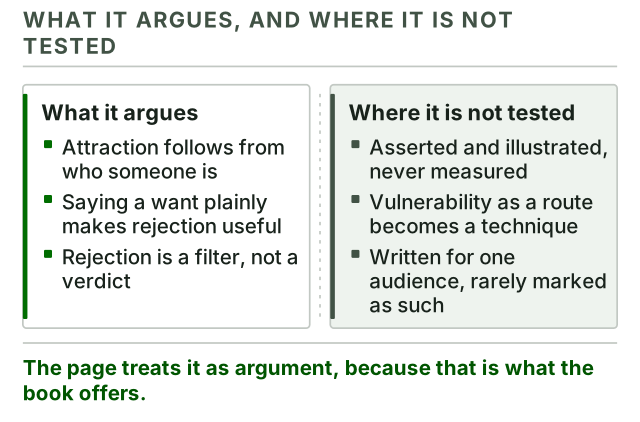
| Attraction is a by-product of who a person actually is, not of what he performs. | Manson's argument from his own time inside the dating-advice industry, written as a rejection of it. | Readers who have tried scripted approaches and found them exhausting to maintain. | The claim is asserted and illustrated, never tested; nothing in the book rests on published research. |
| Vulnerability is the mechanism: stating a want openly is what makes rejection informative. | Reasoning by argument and anecdote, in the register of a persuasive essay rather than a study. | People whose dating life stalls because they never say plainly what they are looking for. | Taught as a route to a result, vulnerability becomes another technique — the exact move the book set out to retire. |
| Neediness — outsourcing your self-worth to someone else's response — is the real subject of dating advice. | Manson's reframing of the genre's own vocabulary, argued in the chapters on neediness and non-neediness. | Readers who recognise that the outcome of a single evening decides how they feel about themselves. | The word carries a lot of weight for a term with no agreed definition outside the book. |
| Rejection is a filter that saves time, not a verdict on the person rejected. | Argued from the book's premise: if you are not performing, a no is information about fit. | Readers stuck in avoidance, who never risk a clear approach or a clear question. | Easy to write, hard to feel; the book offers little for the reader for whom rejection is genuinely destabilising. |
| Lifestyle, honesty and self-respect beat tactics over any long stretch of time. | The book's closing argument, framed as an alternative to the seduction material it grew out of. | Readers who want a direction rather than a routine to memorise. | The advice is written for one audience — heterosexual men — and the book rarely acknowledges the limits of that frame. |
Models by Mark Manson is a dating book, subtitled Attract Women Through Honesty, whose central move is to argue that dating advice built on technique defeats itself. The claim is that a routine works by concealing the person running it, and that anything built on concealment has to be maintained forever.
It matters where the book came from. Manson wrote it after working inside the dating-advice industry, and the book keeps that world’s vocabulary while attacking its premise. That gives it an unusual position on the shelf: it is the genre’s internal criticism, published as a self-help title. It is also why readers arrive expecting one book and meet another.
This page does what we do with every title here: what it claims, what the claim rests on, who it helps, and where the criticism is fair. Checked: 2026-09.
What is Models by Mark Manson about?
It is about replacing tactics with legibility. Manson’s argument is that a man improves his dating life by becoming someone a specific kind of person would want, and then making that plainly visible, rather than by learning what to say in the opening minutes. The book spends its length making the case that the second approach cannot scale into a life.
The structure follows that argument. Early chapters take apart the promise of technique. The middle sets out what Manson calls neediness — treating someone else’s reaction as the verdict on your worth — and its opposite. The later chapters deal with the practical consequences: where to meet people, how to be direct, and what to do with the answer once you get it.
Its register is worth naming in advance. This is a persuasive essay, confidently written, with examples drawn from the author’s experience and observation. It is not a summary of research, does not claim to be, and argues from experience rather than from sources. The confidence is stylistic, and readers absorb tone before they absorb caveats.
The book’s own page, which the author publishes himself, confirms the title, the subtitle and that it appeared through his own imprint rather than a trade publisher. That is the only outside source we use for its facts, and our reasons are on the sources page: see the book’s official page.
One more framing point. The book’s subject is not women. The chapters are about the reader: what he does with his time, what he is willing to say, and how he behaves when the answer is no. Readers hoping for an account of what women want will find the question refused.
What is the uncomfortable truth the book builds on?
The uncomfortable truth is that no method removes rejection, and that the search for one is the problem being described. If attraction depends on who someone is rather than on what he performs, then there is no shortcut available, and the work is slow, personal and impossible to outsource to a script.
Manson’s move is to take the discomfort as the starting point rather than the obstacle. Being open about what you want guarantees clear refusals — and a clear refusal, in his framing, is worth more than an ambiguous evening, because it ends the guessing early. The cost is that you have to feel it.
- For example, the book’s preferred version of an approach is a plain statement of interest rather than an opening line: you say why you came over, and the answer arrives immediately. The point is not that this works better as a trick. It is that it cannot be run by someone pretending to be someone else.
- For instance, on the choice between texting cleverly and texting plainly, the argument runs the same way: an ambiguous message buys more hope and no information. A direct one buys an answer.
- Consider the way the book treats a man’s interests and work. If attraction is a by-product of a life, then the honest advice is unglamorous — build something you would keep doing whether or not anyone was watching. That is a slower instruction than any dating tactic and the book is candid about it.
The word doing the heaviest lifting is neediness. Manson uses it to mean self-worth handed over to somebody else’s reaction, and his practical advice is aimed at that transfer rather than at behaviour. The reframe is genuinely useful. It is also a private definition, argued rather than established, and the book leans on it as if it were settled.
There is a limit that the argument does not address. Being told to be honest is only useful to a reader who can tolerate the reply. For someone whose difficulty is not strategy but the sheer weight of a refusal, the book supplies motivation and no method — and it does not acknowledge that gap.
Who does the book help?
It helps a reader who has tried scripted dating advice, found it exhausting, and cannot say what is wrong with it. Manson gives him the argument: the script works by hiding him, and hiding is unsustainable. That recognition is the strongest thing the book does, and it reads as relief rather than instruction.
It also helps the reader who avoids the question entirely — the one who never states interest, never asks directly, and reads ambiguity as kindness. The book’s insistence on plain approaches is aimed squarely at him, and it is the right instruction, however uncomfortable.
- Imagine someone who has worked through the forums, memorised openers, and comes home from an evening out feeling like he gave a performance. Those chapters answer him plainly, without handing him another routine to run.
Who it fits badly deserves the same space. Readers who are not heterosexual men are reading a book written for someone else; the argument survives translation, but the examples do not. Readers who want evidence will find none. And readers already in a relationship will find little here — this is a book about meeting people, not about staying with one.
There is a practical way to read it. Take the case against technique seriously, treat the specific advice as one person’s experience, and check any sentence that begins with a claim about how attraction works. The general argument is stronger than any particular tip in it.
What are the criticisms of Models?
The recurring objections are the default male frame, vulnerability repackaged as a tactic, and the absence of any evidence base. None of them retire the book; each changes how it should be read. We attach no research finding to this section that we have not verified, and no critic we cannot name.
The default reader is narrow and rarely acknowledged. The book is written for heterosexual men dating women, and it treats that as the shape of dating rather than one version of it. The objection comes from the text itself: the reasoning about honesty and self-worth is general, while every example, pronoun and scenario is specific. A reader outside the frame has to do the translation work the author did not.
Vulnerability presented as a route to a result becomes another technique. This is the sharpest criticism, and it is internal to the argument. If openness is recommended because it attracts people, then a reader can perform openness for that reason — which is exactly the concealment the book set out to attack. Manson argues against instrumental behaviour in a book that is, structurally, instrumental advice.
There is no evidence base, and the tone does not signal that. The claims about what drives attraction are argued and illustrated, never tested. The book carries no citations and reads with the confidence of an account of how things are. That combination is a failure mode of the self-help genre, and being better argued than its neighbours does not exempt this title from it.
It inherits the vocabulary of the world it rejects. Terms carried over from the seduction material — and the framing of dating as a skill problem — sit awkwardly against an argument that the skill framing is the error. Readers who arrive from that world can take the language and leave the thesis, which is a criticism of the book’s effects rather than its pages.
The self-worth advice is thin where it needs to be thickest. Telling a reader to stop routing his sense of himself through other people’s reactions is correct and enormous. The book names the task, motivates it well, and then moves on. A reader who cannot do it on encouragement alone is left where he started.
Who it still serves, criticism included: the reader who has tried the scripted version of dating and needs an argument for abandoning it. Take the case against technique, leave the certainty about mechanisms, and notice when honesty starts being performed.
What this page does not do
A dating book with this history needs its limits stated before the summary can be trusted.
- This is not a purchase page
- Nothing here routes a reader towards buying anything. The outbound link goes to the author's page for the title because that is where its facts can be checked, not because a click on it is worth something to us.
- We print no sales or rating figures
- Copies sold, review counts and star averages are marketing copy wherever they appear, including on an author's own site, so they do not appear on this page.
- We do not teach technique
- This is a description of a book, not a set of instructions. Where Manson advises, we report that he advises, and we reproduce no routines from any book in this genre.
- We quote nothing we cannot source
- Every description of the argument above is our own paraphrase. We do not reproduce passages, and we do not put sentences in an author's mouth to make a point land.
- We write nothing about the author's private life
- His finances, his marriage and his other titles are not evidence about this book, and searches asking about them get no answer from us.
What should you read alongside Models?
Read it next to a book that supplies what it leaves out: an account of the same reader’s habits inside a relationship, or a wider shelf with the criticism attached. Models is strongest as an argument against technique and weakest as a programme, so useful companions are the ones that carry structure.
| Book | What it adds | Who it suits |
|---|---|---|
| No More Mr Nice Guy | The same audience, examined inside relationships rather than before them | Readers whose difficulty is saying what they want to someone already in their life |
| Our reading guide for men | A wider shelf, each title with its criticism attached | Readers deciding what to pick up after this one |
| Our guide to books about dating | The neighbouring titles on meeting people, sorted by what they actually claim | Readers who want to compare approaches before choosing |
No More Mr Nice Guy is the closest neighbour and the sharper contrast: Glover writes about the same reader once he is in a relationship, with far more certainty about causes than Manson allows himself. Our reading guide for men sets both against the rest of that shelf, and our guide to books about dating covers the titles that share this one’s subject without sharing its argument.
A pairing worth naming as a warning rather than a recommendation: this book alongside the online material it grew out of. That material supplies the certainty and the routines the text spends its length rejecting, and reading them together is how a reader keeps the routines and loses the point.
For the wider set of titles, the main reading guide places this one among the rest of the relationship canon. Our sources page explains why an author’s own site is acceptable for a book’s own facts and unacceptable for anything else.
The short version: take the argument against technique, discount the confidence about mechanisms, and read it as one man’s essay rather than a description of how attraction works.