
| What the book claims | What that claim rests on | Who it tends to fit | Where it is challenged |
|---|---|---|---|
| A boundary is a stated limit, not a private decision about what you will tolerate. | The author's clinical practice as a licensed therapist, written up for general readers. | Readers who have quietly decided on limits for years and never said one out loud. | Saying a limit is only the first move, and the book gives less room to what happens after. |
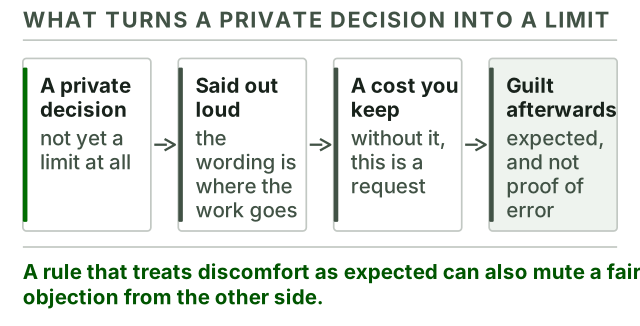
| A limit without a consequence you intend to keep is a request. | Case description from the author's practice, presented as observation rather than research. | People whose stated limits are ignored because nothing has ever followed from them. | Naming a consequence in a therapy room is one thing; carrying it out inside a family is another. |
| The difficulty sits in the wording, so the wording is where the work goes. | The book's own structure: it devotes its length to sentences, scripts and rehearsals. | Readers who understand the concept perfectly and still cannot open their mouth. | Scripts travel badly across families, workplaces and cultures with different norms. |
| Guilt after stating a limit is expected and is not evidence that the limit was wrong. | The author's account of how clients react when they first state a limit out loud. | People who state a limit, feel terrible, and take it back soon afterwards. | A rule that treats discomfort as expected can also mute a fair objection from the other side. |
| The same framework applies at work, with family and online, not only with a partner. | The book's own scope, which moves through settings in turn. | Readers whose hardest relationships are not romantic ones. | Breadth costs depth: settings with unequal power get the same tools as settings without it. |
The case for having limits is the usual subject of a book like this. This one is about what to say. Set Boundaries, Find Peace is a self-help book by Nedra Glover Tawwab that defines a boundary as a limit stated out loud and backed by a consequence the person is willing to keep, and then spends its length on the wording. The set boundaries find peace book is written for someone who has the concept already. They know what they want to stop agreeing to. They do not know the sentence.
That distinction explains the book’s reach and its limits alike. What follows describes the method, the reader it was built for, and the places where the criticism lands. Nobody pays us to recommend a title, and what we consulted is documented in our list of sources. Checked: 2026-09.
What is the book Set Boundaries, Find Peace about?
It is about the gap between deciding on a limit and saying one. Tawwab’s argument is that the reader already knows where the limits are, and that the unspoken version does no work at all. A limit that lives in your head reads to everyone else as consent, which is why the same arrangement keeps returning with the same people in it.
The book therefore treats stating a limit as the skill, and treats the discomfort around stating one as the obstacle to be worked through rather than removed. It moves through settings in turn: partners, parents and adult children, friendships, colleagues, and the various ways people reach you when you are not at work. The framework stays the same in each. What changes is the wording and what the reader can realistically enforce.
The author writes from clinical practice. The publisher’s page, held by Penguin Random House, confirms the title and subtitle and describes her as a licensed therapist and the founder of a counselling practice in Charlotte, North Carolina. That is the extent of what we claim on her behalf, because it is the extent of what a verified record supports.
How does the book define a boundary?
A boundary, in this book, is a stated limit plus a consequence the person intends to keep. Each part is load-bearing. Without the statement it is a private grievance. Without the consequence it is a request, and requests get renegotiated by whoever has more stamina for the argument.
The consequence is not framed as punishment, and that is the distinction the whole idea rests on. It is a description of what you will do, not of what the other person must do. That is the part Tawwab keeps returning to, because it is the part that is inside the reader’s control and the part that does not require agreement from anyone else.
- For example, a reader who is telephoned repeatedly about a relative’s finances states that they will not discuss money on the phone, and then ends the call when the subject arrives. The statement names the limit. Ending the call is the consequence, and it is carried out rather than threatened.
- For instance, a colleague sends work messages late at night. The book’s move is to say plainly which hours you answer in, and then to leave the message until those hours, rather than replying in the middle of the night while resenting it.
- Consider the friend who arrives long after the arranged time, and does so again and again. The wording Tawwab points toward is short and unaccusing: this is when I am there, this is how long I can stay. The consequence is that the reader leaves at the stated time, without a speech about it.
Practical rules run underneath those examples. Say it early rather than at the point of exhaustion, because a limit stated in anger arrives as an accusation. Say it plainly, without a case for the prosecution attached, and without going back to restate it. And expect to feel bad afterwards, which the book treats as a normal by-product of a new position rather than as evidence that the position was wrong.
Who does Set Boundaries, Find Peace help?
It helps the reader who has the analysis and not the language. If you can describe your situation accurately, know exactly which arrangement you want changed, and still go silent when the moment arrives, this is the book built for that gap. It hands over sentences, which is rarer on this shelf than it should be.
It suits readers whose hardest relationships are not romantic. The canon is written for couples. This book gives the same weight to a parent, a sibling, a manager and a group chat, which makes it usable by someone who is not in a relationship at all and is exhausted anyway.
It suits people acting alone. Nothing here requires the other person to read anything, agree to anything, or attend a session. The unit of change is what the reader says and what the reader then does, which is why the book travels well to situations where no one else is willing to sit down and discuss the problem.
There are readers this serves poorly. Anyone whose housing, income, immigration status or safety depends on the other person is being handed tools that assume a room where a limit can be stated without danger. Anyone who wants an account of why they keep agreeing in the first place will find the history thin here, because the book is pointed at what to do now.
What are the criticisms of Set Boundaries, Find Peace?
The strongest criticism is about how the language gets used. Therapeutic vocabulary now circulates outside therapy, and clinicians and critics have argued in the popular press that “boundary” gets deployed to close a conversation rather than to structure one. The book is not the source of that habit, and it does distinguish a limit from a refusal to engage. But it supplies the vocabulary to readers who will meet it without a therapist in the room, and the failure mode is predictable: a limit announced as a verdict, with no route back into the discussion.
Another criticism concerns unequal power, and it is the one we would weigh most heavily. The method assumes a relationship in which a stated limit will be heard and a consequence can be carried out. In relationships involving financial dependence, caregiving obligations, insecure work or the threat of harm, those assumptions fail, and the advice to hold your position can put a reader in a worse spot than the one they started in. The book acknowledges harder cases and points toward professional help. The scripts are the part that carries, and the caveat is easy to read past.
A further criticism is structural: it repeats. The framework arrives early and the later chapters apply it setting by setting, so the reader who has understood the idea quickly spends the rest recognising it in new furniture. Some readers find that reinforcement useful. Others find they could have stopped early and lost nothing.
A last objection needs stating carefully. Guilt after stating a limit is described as expected, which is accurate and is genuinely useful to someone who folds quickly. Read loosely, though, the same rule can turn every reaction from the other side into predicted noise, including the reactions that contain a fair point. That is not what Tawwab proposes, but the text leaves room for it.
In its defence, the book was not offered as science, and measuring it that way misses the job it took on. That job was to give ordinary readers usable language for a conversation they have been avoiding, in a register that is calm rather than scolding, across the settings where the problem actually shows up, and it delivers. Take the wording, treat the harder cases as genuinely harder, and where money, housing or safety is involved, talk to someone qualified before you act.
What to read alongside Set Boundaries, Find Peace?
The missing element here is history, so choose a companion that explains how the agreeing began. Order in the table means sequence, not standing, and this site issues no scores.
| Read alongside | What it adds | What it will not do |
|---|---|---|
| Codependent No More | An account of why the agreeing began, from the recovery-literature tradition | Give you a sentence to say on Monday |
| The Dance of Anger | The repeating pattern a limit sits inside, and what happens when you change position | Provide scripts or settings beyond close relationships |
| Books about codependency | The wider shelf on the same pattern, title by title | Name a winner |
Which companion you want depends on the gap this book left behind. If the missing part is why the pattern of agreeing started at all, our reading of Codependent No More covers the book that answers that question, and the books about codependency collection sets it beside its alternatives. If the missing part is the loop the limit sits inside, and what the other person does when you change position, The Dance of Anger is the closer match. For the entire shelf handled in one manner, begin at the full canon guide.
Where this page stops
How we read Tawwab, and the lines this site does not cross.
- No boundary scripts from us
- We describe how the book words a limit. We do not issue scripts in our own voice, and we give no advice about your family, your workplace or your relationship.
- Not the other Boundaries
- Cloud and Townsend wrote a different book with a similar subject. It has no page here, and we do not blend their argument into ours.
- No buying guidance
- You will find no shop buttons, no price comparisons, no sales claims and no aggregated scores here. That choice is explained on the editorial policy page.
- No lines put in the author's mouth
- Tawwab's wording is summarised here, never reproduced. Anything inside quotation marks on this site was read in the book, at a chapter someone can name.
- Credentials only from the record
- Penguin Random House describes Tawwab as a licensed therapist, and our description of her stops exactly where that page does.
- No safety advice
- Where a relationship involves dependence, control or the threat of harm, a book is not the tool and neither is this page. That belongs with a professional.
Where this page fits: it is filed in the relationship-book canon guide, which gives every title a page of its own rather than a place in a countdown. Checked: 2026-09.