| What the book claims | What that claim rests on | Who it tends to fit | Where it is challenged |
|---|---|---|---|
| Men and women have systematically different emotional needs and communication habits, and conflict between them is a translation failure. | The author's counselling and seminar practice, written up as an allegory. The book presents no studies of its own. | Readers who want a non-blaming story for a partner's behaviour that keeps surprising them. | Linguists and psychologists argue that the variation inside each group overlaps with the variation in the other, so a category is the wrong tool. |
| Men withdraw to recover and return on their own; women recover by talking. | Described as a pattern the author saw repeatedly with couples in his practice. | Couples whose fights escalate because one partner pursues while the other leaves the room. | The withdraw-and-pursue pattern is well described elsewhere without being assigned to a sex, and couples run it the other way round too. |
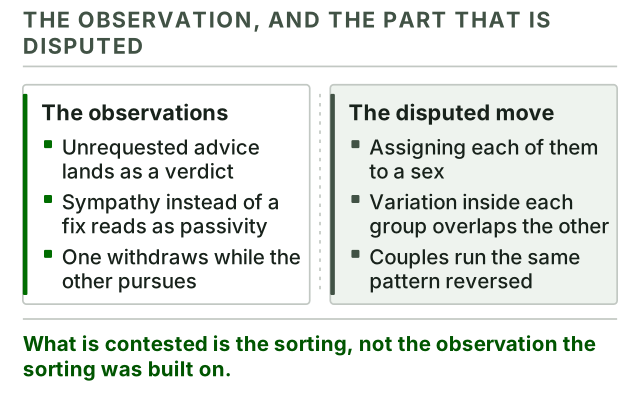
| Unrequested advice reads as a verdict, and sympathy offered instead of a solution reads as passivity. | Practice observation, presented as a rule of the two planets. | Anyone whose helpfulness keeps landing as criticism. | The observation is useful and the sorting of it by sex is the disputed part, not the observation itself. |
| Naming the difference lowers the blame in a fight. | The allegory itself: a partner is foreign rather than uncaring. | Couples stuck in a motive argument about who is the colder person. | Critics argue the same framing supplies a permanent excuse, because a planet of origin is not something anyone is expected to change. |
Men Are from Mars, Women Are from Venus is a popular-psychology book by John Gray that explains couple conflict as a difference of dialect: men and women, it argues, want different things when they are under strain, and read each other’s ordinary behaviour through the wrong manual. The book is a translation guide written from the author’s counselling and seminar practice.
This page does what we do with every book on this site: state what it claims, name what the claim rests on, say who it still fits, and set out where it is disputed. The disputed part carries the weight here, which is why the criticism runs at length below rather than as a footnote at the end. Checked: 2026-09.
What is the book Men Are from Mars, Women Are from Venus about?
It is about the idea that conflict between partners is a misreading rather than a failure of love. The book sorts behaviour into two sets, labels them Martian and Venusian, and gives each partner instructions for interpreting the other: what withdrawal means, what complaining means, what help means, and what each side actually wants when it is upset.
The mechanics are carried by images that outlast the argument around them. Men are described as retreating into a cave when stressed, and as returning of their own accord if left alone. Male closeness is described as elastic, pulling away and springing back. Female self-esteem is described as running in waves that rise and fall without an external cause. Men are cast as compulsive problem-solvers, women as compulsive improvers of other people.
Underneath the labels sits one claim that is easier to defend than the planets: partners offer the kind of support they would want themselves, and then feel unappreciated when it is not received as help. A partner who wants solutions offers solutions. A partner who wants company offers company. Both are giving generously and neither is landing.
The structure of the advice follows from that. It is about timing and about what not to say: how to make a request small enough to be answerable, how to complain about a thing rather than a person, how to let a partner finish being upset without treating the upset as an instruction. Stripped of the planets, it is ordinary courtesy written down for people who stopped extending it to each other some time ago.
The book’s remedy is procedural rather than emotional. It tells you what to do with a partner who has gone quiet, how to ask for something so that it does not arrive as an accusation, and how to receive an upset that is not addressed at you. Read as a manual of restraint, it is gentler than its reputation. Read as an account of what men and women are, it takes on a much heavier burden of proof, and that is the burden it does not carry.
Why is it said that men are from Mars and women are from Venus?
Because the book opens with an allegory, and the allegory outlived the book. In it, the inhabitants of two planets meet, fall in love, move to Earth together, and lose the memory that they ever came from different worlds. Everything that follows is presented as the consequence of that amnesia: two peoples treating each other’s foreignness as bad character.
The two names do quiet work of their own. Mars and Venus carry the old associations of the war god and the love goddess, so the reader arrives already knowing which planet is supposed to mean what, and the book never has to argue for it. That is efficiency, and it is also the problem — a metaphor that persuades before it explains is difficult to disagree with in the moment.
The device also changes what a couple is arguing about, which is where its appeal lies. A partner who has stopped talking is no longer cold or punishing; he is foreign. A partner who wants to go over the same worry again is no longer dramatic; she is running a different recovery process. That reframing takes the temperature down fast, and for a couple locked in an argument about motives it can be the first thing that does.
The allegory also assumes something the rest of the book never revisits. The two peoples in it are internally uniform: every Martian wants the cave, every Venusian wants the conversation. Real households are not like that, and a reader who does not recognise themselves in their assigned planet is left to conclude that something is wrong with them rather than with the sorting. Someone who came to the book hoping to be explained can leave feeling mislabelled instead.
The cost arrives later. A dialect is something a person can learn. A planet of origin is not. Once a partner’s behaviour is filed under where they are from, the natural conclusion is that nothing about it is negotiable, and the same metaphor that lowered the blame quietly removes the expectation of change. That is the trade the book makes, and it is worth seeing before you take it.
Is the book scientifically accurate?
No, not as a description of how men and women actually differ. The book contains no research of its own, cites no programme of study behind its categories, and rests on what the author reports seeing in his practice. It describes two separate populations where researchers who measure communication and emotion describe two overlapping ones.
That distinction is the whole argument, so we will state it plainly. Saying that a group average differs is not the same as saying the groups are different kinds of people. The case the book’s critics make is that where psychological traits have been measured, the range inside each group is wide and the ranges overlap, so knowing someone’s sex does not tell you where a particular person will fall. The psychologist Janet Shibley Hyde put that argument forward as the gender similarities hypothesis, and it is the version psychologists arguing against the book reach for, drawn from meta-analytic work rather than from clinical impression.
The language claims have drawn the sharpest response, because they are the ones that can be tested. The linguist Deborah Cameron devoted a book, The Myth of Mars and Venus, to examining the popular claim that men and women speak different languages, and her conclusion is that the evidence for a categorical difference does not support the confidence with which it is repeated. Cordelia Fine’s Delusions of Gender makes the neighbouring argument about how thin findings become popular certainties once they are attached to a good story.
There is a fairness point owed to the book here. Gray does not present himself as reporting experiments, and criticising a self-help book for failing a standard it never claimed is a cheap move. The trouble is that readers do not use it that way. The two-planet framing is repeated as fact, in workplaces and in couple counselling rooms, by people who have never opened the book, and at that point the question of what it rests on stops being academic.
It also matters where the framing travels. Two-planet language has long since left the book and turned up in management training, in dating advice and in the way relatives explain a marriage to each other, with no memory of a source. A metaphor that circulates without its argument attached is hard to check, and a reader who wants to disagree with it has to argue against something that now presents itself as common knowledge rather than as one author’s claim.
The last objection is about consequences rather than evidence. Critics argue that categorical framing is self-confirming: a man who has learned that Martians need caves has an explanation ready for every withdrawal, and a woman who has learned that Venusians need to talk has one for every pursuit. Each behaviour becomes a species trait rather than a choice, and the couple stops asking the more useful question, which is what this particular person needs in this particular week.
None of that makes the book useless. It is still a plain popular statement of a real idea — that partners systematically misread each other’s attempts to help — and for a reader who has never considered that possibility, it is a working door into the subject. The section below is our attempt to say exactly which parts survive.
What this page does not do
A book page can be honest or it can be a sales counter. We picked the first one.
- We do not sell the book
- No shop links, no affiliate links, no prices, no editions to compare. If you want it, any library or bookshop has it, and we earn nothing either way.
- We do not print sales figures or ratings
- Copies sold, chart positions and star averages are publisher marketing or crowd noise. Neither tells you whether a book is right, so neither appears here.
- We do not quote passages we cannot check
- Everything above is our paraphrase. We would rather describe an argument in our own words than attach quotation marks to a sentence from memory.
- We do not diagnose your relationship
- A book describes patterns it saw in other households. It cannot see yours, and neither can we from here.
What we do stand behind
- Criticism with a name attached
- Where we say a claim is disputed, we say who disputes it and on what grounds, so you can go and read the other side yourself.
- Credentials from publishers only
- Author qualifications come from the publisher's page or a peer-reviewed record. Where we cannot verify one, we describe the role and stop.
- A visible record
- Every external source we rely on is listed on our sources page, with the date we last checked it.
Is any of it still useful?
Yes, in a narrower form than the book intends: the interpersonal patterns it names are real and recognisable, and they hold once you strip the sex label off them. What survives is the description of a mechanism. What does not survive is the claim that the mechanism runs one way in men and the other way in women.
- For example, the cave describes something couples argue about constantly: one partner needs a gap between an upsetting event and the conversation about it, and the other needs the conversation in order to settle at all. Both descriptions are accurate about somebody. Neither is accurate about a sex. The partner who leaves the room is not reliably the man.
- For instance, the advice about unrequested solutions is worth keeping in full. A partner describing a bad afternoon at work and receiving a plan for it has been told, without anyone intending it, that their handling of the afternoon was the problem. The book’s remedy — ask before fixing — costs nothing and works regardless of who is speaking.
- Consider the recovery-pace observation, which the book buries under the tides and waves. Partners can be equally upset by the same argument and still need different amounts of time before they are able to be generous again. Couples who have never named that difference read the slower partner as sulking and the faster one as dismissive.
- Imagine a couple where both partners are, by the book’s own map, on the wrong planet: he wants to talk the argument through tonight and she needs the night to pass first. Everything useful in the book still applies to them, and the labels do not. That is the clearest test of which parts are doing the work.
There is a further point about how the advice is best used. The instructions land differently depending on who is holding them. Read as descriptions of your own partner, they become a way of predicting someone and being disappointed when the prediction fails. Read as descriptions of requests you might make about yourself — I need some time before we talk, I want company rather than a plan — they turn into something a couple can actually negotiate, and the planets drop away without anything being lost.
There is also a practical case for the book as a conversation starter, and it is the reason it still turns up in couple counselling rooms. It is short, it is unintimidating, and it gives two people a vocabulary for a fight they have been having wordlessly. A reader can need a first framework more than an accurate one, and the frameworks that come next are easier to reach once a couple has agreed that the other person’s behaviour has a logic at all.
Our own position is that the book is best read as a period piece with durable observations inside it, and that anything it tells you about men in general or women in general should be treated as the author’s impression rather than as fact. If you read it that way, it can still be worth an evening.
What to read instead?
Three routes, depending on what you came for: Nonviolent Communication for exact wording in a hard conversation, Hold Me Tight for the pattern behind a fight that keeps repeating, and our communication shortlist if you would rather compare before committing an evening. Each delivers the decoding manual the planets only gestured at.
| Instead of | It fits a reader who | The caveat we would state first |
|---|---|---|
| Nonviolent Communication | wants concrete sentences for the moment a conversation turns | The method is simple to describe and demanding to run; early attempts sound stilted, and some readers find the scripted register cold |
| Hold Me Tight | keeps having one fight in different costumes and wants to know why | It reads every recurring argument through a single attachment frame, which is a strong lens and still one lens |
| Our shortlist of communication books | wants to compare the options before committing an evening | A shortlist is a starting point, not a verdict on which book suits your household |
For the first route, our page on Nonviolent Communication sets out what Rosenberg’s method actually asks of a reader, including the parts that feel awkward. For the second, we cover Hold Me Tight: a popular relationship book whose method carries a research literature with it. If you would rather see the field before choosing, our collection of books about communication in relationships lays them out side by side, and the wider reader’s guide to relationship books is the place to start from scratch.
One more page is worth a detour here, because it is the same argument in a newer costume. The love-languages framework also sorts people into types and promises that matching the types solves the problem, and it has since been tested. What happened when relationship scientists looked at it is on our page asking whether love languages are real, and reading the two critiques together tells you more about popular relationship frameworks than either does alone.
What we relied on
The book itself is Men Are from Mars, Women Are from Venus: A Practical Guide for Improving Communication and Getting What You Want in Your Relationships, published by HarperCollins; the edition details and the author biography we drew on are on the publisher’s page for the book. The critical works named above are cited by title and author so you can find them without our help. Which records this site will link, and when each one was last opened, is set out on our sources page. Checked: 2026-09.