
| What the book claims | What that claim rests on | Who it tends to fit | Where it is challenged |
|---|---|---|---|
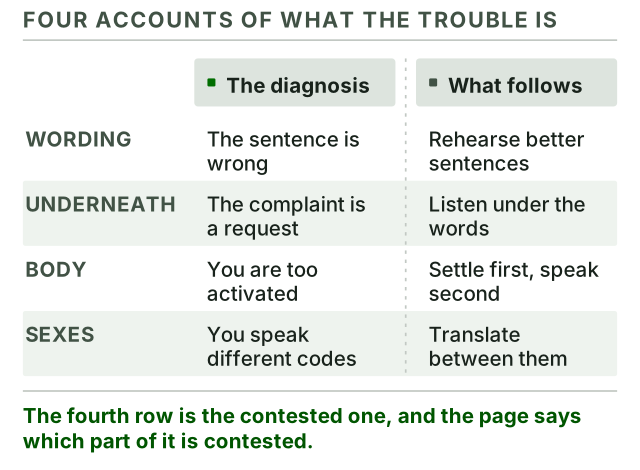
| Communication trouble is a wording problem, and better sentences produce better outcomes. | Method books that set out a repeatable sequence of sentences, presented by their authors as a format any reader can follow. | Readers whose arguments go wrong in the first sentence, before any subject has been discussed. | A rehearsed sentence can carry the same demand it replaced, and practised phrasing is easy to use as a way of correcting how a partner speaks. |
| A complaint is a request for reassurance in disguise, so the job is to hear underneath it. | The attachment tradition applied to adult partners, and the clinical literature attached to emotionally focused work. | Couples who repeat one argument in different costumes and cannot name what it is really about. | Some complaints are exactly what they say they are, and reading every one as an emotional signal can bury a practical grievance about workload, money or time. |
| What matters is not the words but the physical state you are in while saying them. | Observational research on couples in conflict, where arousal during an argument was measured rather than inferred. | Partners who know the right technique, use it calmly, and lose it entirely once the argument heats up. | Popular books turn this into a rule about breaks and timers, which is a long way from what the underlying studies examined. |
| Men and women communicate in systematically different ways, and translation is the answer. | The author's own account of the patterns he describes seeing between men and women, not an independent evidence base. | Readers who want a memorable metaphor for why two people talk past each other. | The premise treats a stereotype as an explanation, and it has aged worse than any other frame on this shelf. |
A book about communication in relationships is a popular-psychology book that treats how two partners talk as the thing to work on, and offers a named method for doing it. That is the whole category, and it is broader than it looks: books about communication in relationships range from sentence-level scripts to accounts of what happens in the body during an argument, and those are not the same product.
A reader arrives at this shelf with one sentence in mind — we can’t talk about anything — and leaves with whichever method the list they happened to read put first. That is how a communication book ends up abandoned partway. The method was fine. It answered a question the reader did not have.
What is a communication book actually teaching?
Each of these books teaches one core thing, and the differences matter more than the covers suggest: a format for saying hard things, a way of hearing what sits under a complaint, a set of moves for repairing a fight afterwards, or a vocabulary for naming what you want. Everything else in the genre is packaging around those.
Format books hand you a sequence of sentences. Rosenberg’s Nonviolent Communication is the clearest example: describe what happened without evaluating it, name the feeling, connect it to a need, end with a request the other person can answer. The promise is that the wording carries the outcome, and the practice is much harder than the idea.
Books about what sits underneath argue that the wording is a symptom. Sue Johnson’s Hold Me Tight treats a repeating argument as a protest about disconnection, which means the useful move is not a better sentence but hearing what the raised voice was asking for. That book comes out of a clinical method rather than out of a writing career, and it reads that way — slower, more demanding, with exercises.
Repair books are about after. They accept that the fight will happen and work on what the following hour looks like: how the subject gets reopened, who moves first, what an apology has to contain to be accepted. Gottman’s writing for couples sits mostly here, and we cover that corpus separately on which Gottman book to read first.
Vocabulary books give you nouns. Take The 5 Love Languages: it teaches nothing about how to argue, and instead hands a couple shared words for what each of them notices going missing. That is a real service, and it gets mistaken for a communication method, which is where the disappointment comes from — and the categories themselves have been questioned, which we set out on are love languages real.
One boundary before the shelf itself. A book about how a couple talks is not a book about what to do when one partner is frightened of the other, and none of the titles below are written for that situation. Where safety is the question, the answer is a professional or a service, not a paperback.
Which communication book should you read?
Read the row that matches your actual complaint, not the one that leads a recommendation list. The columns here are built for this shelf specifically: the move a book teaches, the argument that move is designed for, and the thing it asks of you that the cover does not mention. It is not a ranking, and the order carries no judgement.
| Book | What it teaches | Best for | The catch |
|---|---|---|---|
| Nonviolent Communication (Rosenberg) | A sentence format: observation, feeling, need, request | Arguments that go wrong in the opening line | The phrasing sounds conspicuous, and can be used to police how a partner speaks |
| Hold Me Tight (Johnson) | Hearing the bid for reassurance under a complaint | One argument that repeats in different costumes | It is a therapy course in book form and assumes two willing readers |
| The Dance of Anger (Lerner) | What to do with anger before it becomes a conversation | Readers who go quiet, then resentful, then explosive | Written for women, and about the reader's own pattern rather than the couple's |
| The 5 Love Languages (Chapman) | Shared vocabulary for what each partner misses | Couples with no words for a vague sense of being unnoticed | Not a communication method, and the categories overlap more than the book allows |
| Getting the Love You Want (Hendrix) | A structured dialogue with fixed turns and mirroring | Couples who cannot let each other finish a sentence | The dialogue is stiff by design, and the theory behind it is the author's own |
| Men Are from Mars, Women Are from Venus (Gray) | A metaphor for talking past each other | Readers who want the historical reference point | Builds a whole method on a gender stereotype, and has aged badly |
A caveat about sourcing applies to some of those rows, and we would rather say it than hide it. For Hold Me Tight, the author’s role is checkable on the publisher’s page for Hold Me Tight, where Sue Johnson is described as the developer of emotionally focused therapy. For Nonviolent Communication and Getting the Love You Want, we have not verified a publisher record we are willing to cite, so we name the books and describe what they argue, and we make no claim about their authors’ qualifications.
If a shelf is more than you wanted, the guide to relationship books places this category against the rest of the canon. Before buying anything from the table, read Nonviolent Communication and Hold Me Tight — the format book and the underneath book, which between them cover what the others recombine.
Which of these methods survives a real argument?
The methods that survive are the ones that still work when you are upset, which is a hard test for a script. A format you can produce calmly on a Sunday afternoon is a different skill from a format you can produce while your heart is hammering, and the books rarely distinguish between the two.
There is research behind that distinction rather than just intuition. Levenson and Gottman on physiological arousal during conflict recorded what happens in the body while couples argue, and the finding that matters for this shelf is qualitative and uncontroversial: the physical state a partner is in during a disagreement is not incidental to how the disagreement goes. A method that ignores that is teaching you sentences for a person who is not there.
- For example, a couple who have both read a format book can manage the first exchange perfectly and then abandon it entirely at the point where one of them feels accused. The script did not fail; it was never rehearsed under the conditions in which it was needed.
- For instance, a reader who takes only the vocabulary from Hold Me Tight — the idea that the argument is a protest — finds that it changes what they hear in the opening moments of a fight, which is earlier than any technique gets a chance to be applied.
- Consider the partner who goes silent rather than loud. A format book does not reach them, because the problem is not the wording of a sentence that never gets said. Lerner’s The Dance of Anger works on that pattern directly, which is why it belongs on a communication shelf despite not being a communication book.
What survives, in our reading, is small and portable: a sentence you can say when you notice you have stopped listening, an agreement about what happens when either of you needs to stop, and a shared word for the pattern you both keep falling into. Books that hand you a portable piece get used. Books that hand you a procedure get admired and shelved.
Which communication books keep getting recommended?
Nonviolent Communication and Hold Me Tight are the two names a reader of this genre meets first, and they hold that position because they occupy the ends of it: a script for the sentence, and an account of what the sentence was standing in for. That is a remark about the shape of the shelf, not a count of anything. No sales figures, chart positions or review scores appear here, and the standard a number has to meet before we would print one is set out on our sources page.
Recommendation is a weak signal in this genre for a specific reason: the lists are written by people summarising other lists. A book that got onto lists keeps getting onto lists, because being on lists is what gets you onto lists. That mechanism explains why Men Are from Mars, Women Are from Venus still appears on communication round-ups long after its central premise stopped holding up, and we treat that book as a historical reference point rather than a current recommendation.
The better question is which book gets finished, and that turns on shape rather than quality. A short book with a single idea can be carried to the end on a commute; a course-shaped book stops being a book at the point where it asks for a two-person exercise. If you know you will not do exercises, that is worth admitting before you choose, not after.
What this page does not do
This is a shelf of methods, and the honest limits of a reading guide matter more here than usual.
- We do not give communication advice
- We describe what each book proposes and where it has been disputed. We do not add our own protocol for how you should talk to your partner, because we are not in the room and a reading guide is not counselling.
- We do not sell anything
- Nothing on this page routes you to a checkout and nothing here earns us a cut if you buy a communication book elsewhere. A publisher link appears only where it settles a question of fact about a title or an author, and never as a way out of the page.
- We do not rank the books
- The table is grouped by method. A ranking would imply one method suits every reader, which is the assumption that makes these books disappointing.
- We do not use unverified credentials
- Where we have not confirmed an author's qualifications through a publisher record, we say what the book argues and stop there. Some of the books on this page are described that way on purpose.
- We do not publish sales or rating figures
- No copies sold, no chart positions, no review averages. Any figure on this site has to come with a named source and a year, and those do not.
Where do communication books fall short?
They fall short wherever the trouble is not symmetrical. Every method on this page assumes two people with roughly equal freedom to speak, roughly equal stake in the outcome, and enough goodwill to try something awkward in front of each other. Where any of those is missing, better phrasing does not reach the problem.
Where one person holds more power. If one partner controls the money, the housing or the immigration status, a technique that asks the other to state a need and accept either answer is asking them to negotiate from a position they cannot leave. The books do not say so, and that gap between the examples on the page and the reader’s kitchen is where the method quietly fails.
Where the reader is not safe. None of these books are written for a relationship where someone is frightened. Instructions to be more vulnerable and stay in an emotionally exposed conversation are the wrong instructions in that setting. That situation needs a professional or a support service, not a reading list, and we do not pretend otherwise.
Where only one person is reading. The single-reader problem is the one this genre invites. One partner reads, gets a vocabulary, and starts describing the other person’s behaviour in it. The vocabulary was meant to be shared; used one-sidedly it becomes a better-armed version of the same argument.
Where the disagreement is real. Some couples communicate perfectly well and want different lives. A method book reads persistent conflict as a failure of process, which quietly implies that any conflict can be dissolved by talking about it correctly. Some cannot, and a book that never says so leaves readers grinding at a technique when the honest finding was elsewhere.
None of that cancels the shelf. A format book genuinely helps a person whose first sentence is already a verdict. A book about what sits under a complaint genuinely changes what a partner hears. A shared vocabulary genuinely shortens arguments that used to take an evening. Those are modest, real results, and they are what the good books in this category actually deliver — which is worth knowing before you buy one that promised more.
Where to go next depends on which row you recognised. Readers who saw themselves in the format row should start with Nonviolent Communication, which is the shortest way in. Where the trouble is the pattern underneath the words, Hold Me Tight asks more of you and stands on firmer ground. And if shared words are the point rather than a method, The 5 Love Languages is short enough to carry to the end — read with the caveats set out on its page. The wider set of method-based books sits on books used alongside couples counselling.