| What the book claims | What that claim rests on | Who it tends to fit | Where it is challenged |
|---|---|---|---|
| Books about codependency describe one recognisable pattern: a life organised around another person's problems. | The recovery-movement writing that popularised the term and the therapist-written boundary books that followed it. | Readers who can describe what they do for someone else but have no word for the shape of it. | Critics say the description is drawn so widely that ordinary attentive care falls inside it. |
| The word carries a theory of cause that the reader is not told they are buying. | The earliest books came out of addiction-treatment culture, where the pattern was explained by proximity to someone else's drinking. | Anyone deciding whether they want a recovery framing or a plainer behavioural one. | Later boundary writing keeps the pattern and drops the illness framing, which suggests the framing was never load-bearing. |
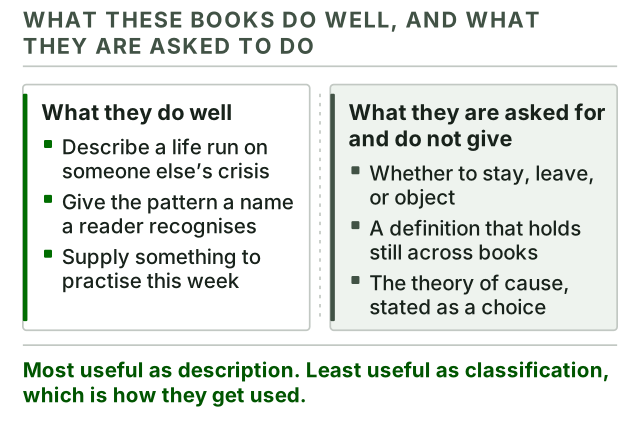
| These books are most useful as description and least useful as classification. | The term was never adopted into psychiatric classification, so nothing in it distinguishes a case from a non-case. | Readers who want recognition and language, not a verdict on themselves. | Book covers and online quizzes present it as a condition you either have or do not have, which the literature cannot support. |
| Naming the pattern does not tell you whether to stay, leave, or object. | None of these books assess a particular situation; they describe a shape and offer practice. | Readers who want a starting vocabulary before talking to someone qualified. | Turning the reader's attention inward can read as advice to stop objecting to real harm, and a book has no way to tell which situation it has landed in. |
What does codependency mean in these books?
Codependency is the name these books give to a pattern in which a person’s attention, time and mood are organised around another person’s problems, to the point where their own wants become hard to name. Readers looking for books about codependency are looking for that description, not for a theory of where it comes from.
The description is the durable part. The explanation attached to it has shifted since the term appeared, and a reader who does not notice which explanation they have bought will find the same shelf either illuminating or insulting. The recovery-tradition books treat the pattern as something like an illness, caught by living close to somebody else’s addiction. The therapist-written boundary books that followed keep the same behaviour and drop the illness framing entirely, describing it as a set of habits about limits that were learned and can be relearned.
Something else separates this shelf from other relationship reading: it is written for a solitary reader. The books here assume the other party is not reading, is not co-operating and may not agree that anything is happening. That assumption is what makes the category useful to readers who have run out of ways to raise the subject, and it is also the source of its worst failure mode, since a book that only ever addresses the reader will keep finding the reader’s contribution wherever it looks.
That difference is not decorative. It changes who the book thinks you are: someone in need of recovery, or someone who has never been taught to say no without a paragraph of justification attached. It also changes the tone. One shelf speaks the language of surrender and inventory; the other speaks the language of practice and scripts.
We publish no rankings, no ratings and no sales figures anywhere on this site. The grouping below is by what the book actually offers, and the order is not a preference; our sources page carries the reasoning behind that policy.
Which codependency book should you read?
Pick by the framing you can tolerate and the problem you can describe. The recovery classic gives the pattern its original name and reads as practical, repetitive prose. The boundary books give the same behaviour a plainer vocabulary and a set of things to say. The pattern-focused writing sits between them, tracing how a loop keeps repeating rather than labelling the reader.
| The book on this site | What it offers a reader | Who it fits | Watch for |
|---|---|---|---|
| Codependent No More | The original popular naming of the pattern, plus practice around detachment and self-care | Readers whose week is planned around someone else's crisis and who have no word for that | Recovery framing throughout; describes the pattern so broadly that ordinary care fits inside it |
| Set Boundaries, Find Peace | Plain behavioural language about limits, with wording for saying them out loud | Readers who agree to things they resent and want sentences rather than a philosophy | Written for the reader alone; says little about a household where the other person will not adjust |
| The Dance of Anger | A reading of anger as information about a pattern that keeps repeating | Readers who over-function for others and go quiet instead of objecting | Addressed to women specifically, and to individual reflection rather than joint work |
Order matters on this shelf. Readers who start with the recovery classic and find the framing alien may abandon the subject entirely rather than try another book, which is a shame, because the behavioural writing describes the same Tuesday evening in a vocabulary they would accept. Readers who start with the boundary book and want to know where the idea came from can then read the classic as a historical document without having to agree with it.
Where a publisher page can be opened and confirmed, it decides what we are allowed to tell you about an author, so it is worth saying where that was possible here. Set Boundaries, Find Peace was published by TarcherPerigee; the publisher’s page describes Nedra Glover Tawwab as a licensed therapist and the founder of a counselling practice in Charlotte, North Carolina. Those are the only credentials we will state about her, because they are the ones we could check.
For the recovery classic we could not confirm the publisher’s page at all, so this page names Codependent No More by title and describes what it argues, without stating qualifications for its author and without linking anywhere to buy it. That is the rule this site runs on rather than an opinion about the book, and the same rule applies to The Dance of Anger, where the publisher page loads but carries no readable author biography.
Where did the concept come from?
The word came out of addiction treatment in the United States, and it was a description of family members before it was ever a description of readers. Counsellors working with people dependent on alcohol noticed that the relatives around them had developed patterns of their own, and reached for a term that placed those relatives inside the same picture.
That origin explains the strangeness of the older books. The vocabulary of surrender, inventory and detachment belongs to the family-group tradition around addiction treatment, which is why the earliest codependency writing sounds like a programme even when it is being sold as a general self-help book. The lineage is history, not an endorsement, and we describe it rather than recommending anyone join anything.
Publishing did the rest. Once the word left the treatment centre it stopped requiring an addicted person in the household at all, and came to cover anyone who over-gave, over-managed or over-monitored someone else. The books grew broader with the market. By the time the boundary generation arrived, authors had quietly kept the behaviour and dropped the causal story, which tells you how much weight that story was carrying.
- For example, the older books explain a reader’s habit of smoothing over a partner’s outbursts as a symptom of the reader’s own condition, while Set Boundaries, Find Peace treats the same habit as a limit that was never stated and can be stated now. Same Tuesday evening, different accounts of what is wrong.
- For instance, the phrase “detachment with love” reads as ordinary sense to someone raised around family groups for addiction and reads as instruction to go cold to a reader who has never encountered the tradition. The words carry a history the book leaves unexplained.
- Consider a reader who picks up the classic expecting research. They will find a writer reporting what she saw and lived, in plain repetitive prose, without studies behind it. That is not a flaw in the book, but it is a mismatch with what the covers now imply.
Why do clinicians dispute the concept?
Because the term was never adopted into psychiatric classification and has no agreed definition, which means nothing in it separates a case from a non-case. Clinicians have made that objection since the concept became popular, and it is the reason careful writers use the word as shorthand between colleagues rather than as a description of a person.
The criticism recurs along familiar lines, and each line has a named source rather than an anonymous one.
Clinicians and researchers on definition. The concept grew inside the chemical-dependency field rather than out of a research programme, and repeated attempts to pin down its boundaries have not produced a shared definition. Without one, self-tests and checklists cannot say what they claim to say, and the label stretches to cover attentive care of any kind.
Feminist writers on what gets pathologised. Writers in that tradition argued, from the time the books became popular, that the behaviour being described is what women are raised and rewarded for doing — anticipating needs, keeping the peace, managing a household’s emotional weather — and that naming it a personal disorder converts a social arrangement into an individual fault. The objection is not that the pattern is imaginary. It is that the explanation stops at the reader.
Practitioners on where the attention goes. Turning a reader’s focus inward is useful when the problem is over-functioning and unhelpful when someone is being harmed. A book that tells a reader to work on their own reactions has no way to tell which situation it has landed in, and the older ones include no step for asking.
Imagine a reader whose partner drinks heavily, reading a chapter that describes their worry as part of their own condition. The description may fit. It also quietly moves the subject of the book from the drinking to the worrying, and the reader is the only one in the house being asked to change.
There is a quieter objection from reading practice, and it belongs to the reader rather than to any expert. The word is easy to apply to somebody else. A reader who finishes one of these books and comes away with a label for a partner, a parent or a friend has produced the outcome the whole shelf is supposed to prevent, and none of the books can stop that happening. The vocabulary describes a pattern between people; used on a person, it becomes a verdict, and a verdict ends the conversation these books exist to start.
The professional route. If you are frightened of someone, or the situation you are reading about involves harm rather than over-giving, that belongs with a qualified professional or a local support service rather than with a paperback, and this site is not the place to work out what to do next. Our work here is describing books; assessing a situation or advising treatment is not ours to do.
None of this cancels the shelf. These books gave a familiar experience its first usable name, and readers who use them as description rather than as classification still get the thing that is hardest to get elsewhere: language for what they have been doing for years without calling it anything.
What this page does not do
This word sits close to clinical language without being clinical language, which makes the limits of a reading guide worth stating plainly.
- We do not diagnose
- No checklists, no quizzes, no symptom counts. The concept has no diagnostic status, so any test built on it is describing a mood, not a condition.
- We do not state causes as fact
- Where a book explains why the pattern developed, we report that as the book's argument. The explanations differ between books and none of them has been settled.
- We do not sell anything
- Nothing on this page is a purchase route, and no retailer is named. A publisher page appears here for one reason only: it was the record we checked before stating anything about an author.
- We do not print numbers we cannot source
- No recovery rates, no ratings, no copies sold, no share of people said to be affected. Every figure on this site must come from a named source with a year, and for this topic we have verified none. See /sources/.
What should you read next?
Start with the framing you can stand, then move to the practice. Readers who want the origin story and do not mind recovery vocabulary should begin with Codependent No More, which is the book that put the word into general use and still reads as the plainest account of the pattern itself. Readers who bounce off that vocabulary lose nothing by starting with Set Boundaries, Find Peace instead, and may well finish it.
If the recurring problem is that you go quiet rather than object, and then find yourself furious about something small, The Dance of Anger tracks that loop more precisely than the others. Our questions about scope and policy — why we publish no ratings, why we quote no passages — are answered on the FAQ, and the wider map of everything we cover sits on the best relationship books guide.
Our reading of this shelf, in a sentence: the description is worth having and the diagnosis is not on offer, so take the language, leave the label, and decide what to do about your own situation with someone who can ask you questions a book cannot.