| What the book claims | What that claim rests on | Who it tends to fit | Where it is challenged |
|---|---|---|---|
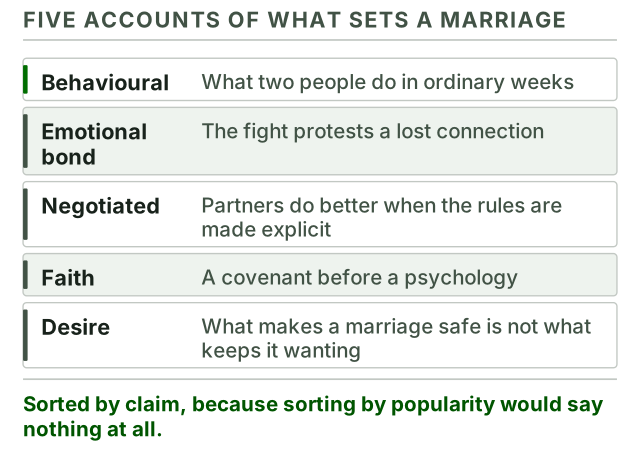
| Behavioural: a marriage is set by what two people do in ordinary weeks and ordinary arguments. | Long-running observational research in which couples were filmed talking and their behaviour coded. | Spouses who would rather watch a habit than interpret a feeling. | The prediction figures repeated online are not printed here; we link the publisher page and the record instead. |
| Emotional bond: the recurring fight is a protest about a broken connection, not about the dishwasher. | A clinical model developed with couples in therapy rooms and written down for readers. | Marriages circling the same argument for years. | The model was built for a room with a therapist in it, and a paperback cannot notice when a conversation is going badly. |
| Negotiated agreement: partners do better when the rules of the marriage are made explicit. | Practitioner experience, plus framing borrowed from attachment writing. | Couples who want their arrangements in writing rather than assumed. | Assumes both sides will keep an agreement once it is stated, and that assumption is where the arrangement breaks down. |
| Faith: marriage is a covenant, and the difficulty is a spiritual task before it is a psychological one. | Theology and pastoral practice, stated openly by the books themselves. | Readers who already hold the belief the book starts from. | The advice does not transfer to readers outside that belief, and a list that leaves the genre unlabelled hides that. |
| Desire: the conditions that make a marriage safe are not the conditions that keep it wanting. | Clinical case material written as essay rather than as study. | Long marriages where affection survived and desire went quiet. | Case material shows what happened in particular marriages, not that it holds as a general rule. |
A marriage book is a work of non-fiction that makes an argument about what a long partnership runs on and what a couple should therefore do differently. Searching for the best books on marriage returns lists that mix incompatible arguments in the same column, which is how a reader ends up with recommended titles that contradict each other about the same ordinary Tuesday.
This page sorts the shelf by school instead, and puts every title through the standing questions used across the guide, which the main canon page sets out in full. No rankings, no ratings, no shop links, no faith framing presented as neutral. Checked: 2026-09.
What separates one marriage book from another?
What separates them is the thing each book believes a marriage runs on. One school says observed behaviour during ordinary weeks; another says the emotional bond underneath the fight; another says explicit agreements between two adults; another says shared belief. The advice follows from that starting assumption, and the assumption is rarely stated on the cover.
Once you can name the school, the contradictions stop being contradictions. A behavioural book tells a couple to change what they do in the opening moments of a disagreement. An emotional-bond book says those moments are a symptom and asks what the protest underneath is about. Both can be right about different marriages, and neither is talking to the same reader.
These signals do the sorting when we open a marriage book:
- For example, a book that names the basis of its claim — filmed and coded studies, a clinical practice, a theological tradition — tells you what kind of thing you are being handed. Naming the basis does not prove the claim, but a book that presents an observation as though it arrived from nowhere is harder to argue with, and that is a weakness rather than a strength.
- For instance, watch for the limits a book sets on itself. Material written for a marriage of twenty years fits a couple in their first year badly, and an author who marks that mismatch on the page is describing a real reach instead of promising a universal one.
- Consider how the book behaves when the reader disagrees. Some make room for it and mark where the argument may not apply. Others treat disagreement as evidence that the reader has the very problem being described, which is a closed loop, and a closed loop is worth noticing before you reorganise a household around it.
There is a further split that decides how much any of these books can honestly promise. A descriptive marriage book hands you a pattern and leaves the application to you. A prescriptive one hands you a sequence and expects the marriage to answer to it. Patterns survive the move into a household the author never saw; sequences do not, because a sequence was cut to fit the couples the author happened to work with.
A prescriptive book can still be read for its description, and that is the half with the longer shelf life. Scheduled exercises date at the speed of the therapy fashion that produced them; the observation sitting underneath the exercise is what a couple can still put to work later.
Which marriage book fits which problem?
Match the book to the problem you can already name, not to the position of a title on someone’s list. The table below is the marriage shelf grouped by school, with the reader each one tends to fit and the caution we would attach before anyone treats it as a settled finding.
| Book | School | Who it tends to fit | Read it with this caution |
|---|---|---|---|
| The Seven Principles for Making Marriage Work | Behavioural | Spouses who want habits they can watch themselves perform | The prediction figures repeated online are not printed here; we link the publisher page instead |
| Hold Me Tight | Emotional bond | Marriages circling the same argument for years | Written from a therapy model, without the therapist in the room |
| Wired for Love | Negotiated agreement | Partners who want the rules of engagement made explicit | The brain framing is a metaphor for the argument, not its evidence |
| The 5 Love Languages | Expression preferences | Spouses who feel unseen although both are trying | A peer-reviewed review reports that the categories overlap |
| Getting the Love You Want | Structured dialogue | Couples willing to do exercises together on a schedule | The mechanism is an interpretation, and the publisher page could not be verified |
| Nonviolent Communication | Communication method | Readers who want a form of words for the moment they lose | A named method with training organisations behind it, not a body of trials |
| Mating in Captivity | Desire | Long marriages where affection stayed and wanting went quiet | Essay and case material rather than study; read it as argument |
| Come As You Are | Sexual response | Readers told there was something wrong with them | The synthesis is the author's own; attribute the claims to her, not to consensus |
| Men Are from Mars, Women Are from Venus | Gender difference | Readers who find the metaphor clarifying | Its gender essentialism is where the standing criticism of this shelf lands |
| The Dance of Anger | Anger as signal | Spouses who go quiet for months and then go off | Written for women in an earlier decade; some framing has dated |
Each row has a page where the argument is taken seriously rather than summarised in a line. The behavioural school is gathered on the Gottman books; the therapy-room titles sit on books for couples counseling; the desire writing starts at Mating in Captivity.
The questions readers arrive with point at different rows. A couple holding the same disagreement year after year is better served by Hold Me Tight than by anything behavioural, because that book is organised around the loop itself. A spouse who feels invisible despite effort on both sides is asking the question The 5 Love Languages was written for, with the criticism on its own page read alongside. And a marriage where something easy has gone quiet is asking about desire, which the communication books will not answer.
Another arrival question is quieter: what to read when the marriage is fine and has simply gone flat. That reader is poorly served by the whole category, because the genre is written for a crisis and finds its urgency there. The nearest fit is the desire writing, read for the questions it opens rather than for a procedure, and the honest addition is that a book is a small instrument for that particular job.
If none of those describe your week, the honest answer is that a book may not be the right object. A marriage book supplies vocabulary, and vocabulary is not care. Nothing on this page stands in for a clinician, and nothing here is written as though it could.
Why do faith-based marriage books keep turning up in these lists?
They turn up because marriage publishing in the United States has an established Christian wing, with its own imprints, its own bookshops and its own review circuit. Search for the best books on marriage and titles from that wing come back mixed in with the secular ones, which is not a judgement about the books, only a description of how the category is published.
The distinction that matters to a reader is not belief against unbelief. It is whether a book’s central argument still works once you remove the premise it starts from. A covenant framing carries obligations that follow from theology: the marriage is a promise made before something larger than the couple, and difficulty is treated as a task inside that promise. A reader who holds that premise gets a coherent, demanding book. A reader who does not is left holding advice whose reasons have been removed.
This site is secular, and the guide is built for readers who want the argument without the premise. That is a scope decision rather than a verdict. We do not tell anyone their faith is the wrong lens for their marriage, and we do not review pastoral literature on its own terms, because doing it properly needs a reviewer inside that tradition.
What we do object to is unlabelled mixing. A list that puts a covenant-based book next to an observational one and calls both simply excellent has hidden the only difference that would help a reader choose. Naming the school on every row, as the table above does, costs nothing and prevents the disappointment this category specialises in.
There is a practical consequence for anyone comparing lists. If a marriage book’s recommendations seem obvious and unarguable, check what it assumed before it began. Assumptions do the heavy work in this genre, and the strongest sign of an honest book is that it states its own out loud in the opening pages rather than leaving the reader to work it out late.
What do these books get wrong?
What they get wrong is consistent across the shelf: gradients are sold as categories, one practice’s caseload is presented as general law, confident findings are repeated with figures their sources do not carry, and the feeling of recognition is treated as evidence. Knowing the pattern in advance makes every title easier to read. None of it is a reason to skip these books; it is a reason to read them as arguments rather than as findings.
Categories that started as gradients. Research on couples produces continua: more of this, less of that. Books need names, so continua become types, and a type is easy to wear as an identity. The clearest documented case on this shelf is the love languages, where a peer-reviewed review by Impett, Park and Muise, published by the Association for Psychological Science, reports that people value every one of the ways of receiving care rather than a favourite, that the categories overlap, and that matching partners on a language shows no consistent association with satisfaction. Our full treatment sits on are love languages real.
One consulting room generalised into a law about marriage. A good part of this shelf is written out of clinical practice, and the couples in that practice arrived because something had gone wrong badly enough to book an appointment. What an author learns there is hard to come by any other way, but it is learned from marriages already in trouble, which is not the same population as the marriages reading the book. Where a title rests on practice rather than on studies, the table row says so and the book’s own page says it again.
Numbers that outrun their sources. The behavioural school states its claims with unusual confidence, and its findings get repeated online with percentages attached that the original papers do not support in that form. We print none of those figures anywhere. Readers who want the underlying book can go to the publisher’s page for The Seven Principles for Making Marriage Work, published by Harmony, and read what the book itself sets out.
The mirror problem. Self-help prose is written to be recognisable, so a spouse already worried about the marriage will meet their own household on page after page. That feeling of being seen is the genre’s engine and its weakness at once: recognition is not evidence that the described mechanism is the one running in your house. It also explains why the same book gets described as uncanny by one spouse and as padding by the other, in the same household, in the same week.
The related failure is scope. A marriage book is written for a reader who is safe, free to leave and negotiating in reasonably good faith with someone doing the same. Where that is not the case, the advice in these books stops applying, and a general reading guide is not the place to work out which situation you are in. We say that here rather than letting a table row imply otherwise.
One further objection is rarely stated outright. A manuscript has to end, and a publisher wants it to end well, while a marriage carries on past the closing chapter and carries its difficulty with it. A book willing to say that the difficulty may simply be lived with is the better book; a book that closes on a transformation has described its own structure, not a household.
None of this cancels the shelf. A book that gives an accurate name to something a couple has noticed for years has done a real thing, even if the model underneath turns out to be a rough sketch. That is the standard we hold these titles to, and the better titles on this shelf meet it.
Where should this page leave you?
It should leave you with a book chosen for a reason you can say out loud. Take the school that matches your question, read a single title from it to the end, and give it a fortnight before starting another. Marriage books stacked one on the next merge into a general unease that something must change, which is the least useful state this genre can leave a couple in.
Readers who are not married yet have a shorter and different list, gathered on books for engaged couples. Readers who want the whole canon rather than the marriage corner of it should start at the best relationship books, where every school on this page is set out with its full reading list.
We give no marriage advice of our own here, on purpose. Describing what a book argues and telling someone what to do in their own house are different jobs, and only the first one can be done honestly by an editorial team that has never met them.
Every record behind this page, and the check it had to pass, sits on the sources page. Questions about scope — fiction, quotations, ratings, retailers — are answered on the FAQ.
What this marriage list does not do
A category this crowded rewards being specific about what a guide refuses to do.
- We do not rank the books
- There is no winner here and no order of merit. Titles are grouped by the school they argue from, because the school is the distinction that helps a reader choose.
- We publish no ratings or sales figures
- A star average tells you who happened to review a marriage book, and a copies-sold claim comes from the party selling it. Neither can be checked from outside, so neither is repeated here.
- We do not sell books
- No affiliate arrangements, no retailer links, no prices, no editions compared. A publisher is named where the record matters and nowhere else. No title on this page pays better than another, because none of them pay at all.
- We do not give marriage advice
- We describe what books claim. We do not tell readers what to do at home, do not assess anyone's spouse, and do not present a page as a substitute for a professional.
- We do not review faith-based marriage books on their own terms
- Judging pastoral literature properly needs a reviewer inside that tradition. We name the genre so readers can recognise it, and we leave the reviewing to people qualified for it.