
| What the book claims | What that claim rests on | Who it tends to fit | Where it is challenged |
|---|---|---|---|
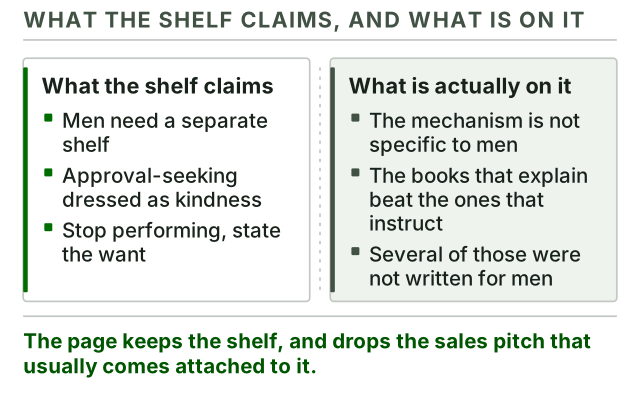
| Men need a separate relationship shelf because they read differently. | Publisher positioning and cover design more than anything in the texts themselves. | Readers who will not pick up a book that looks aimed at couples or at women. | The mechanisms these books describe — unstated deals, avoidance, score-keeping — are not male-specific, and the books themselves stop short of arguing that they are. |
| The core problem for male readers is approval-seeking dressed as kindness. | Glover's account of what he saw in a private practice, offered as observation. | Readers whose giving is automatic and whose resentment arrives without an explanation. | The syndrome name lends a habit the grammar of a diagnosis, which no manual has granted it. |
| Dating improves when a man stops performing and states what he wants. | Manson's case against the industry he worked in, made in the register of an opinion piece. | Readers for whom the memorised approach has become work in itself. | Honesty recommended for its effect can be performed for its effect, which returns the reader where he started. |
| The books on this shelf that explain rather than instruct were not written for men at all. | Our editorial reading: the attachment and communication titles carry arguments that outlast the instructions around them. | Readers who want an explanation of the pattern rather than a programme. | They are harder to start, and none of them flatter the reader the way the men's shelf does. |
Relationship books for men is a shelf label rather than a genre: a set of titles about attraction, resentment, self-respect and communication, packaged so that a man who would not pick up a book with wedding rings on the cover might pick this one up instead. The packaging is real. The category underneath it is thinner than the marketing implies.
That matters for choosing. Some of these books describe a pattern precisely and honestly. Some sell a stance. And the books that explain the mechanism instead of selling a stance were never aimed at men at all, which keeps them off lists like this one. This page sorts the shelf by what each book claims, who it fits, and what comes attached. Checked: 2026-09.
What makes a relationship book “for men”?
The cover, the register and the assumed reader — not the mechanism being described. The behaviour these books analyse (giving in order to be owed, avoiding a direct request, keeping a private ledger of concessions) belongs to no particular reader, and the books themselves stop short of claiming otherwise. What is genuinely male about the shelf is the tone: blunt, structured, allergic to being told to feel things.
The shelf sorts into families that answer different questions. Part of it is about approval-seeking and the resentment that grows under it, written in the recovery-literature format with exercises at the end of each chapter. Another part is about dating: meeting people, being direct, handling rejection. A further group is not a men’s genre at all — general relationship books with a male author, or with an argument men happen to find easy to enter.
Knowing which family a book belongs to prevents a familiar disappointment. A reader whose actual problem is a recurring argument buys a dating book because it was recommended in a thread, and concludes that relationship books do not work. The book worked; it just answered a question he was not asking.
Something else separates this shelf from the rest of the site’s canon. Books addressed to men turn prescriptive early: description gives way to assignments quickly. That speed is the appeal and the risk. Description you can test against your own life; instructions you either follow or ignore, and following them without the description underneath is how a book becomes a personality rather than a practice.
Which of these books are worth reading?
The ones that describe a mechanism you can check against your own behaviour, rather than the ones that hand you a stance to adopt. Below is the shelf as we read it: every title with the claim it makes, the reader it suits, and the caveat we would want stated in the same breath. Each entry links to our full page on that book, where the criticism section is longer than the summary.
| Book | What it claims | Who it suits | What comes attached |
|---|---|---|---|
| No More Mr Nice Guy (Glover) | Accommodation can be a bid for approval, and the deals nobody stated end in bitterness | Readers who cannot make a plain request and cannot account for their own anger | A syndrome name it did not earn, and a following that reads it differently from how it was written |
| Models (Manson) | Technique defeats itself, because a routine works only while the person running it stays hidden | Readers who can feel that the memorised approach costs more than it returns | An essay's evidence: illustration and assertion, with no research behind the claims about attraction |
| Attached (Levine & Heller) | Adult relationship patterns follow the shape attachment research describes | Readers who want vocabulary for a pattern before any advice | The pull towards labelling a partner on brief acquaintance, which the research never supported |
| Hold Me Tight (Johnson) | Recurring fights are attachment protests, not arguments about the dishes | Readers in a long relationship that keeps looping | Not written for men, and asks for more emotional vocabulary than the rest of this shelf does |
| Set Boundaries, Find Peace (Tawwab) | Boundaries are sentences you say, not walls you build | Readers who need the words, not the theory | Reads as a workbook; light on why the difficulty exists in the first place |
| Nonviolent Communication (Rosenberg) | Requests survive conflict better than judgements do | Readers who escalate or go silent and want a different move | A named method with a particular vocabulary; some find it stilted out loud |
No More Mr Nice Guy is the entry point this shelf is built around, and it earns part of that position. Its publisher’s page is where we take the author’s credentials from, and nowhere else. Models sits next to it as the dating-side equivalent, and the author’s official page for the book serves the same purpose here.
The titles that explain without raising their voice are Attached and the communication books. Neither was written for this shelf. Both explain why the pattern happens, and an explanation keeps working after a set of instructions has stopped applying.
A note on order, since the shelf invites the question. The table is not a sequence. Reading Glover and Manson back to back gives a reader confident voices about the same audience and no way to weigh them, which is how a shelf turns into an identity. Pairing one of them with a book that explains the mechanism — the attachment or communication side — gives the reader something to check the confident voice against, and that pairing is what we would suggest to anyone starting from scratch.
Which ones come with a worldview attached?
The honest move here is to name the worldview rather than the book. A worldview is attached when a text stops describing behaviour and starts explaining what men and women essentially are — at which point the reader is no longer testing a claim against his life, he is adopting a position and looking for confirmation.
- For example, a book that explains a couple’s difficulty by saying that men and women process distress in categorically different ways is making a claim about human nature, not about the reader. Our page on Men Are from Mars, Women Are from Venus sets out where that claim ran into trouble.
- For instance, a chapter on directness with no chapter on repair hands over an unfinished skill. He says what he wants, it lands badly, and the book has nothing for the hour that follows. That gap is easy to fill with bluntness and call it progress.
- Consider what happens to a book after it leaves the shop. A title written in one voice can acquire a second one in circulation, until its reputation arrives before its pages do. The text has not changed; the expectation a new reader brings to it has.
None of this retires the books. Glover’s description of unstated deals is sharp, and Manson’s objection to performance-based dating is well aimed. The instruction is narrower: read the description, treat the prescriptions as experiments, and notice when a paragraph shifts from this is what you do to this is what men are.
There is a related tell worth watching for. When a book’s advice can only be evaluated by whether the other person responded the way the book predicted, it has stopped being about the reader. Books that keep the attention on the reader’s own behaviour are the ones that stay useful once the particular relationship they were bought for has changed or ended.
What is missing from the men’s shelf?
What happens after the first difficult conversation. The shelf is strong on recognition — here is the pattern, here is what it costs you — and thin on repair, on the ordinary maintenance of a long relationship, and on what to do when directness makes things worse before it makes them better.
Other gaps are more specific. Friendship appears only as background, though isolation is doing visible work in the case descriptions these books rely on. Grief and loss go unaddressed. Fatherhood turns up as a motivation rather than a subject. And the shelf has no answer for a reader whose relationship is going reasonably well and who simply wants to be better at it.
Certain absences are worth naming rather than filling. The shelf does not treat relationships that end well or end fairly, and it leaves out what a man does with the version of himself that a long relationship built. Those are subjects the general canon handles better, and pretending a men’s title covers them would be flattery.
Where the shelf runs out, the general canon takes over. Our reading guide to the relationship-book canon covers the same questions without the gendered framing, and books about communication in relationships covers the repair half that the men’s titles skip. Readers who arrived here because dating is the actual question will get more from books about dating, where the same titles are sorted by what they claim about choosing rather than by who they were marketed to.
What this page does not do
Strong opinions and stronger marketing gather around this shelf. What follows is what we refuse to add to it.
- This shelf is not a storefront
- A list like this one is easy to build out of buy buttons with paragraphs between them. This one carries no purchase route of any kind, and the publisher pages we link are here so a claim about a book can be checked, not so a reader can be moved along to a checkout.
- We do not publish a ranking
- A ranked list implies a measurement nobody has taken. We sort by the question a reader arrived with, and we name the caveat next to every title.
- We do not give relationship advice
- We describe what each book argues and where it has been criticised. What to do about your own relationship is not something a reading guide can know.
- We do not print sales figures or review scores
- Copies sold, chart positions and aggregate ratings are marketing copy or unverifiable, so this site publishes neither. Our sources page explains the rule.
The shelf is worth using, with its labels read as labels. A book aimed at men is still a book, and the good ones on this page describe a habit precisely enough that the reader cannot go back to performing it unconsciously. That is a real thing for a book to do, and it does not require anyone to believe that men are a separate species with their own manual. Which publisher pages we accept for the titles on this shelf, and what we refuse to repeat about any of them, is set out on our sources page.