| What the book claims | What that claim rests on | Who it tends to fit | Where it is challenged |
|---|---|---|---|
| Some relationship books are built for two readers and some only look like they are. | The books' own structure: whether a chapter ends in a shared conversation or in a private self-assessment. | Couples choosing a first book and wanting to avoid the one that stalls in week two. | Publishers market relationship titles as something to read as a pair regardless of how the chapters are built, which flattens the distinction. |
| The format — pace, who reads aloud, what happens after a chapter — decides more than the title does. | Editorial reading of how these books structure their exercises, and of where that structure gives way when two people share it. | Pairs who have abandoned a book before and blamed the book. | This is our reading of the genre, not a tested finding; no study we can cite compares reading formats. |
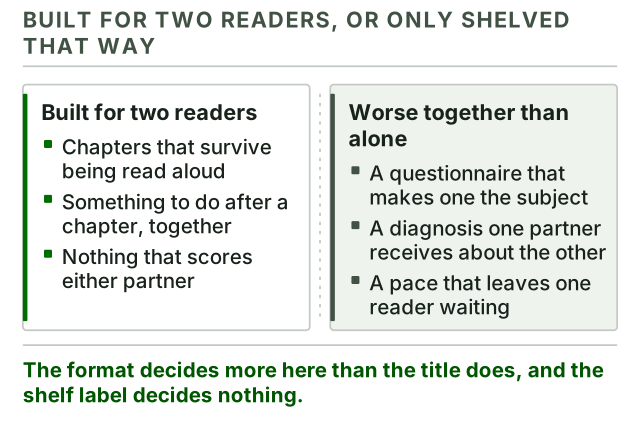
| Questionnaire-led books create an asymmetry when read side by side. | The instruments in these books produce labels, and a label read over a shoulder becomes a description of the other person. | Couples drawn to books with a quiz in the first chapter. | Authors would say the quiz is an invitation to talk, not a verdict, and some pairs use it exactly that way. |
| Books shelved as couples reading can still be worse read together than alone. | Their subject matter is one person's history, body or anger, and a second reader changes what can be written in the margin. | Readers who assumed a couples shelf means couples reading. | Some partners want to be read alongside, and for them the solo framing feels like exclusion. |
What makes a book work for two readers?
A book works for two readers when both people are given the same thing to do at the same point, and it fails when one of them is given a score and the other is given a wait. That is the whole criterion, and it sorts the shelf faster than any list of best books for couples to read together.
A book for couples to read together is a relationship book whose structure assumes two people moving through it at one pace: shared vocabulary in the early chapters, and a task at the end of each one that neither partner can complete alone. Everything else is a book that two people happen to own.
The distinction matters because the genre is marketed as if it did not exist. A couple on the cover says nothing about the structure inside: a title can be sold that way and still be written for a single reader thinking about a relationship. Those are different books doing different work, and the second kind stalls when two people try to move through it in step.
A second thing separates the two kinds: whether the book gives you words or gives you a verdict. Shared vocabulary is the durable product of reading as a pair, because it survives the book. Once two people have a phrase for the thing that keeps happening on Sunday evenings, they can raise it without an accusation attached, and that phrase stays useful long after the chapters are forgotten.
There is a third, quieter requirement: the book has to be survivable when you disagree with it. A book that treats its own framework as settled leaves a sceptical partner with two options, agree or stop reading. A book that says plainly where its argument is an interpretation gives that partner somewhere to stand, and the reading continues.
Which books work best read together?
The books that hold up as a pair are the ones with a conversation, not a questionnaire, at the end of the chapter. The table below sorts the titles this site covers by what each one asks two readers to do once the chapter is finished, which is the part that decides whether you reach the middle of the book.
| Book | How to read it as a pair | What to do after each chapter |
|---|---|---|
| Hold Me Tight | Both read the same chapter, then talk before the next one | Have the conversation the chapter sets up, out loud, in one sitting |
| Gottman and Silver's practical guide | Alternate who reads aloud; the exercises are the spine of it | Pick one exercise and finish it rather than sampling several |
| The 5 Love Languages | Read together, but take the questionnaire separately | Compare answers only after both are done, and treat them as a starting point |
| Wired for Love | A chapter a week; it is written in short, teachable units | Name one moment from your own week that the chapter describes |
| Nonviolent Communication | Read together, practise on conflicts that are not yours | Rewrite one sentence each of you said this week in the book's format |
| Attached | Better read one after the other than side by side | Summarise it to each other rather than sorting each other with it |
| Come as You Are | Written for one reader; share the chapters you choose to share | Decide what you want to pass on before you pass the book over |
Couples who want to be told what to do once the chapter ends have the easy case here. Hold Me Tight tells them, in order, and the telling is the book: Sue Johnson’s named conversations are the content rather than an account of it, so skipping them leaves a pair holding nothing they can use. Its page at the publisher calls it a book for couples, and on this shelf that label is unusually literal.
Exercises short enough to finish in one evening are what keep the Gottman and Silver title alive between two readers, including the case where one of them is unconvinced by the research framing: there is always something concrete to do next, and doing it does not require agreement first. Its listing at the publisher names both authors; the book gets its own treatment on our Gottman page.
The awkward one is The 5 Love Languages, and the awkwardness has a location: the questionnaire arrives early, and read side by side each partner watches the other answer it. Split the questionnaire off, compare afterwards, and the book does the thing it is actually good at — handing two people a word for something they had been arguing about without one.
Pairs who want a weekly prompt rather than a book to get through are the fit for Wired for Love. Stan Tatkin writes in short teachable units, which makes it easy to read a stretch aloud and stop where it stops; the confidence of the vocabulary is the trade, since a sceptical partner meets a run of assertion early on.
The objection to reading Nonviolent Communication as a pair should be met first: the format it teaches turns unbearable the moment one person starts using it to correct how the other speaks. What it teaches only becomes real when both of you apply it to something that actually happened, so the way round is to rehearse on an argument belonging to neither of you. The alternatives to it are lined up on our communication books page.
How should a couple actually read one?
Read slower than either of you would alone, agree in advance on what happens at the end of a chapter, and decide whether you are reading aloud or separately before you start rather than renegotiating it every evening. Those decisions are what separates a book that gets finished from a book that lives on the nightstand.
Pace first. These books are written on the assumption that the previous chapter’s conversation has already happened, so reading several chapters in an evening leaves the exercises stacked up and unattempted. A chapter at a sitting with a gap after it is the rhythm the structure expects.
- For example, a pair working through Hold Me Tight who read two conversations in one weekend will find the second one asking them to build on an exchange they never had. The book is not broken; the order was.
- For instance, reading aloud suits books written in short units, such as Wired for Love, because the units end naturally and a listener can interrupt without losing the thread. It suits a dense argument far less well, and forcing it there is how couples conclude they dislike reading together.
- Consider the partner who reads faster. The answer is not to slow them down but to let them read ahead privately and return to the shared chapter for the conversation, which keeps the pace honest without turning the fast reader into a chaperone.
Then there is what happens when the book is wrong, or feels wrong. Saying so out loud while the chapter is still fresh is a large part of what the shared reading is for, and it works best when it is specific: which claim, and what you think happens instead. Silent disagreement produces a finished book and no change, which is one version of a book that “did not work”.
Aloud or separately is a decision worth settling once, in advance, rather than reopening every evening. Reading aloud makes the pace shared by force and turns the book into an evening rather than a task, which suits short units and suits pairs who read at very different speeds. Reading separately and meeting at the chapter break suits dense argument, suits anyone who dislikes being read to, and produces better notes. Neither is correct; picking one and keeping it for the whole book is what matters, because switching formats mid-way is how the reading quietly stops.
One practical note about margins. A shared copy means neither person writes freely in it, and the notes that would have been the most useful are the ones that do not get written. Two copies, or one copy and a separate notebook each, change what the reading produces.
What happens when only one of you keeps reading?
The reading becomes one person’s reading, and the honest move is to say that out loud instead of waiting. A book abandoned by one partner is an ordinary outcome and not a diagnosis of anything; what turns it into a problem is the version where the reader keeps going in silence and starts quoting chapters at someone who never agreed to them.
There are two workable routes from there. The first is that the reader finishes alone and describes what they found in their own words, which is one of the ordinary ways a relationship book enters a relationship at all. The second is swapping the book for one that does not need two readers, and some of the titles on this shelf are exactly that.
- Consider a pair who started an exercise-led book and stalled at the third exercise. Dropping back to reading only, with no tasks, keeps the vocabulary and loses the obligation, and the vocabulary was the part that was working.
- For example, a partner who agreed to read and then did not may be objecting to the framing rather than the reading; a book that argues its case differently can restart the whole thing, which is why the disagreements between these books are worth knowing in advance.
Which books are better read alone?
Books about one person’s history, body or anger are better read alone, because their method depends on a reader being honest with themselves before anyone else sees it. Handing that book to two people at once does not double the effect; it changes what either of them is willing to think.
Attached is the clearest example. Its typology is memorable, portable and easy to apply to the person sitting next to you, and read side by side it can turn into a way of describing a partner rather than a way of describing a pattern between two people. Read one after the other, with a conversation in between, it does far less damage and much the same work.
Come as You Are is written to a single reader in the second person, and the questions it asks are ones a reader may want to answer privately before discussing. The same applies to The Dance of Anger, whose subject is a reader’s own pattern rather than a couple’s.
None of this makes them unsuitable for couples. It makes them books that arrive in a relationship second-hand, through one person describing what they found, and that is a legitimate route. The mistake is buying them expecting the shared-chapter format and then concluding that the book refused to cooperate.
For a first book to read as a pair before a wedding specifically, the shorter, exercise-led titles travel better than the ones that ask for a long private reckoning; our page on books for engaged couples covers that case. The wider map of what this site covers starts on the main guide, and our sources page lists the publisher records this site is willing to link, and the claims about these books it will not pass on.
What does reading together not fix?
Reading a book together is a shared activity with a vocabulary attached, and what it reliably provides stops there. It is not a substitute for a conversation neither of you wants to have, and no book on this page claims otherwise in its own text, whatever the cover promises.
Two honest limits are worth stating. A book cannot notice that one partner has gone quiet, and it cannot tell whether the silence is boredom or something heavier. Where a couple wants structured help, that is what counselling is for, and saying so plainly seems better than letting a paperback look like it reaches that far.
A third limit is expectation. A book read together can be carrying a hope that neither partner has said out loud: that finishing it will settle an argument that predates it. Books do not settle arguments. They give both people the same words for what the argument is about, which is a smaller and more useful thing, and expecting the smaller thing is what keeps the reading going.
A fourth limit is asymmetry. If one person chose the book, chose the pace and chose the chapter, the reading is already a lopsided conversation, and the book will be blamed for a shape it did not create. Choosing the title together is a smaller decision than it looks and it removes that problem at the source.
What this page does not do
This shelf is marketed as therapy for two. A reading guide is not that, and the difference is worth spelling out.
- We do not sell the books
- You cannot buy anything through this page: we run no affiliate codes, quote no price, carry no shop button and publish no star score. A publisher link appears only where it lets a reader confirm the record.
- We do not invent exercises for couples
- Every task described here belongs to a book and is attributed to it. We do not add our own relationship advice to someone else's method.
- We do not rank these books
- The table sorts by reading format, not quality. A ranking would imply we know which argument fits your relationship, and we do not.
- We do not print sales figures or ratings
- How many copies a book has sold, and how reviewers scored it, is marketing material rather than evidence about the argument inside it. See /sources/ for how that rule works on this site.
The short version: pick a book whose chapters end in a task rather than a score, agree on the pace before the first page, and treat disagreement as the point rather than the problem. The title matters less than either of you expects, and the format is what decides the outcome.