| What the book claims | What that claim rests on | Who it tends to fit | Where it is challenged |
|---|---|---|---|
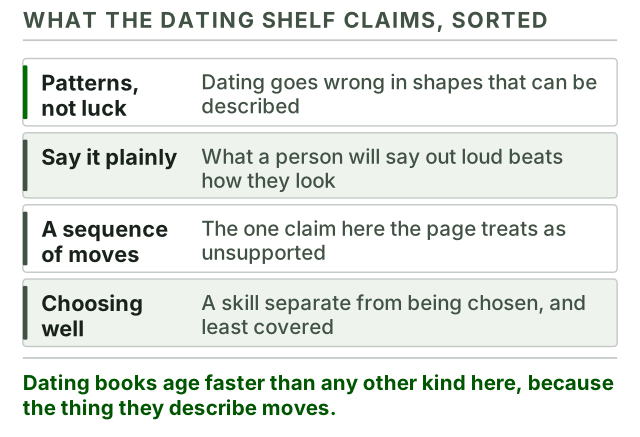
| Dating goes wrong in patterns, and the pattern can be described before it is judged. | Adult attachment research and the couples literature the better books draw on. | Readers who keep ending up in the same conversation with different people. | Description slides into typing people early, which the underlying research does not license. |
| How you present yourself matters less than what you are willing to say out loud. | The authors' own practice and editorial judgement, stated as such in the honest books. | Readers tired of tactics who want a stance instead of a script. | It is advice, not a tested programme, and the books in this group do not say so plainly. |
| A repeatable sequence of moves produces attraction. | Author experience, worked examples, and confident retelling. | Readers after relief from uncertainty rather than accuracy; the appeal does not survive contact with an actual person. | The claim is untestable as written, and the sequence is built for one era of meeting people. |
| Choosing well is a skill separate from being chosen. | Standard in the therapy-adjacent books; treated as an afterthought in the method books. | Readers deciding whether to continue, not readers trying to start. | How to tell a considered decision from an avoidant one is left unaddressed. |
What is a dating book supposed to do?
A dating book is a non-fiction book about the stage before commitment: meeting people, deciding who is worth continuing with, and saying what you want early enough for it to matter. That is the whole remit, and it is narrower than the shelf pretends.
Books about dating come from two rival traditions that share the label. One explains mechanisms: why a pattern repeats, what people actually notice about each other over weeks rather than minutes, what happens when one person wants more certainty than the other can give. The other supplies procedure: what to send, when to reply, how to behave on an early meeting.
The mechanism books survive being read years later, because the mechanism does not depend on which platform people are using. The procedure books are dated by the medium they were written for, and the passages written for a particular platform are the ones that date first.
There is another thing on the shelf that is not really a dating book at all: a general relationship book with dating examples in the opening chapters. Some of the titles below belong to that group, which is why they read as unusually calm. They were not written to help you win anything.
Which dating books are worth reading?
The books below earn their place because each makes a claim you can examine and disagree with. The table sets the claim beside the objection, which is the format this site uses everywhere.
| Book | What it claims about dating | Who it fits | Where it is disputed |
|---|---|---|---|
| Attached (Levine & Heller) | Early relationships run on an attachment system, so the pattern is describable rather than a character verdict | Readers who keep landing in the same dynamic with different people | The research measures dimensions; the book hands readers categories and invites labelling a partner |
| Models (Mark Manson) | Attraction follows from honesty and a willingness to be rejected, not from technique | Readers who have tried tactics and want a stance instead | It rests on the author's experience and judgement, not on studies, and the register can read as prescription |
| No More Mr Nice Guy (Glover) | Approval-seeking produces resentment, and resentment ruins the relationships it was meant to protect | Readers who agree to things they did not want and cannot say why | A single explanatory frame is applied very broadly, and the recovery-literature lineage is stated as history rather than proof |
| Set Boundaries, Find Peace (Tawwab) | Disappointment in early dating traces to arrangements never stated out loud | Readers who need language for what they will and will not agree to | Written for life in general, so the dating material is thinner than a reader arriving for dating expects |
| Polysecure (Fern) | Attachment thinking applies outside monogamy, and dating several people is a structure rather than a stage | Readers whose situation the other books quietly assume away | Combines two contested literatures at once, and the practical sections outrun the evidence behind them |
The odd thing about that list is how little of it is about dating in the recruitment sense. These books dwell on what happens after two people have already met, which is a fair description of where the difficulty actually lives.
If a reader wants a single starting point, Attached is the one to take, because it gives a vocabulary for the confusing part that the reader can then argue with. If the problem is performance rather than pattern, Models is the better first read. The titles aimed specifically at a male readership are gathered, with the same treatment, on the men’s shelf.
Which claims in dating books have research behind them?
The attachment claim does: that adult romantic behaviour can be described using the framework built to study attachment in children. Cindy Hazan and Phillip Shaver’s paper, romantic love conceptualized as an attachment process, is the study that opened that field, and the attachment-flavoured dating books all sit downstream of it.
What that literature supports is modest and useful: people differ in how much reassurance they seek and how much closeness they can sit with, those differences show up early, and they shape what happens between two people rather than sitting inside one of them. That is a mechanism.
What it does not support is the leap the books make next. The research works with continuous measures; the books hand readers a category and a name for it. Their publisher’s page lists a Columbia psychiatry post for Levine and a social-psychology background for Heller, and our page on Attached sets those out in full. Qualified authors, and the shortcut is still a shortcut.
Everything else on the dating shelf is judgement. That is not a criticism by itself, because experienced judgement is worth reading. It becomes a problem when a book alternates between a cited finding and an author’s hunch in the same voice, and the reader cannot hear the seam.
What do method-driven dating books get wrong?
They treat another person’s interest as an output you can produce with the right input, and they are written with a confidence the material cannot support. The same failure modes recur, and each is visible on the page before the reader tries anything.
- For example, take any book organised as a numbered sequence of stages. The sequence assumes everyone is moving at the same pace and reads a deviation as a mistake in execution. In practice a deviation means the other person wants something different, which is information the format has no slot for.
- For instance, consider the books whose advice depends on a channel: what to write in an opening message, how long to leave a reply, which platform is worth the time. That advice is perishable by construction. A reader who followed it faithfully would be rehearsing the etiquette of a service that has since changed everything about how it works.
- Consider the promise of decoding someone quickly, offered by books that turn small early behaviours into a verdict on character. It flatters the reader’s wish to stop feeling uncertain, and it substitutes a guess for the only thing that actually settles the question, which is watching what someone does over time.
There is a quieter failure underneath all of them. Method books frame dating as a performance problem, so a reader who is unhappy concludes they performed badly. The real finding can be simpler: two people wanted different things, and no sequence of moves would have changed that.
What this page does not do
Dating writing is the easiest place for a reading guide to start issuing instructions. It does not happen here, and this is why.
- We do not give dating advice
- This is a reading guide. What to say, when to reply, how to meet people: none of that is ours, and a book review is a poor place for it.
- We do not define the slang
- Terms readers meet in dating writing get defined by sites that specialise in the vocabulary. Here, a book is described by what it argues, not by the words it made popular.
- We do not print sales figures or ratings
- Copies sold, chart positions, star averages: publisher marketing, not evidence. Our /sources/ page explains why none of it appears anywhere on this site.
- We do not sell the books
- There is no route from this page to a checkout, and nothing here pays us if you go and find one. The publisher and research pages we link are working references: they let you open the record behind a sentence about dating research.
- We do not sort anyone into a type
- Books that hand out labels are described as making that move. We report the claim and the objection; we do not apply either to a reader or to their partner.
What is missing from the dating shelf?
Whole readerships are absent from it, and the absence goes unacknowledged inside the books themselves. The genre is written for someone young, unattached and starting out, and it assumes a run-up that readers arriving later no longer have.
Dating after a long marriage is the clearest gap. A reader in that position is not learning to choose for the first time; they are choosing again with a history, and in some cases with children and a household already arranged around other people. The advice about availability and pace reads very differently from inside that life, and that is not where the shelf is looking.
The same is true of dating later in life, dating with a chronic illness or a disability, and dating across a religious or cultural line where the disagreement is not about pace at all but about what the relationship is for. Money is another quiet omission: what two people can afford, and how differently they were raised about it, shapes early relationships, and the shelf does not take it up.
For example, a book that recommends saying what you want early is giving sound advice and no help at all to a reader whose difficulty is that saying it will end things with someone they like. The gap between a principle and a situation is where these books stop, and it is worth knowing that in advance rather than concluding you read them badly.
What should you read once dating turns into a relationship?
Switch shelves, because the questions change. Dating books are about selection, and once selection is settled the remaining problems are about maintenance, repair and negotiation, which is a different literature with better evidence behind it.
The transition catches readers out in a predictable way. A book that was clarifying while deciding becomes an odd lens once the decision is made, and a reader who keeps applying it ends up assessing a partner they already chose. That is the point to put it down.
There are useful routes from here. The full canon, with every title given the same four questions, sits on the main guide to relationship books. Books that genuinely work read as a pair are gathered on books for couples to read together.
If the interesting part was the pattern rather than the advice, the wider set of attachment theory books takes that history slowly and shows where the popular versions part company with the research. The sources page describes the test a publisher page or a research record has to pass before we link it, along with the blurb claims that fail it.
The short version: read the books that explain how choosing works, argue with them, and treat any book offering a sequence as a period document about the year it was written.