| What the book claims | What that claim rests on | Who it tends to fit | Where it is challenged |
|---|---|---|---|
| Breakup books are not one genre; they split by the job they do — explaining, accompanying, or moving you along. | The books' own structure: an argument with chapters, a collection of letters and essays, or a staged programme with tasks. | Readers who picked up a recommended title, found it unbearable, and assumed the problem was them. | The split is our editorial reading of the shelf, not a classification any of these authors use. |
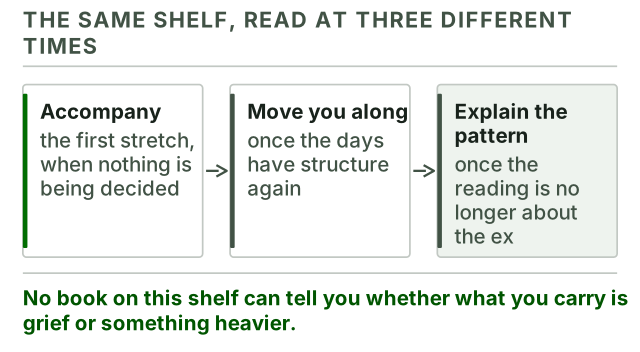
| Timing decides more than the title does. | The programme-style books open by asking for effort a reader in the rawest stretch cannot supply; the accompanying books ask for nothing. | Anyone choosing between a structured book and a book of essays. | Some readers want a task precisely because everything else has stopped, and for them the programme arrives at the right moment. |
| Books that explain patterns are read best once the reading is no longer about the ex. | Attachment-based popular books describe recurring patterns across relationships, which only becomes usable material when it stops being evidence in an argument. | Readers who keep landing in the same ending and want the pattern named. | The same books get used as retrospective diagnosis of a former partner, which is not what their own research base supports. |
| No book on this shelf can tell you whether what you are carrying is grief or something heavier. | Books cannot observe the reader; the titles here are written for a general reader and say so. | Readers deciding between a paperback and a professional route. | Some of these books do include warning signs and a referral line, which is more than their marketing suggests. |
What are breakup books actually for?
Books about breakups are written to do a particular job, and a reader’s disappointment traces back to picking a book doing a different job from the one they needed. Explaining, accompanying and moving along are separate tasks, and they pull a book in different directions.
A book about breakups is a non-fiction title written for a reader whose relationship has ended, offering either an account of why endings feel the way they do, a body of writing to keep the reader company, or a structured process for getting through the period after. Memoirs and essay collections sit on the same shelf without belonging to the same genre.
The explaining books argue. They take the ending and make it legible: what a bond does when it breaks, why the mind returns to the same evening on a loop, why the ex who was ordinary last month is now the most interesting person alive. Reading them is an act of thinking, and that is the requirement they impose.
The accompanying books do not argue at all. Letters, essays and memoir hand the reader someone else’s version of the same weather, and the only thing asked is attention that comes and goes. They are the books that work when concentration has collapsed.
The moving-along books are programmes. Chapters end in tasks, the tasks assume a reader with capacity, and that assumption is exactly what the early stretch does not have. Given later, the same structure is the reason the book gets finished.
Another distinction runs underneath those categories. Some of these books are written from a clinician’s caseload, some from an author’s own ending, and some from a columnist’s postbag. None of those origins is better than the others, but they produce different kinds of sentence: the caseload book generalises, the memoir does not, and the postbag book alternates. Knowing which one you are holding explains where the irritation comes from.
The genre also inherits a problem from grief writing. An ending is a loss without a funeral, and nobody arranges anything, so books get asked to do the work that ritual does elsewhere. That is work a paperback is not built for, and the titles that acknowledge it read more honestly than the ones that promise a method.
Which breakup book fits which stage?
The fit is decided by how much the book asks of the reader on its opening page. The table below sorts the titles that recur in recommendations by what each one does and when it becomes readable, which is a more useful axis than a ranking nobody can make on a stranger’s behalf.
| Book | What it does | When it is readable |
|---|---|---|
| Tiny Beautiful Things | Keeps company; letters and replies, read in any order | Immediately, in fragments, with no obligation to finish |
| How to Fix a Broken Heart | Argues that heartbreak deserves to be taken seriously as an injury | Early, because it is short and sets no exercises |
| It's Called a Breakup Because It's Broken | Takes a brisk, unsentimental line on staying in contact | Once brisk stops feeling like being told off |
| Getting Past Your Breakup | Structured programme with stages and written work | Later, when writing something down feels possible |
| Conscious Uncoupling | A staged process for ending without hostility | When the ending is shared or practical arrangements remain |
| Attached | Explains recurring patterns across relationships, not this one | Once the reading stops being about the ex |
| The Dance of Anger | Names a pattern in how anger gets expressed and absorbed | When anger has arrived and outstayed the sadness |
Some of the rows deserve a caveat. Conscious Uncoupling is written for an ending both people are participating in, and a reader who was left without discussion will find its premise does not match the facts. It is a good book aimed at a specific situation, and the mismatch gets read as the book being wrong.
The programme titles carry the opposite risk. Their structure is their value, and structure only helps a reader who can meet it. Abandoning one early and returning to it later is a normal use of the book, not a failure to complete it.
Which books explain what went wrong?
Some of the books that best explain endings are not breakup books at all. They are books about how bonds work, written for people still inside relationships, and they answer the “why did this happen” question better than titles written for the aftermath, because they are describing a mechanism rather than consoling a reader.
Attached is one of the titles handed to someone after an ending. Levine and Heller apply adult attachment research to dating and couple relationships, and the popular typology comes out of a research line that begins with Hazan and Shaver’s 1987 paper extending attachment theory to romantic love. The publisher’s page for Attached carries the authors’ details.
The book is at its most useful when a reader keeps arriving at the same kind of ending, and at its least useful in the week the ending happened. Read then, its categories become labels for the person who just left. That is a misuse of the material and also the tempting thing to do with it, which is why we keep saying it.
- For example, a reader who finishes Attached in the rawest stretch can come out with a category for the ex and no description of what the pair did to each other. Read much later, the same chapters can read as a pattern with the reader in it.
- For instance, The Dance of Anger is not marketed for breakups, and Lerner is describing how anger circulates in close relationships rather than how to survive an ending. It arrives usefully at the point where sadness has been replaced by fury and the fury has stopped being satisfying.
- Consider the reader whose ending was preceded by a long stretch of managing someone else’s moods. The literature that fits is not the breakup shelf but the one covered on books about codependency, where Codependent No More sits, and where the vocabulary is about what the reader was doing rather than about the departure.
Another bridge is worth naming. Set Boundaries, Find Peace gets recommended after endings because the aftermath is full of negotiation: what gets returned, who is told, which mutual friendships continue. Tawwab’s book is about stating limits generally, which is why it survives being read in a situation it was not written for.
A second reason to be careful with the explaining shelf: it answers a question that is not always the one being asked. “Why did this happen” and “why does this hurt this much” are different questions with different literatures. Attachment-based books answer the first. The short books about heartbreak as an injury answer the second, and reading the wrong one produces a sense that the book is talking past you.
There is also the question of whose account you are getting. A book that explains an ending is necessarily a book about a pattern rather than about the particular evening it fell apart, and the particular evening is what the reader wants explained. No book has access to it. What a book can do is describe the class of thing that happened often enough for someone to write about it, and leave the reader to decide whether the description fits.
Should memoir and fiction count as breakup books?
Memoir and fiction belong on this shelf whenever they do the accompanying job better than the non-fiction does. A novel about an ending makes no claims, demands no exercises and cannot be argued with, and for a reader who cannot yet think in arguments that is precisely the right shape.
The trade is straightforward. Fiction and memoir give recognition without explanation: you finish the chapter feeling less strange and no better informed. Non-fiction gives explanation without recognition: you understand a mechanism and still feel exactly as bad. Both have their uses, and the order in which they arrive is the part the recommendations get wrong.
- Consider the reader who has been handed a structured programme by a well-meaning friend and cannot get past the opening written exercise. Swapping it for an essay collection is not giving up on recovery; it is matching the book to the available attention, and the programme is still there afterwards.
- For instance, grief memoirs written about deaths rather than departures get recommended into this shelf, and the borrowing works because the description of a rearranged daily life transfers. The mismatch is only in the social permission around the loss, which the reader already feels keenly.
One more difference separates the two shelves. Non-fiction dates quickly, because it carries the vocabulary of the decade it was written in, and a chapter on answering machines or on texting etiquette starts to read as a period piece even when its argument still holds. Fiction and memoir age differently: the daily detail dates, the account of an ending does not. That is part of why essay collections keep being handed on long after the how-to titles they once shared a table with have gone quiet.
Where fiction is concerned, our page on the best books about love covers the titles people reach for when they want an ending rendered rather than analysed. We keep these shelves separate here because the questions differ: this page is about what to read when the relationship has stopped, not about what to read to think about love in general.
What can no book do?
No book can see the reader, and that limit produces every other one. A book cannot tell whether what it is being handed is ordinary grief or something that needs a professional, it cannot adjust its pace to a bad morning, and it cannot know which parts of its own advice do not apply to your situation.
The professional route. If the aftermath includes not eating, not sleeping, thoughts of harming yourself, or fear of the person who left, that is the point where reading is the wrong tool and a clinician or a doctor is the right one. Naming this is not a formality. The better books on this shelf say the same thing in their opening pages, which is where it is easiest to skip.
Two narrower limits belong here too. The genre skews towards recent, short relationships and towards a dating-era vocabulary, so a reader coming out of a long shared life can find the examples faintly insulting. And a book cannot supply the thing books can only describe, which is other people.
The genre also has a habit of promising an arc. Chapters are ordered as stages, stages imply progress, and progress implies a schedule. We do not print timelines on this site, and we would treat any book that guarantees one with the same suspicion we would apply to a book guaranteeing a relationship.
Finally, the recommendation problem. Breakup books are given rather than chosen: someone who cares about you picks a title based on what worked for them after a different ending in a different life. That is a kind gesture and a poor selection method, and refusing the book is allowed. The table above exists so that the refusal can come with a substitute.
What this page does not do
This is a reading guide, and breakups are the subject where a reading guide is easiest to mistake for something else.
- We do not give breakup advice
- No rules about contact, no stages of recovery, no view on whether people come back. We describe what books argue; we do not add our own instructions to the pile.
- We do not print timelines
- How long anything takes is not something we can source, so we do not state it. Books that state it are describing their author's experience, not a measured finding.
- We do not sell the books
- Nobody earns anything if you buy one of these titles, and there is no button here that would let you. Where a publisher page is linked, it is there so the record behind a sentence can be opened and checked.
- We do not diagnose readers
- Nothing here tells you what pattern you have or what your ex was. The books that offer categories are described as making that offer, which is not the same as endorsing it.
The short version: choose by what you can currently read rather than by what was handed to you, let the essays cover the stretch where nothing else lands, and save the explaining books for the point where the pattern matters more than the person. The wider map of the shelf starts on the main guide. What has to be true before we link a publisher’s page or a peer-reviewed record, and the kinds of claim we will not pass on, are set out on the sources page.