| What the book claims | What that claim rests on | Who it tends to fit | Where it is challenged |
|---|---|---|---|
| The engagement shelf is not a separate genre; it is the marriage shelf read under a deadline. | The books recommended to engaged couples are the same titles recommended to married ones, minus the chapters about repair after long-accumulated damage. | Readers who assumed there was a dedicated premarital canon and could not find it. | Faith-based premarital publishing does have its own canon, built around a specific tradition, and readers looking for that will find this framing too secular. |
| A book's value before a wedding is measured by which conversation it forces, not by how good its theory is. | Engagement is a period with a fixed end date and a competing project; the reading that survives it is the reading that ends in a question one of you asks out loud. | Couples with a short engagement and no intention of finishing a reading list. | This is our editorial reading of how the books behave, not a tested finding, and some readers want the theory first. |
| Conversation-led books work better here than assessment-led ones. | An exercise can be done in an evening between other tasks; a self-assessment produces a label that then needs somewhere to go, and a wedding calendar is not built to make room for that. | Pairs choosing one book rather than a stack. | Authors of assessment-led books would say the questionnaire is the fastest route to a conversation, and for some couples it clearly is. |
| Reading before a wedding is not premarital counselling and does not stand in for it. | A book cannot notice what happens in the room, ask a follow-up question, or tell the difference between agreement and avoidance. | Couples deciding whether to book sessions, read, or do both. | Some couples have no access to counselling, and for them a structured book is not a substitute but the only structure available. |
What are engagement books for?
Books for engaged couples do one job well: they put the topics that a wedding pushes aside back on the table, at a point when both people are still deciding what the arrangement will be. Money, household work, family expectations and time are the recurring subjects, and a book raises them without either partner having to be the person who raised them.
A book for engaged couples is a marriage book read under a deadline: the same shelf married readers use, chosen for how quickly it produces a conversation rather than for how complete its theory is. There is no separate premarital canon outside faith-based publishing, and the titles recommended before a wedding are the titles recommended after one.
That is worth saying plainly, because the search for a dedicated engagement shelf ends in disappointment or in wedding-planning content wearing a relationship jacket. What changes before a wedding is not the reading list. It is the constraint: a fixed date, a competing project, and a period in which both people are unusually willing to talk about the future.
The constraint is also the opportunity. Engagement is one of the few stretches where questions about the shape of a life together are socially normal to ask, so a book that supplies the questions arrives at the right moment. After the wedding the same questions have to be introduced against a background of habit, and they land differently.
Which books work before a wedding?
The ones that end a chapter in a conversation rather than a score. Under a wedding calendar, an exercise that fits into an evening gets done and a self-assessment that produces a label does not, because the label then needs a longer conversation that nobody has scheduled. The table sorts the titles this site covers on that basis.
| Book | What it puts on the table | How it behaves before a wedding |
|---|---|---|
| Gottman and Silver's practical guide | Everyday habits: how you argue, how you notice each other | Exercise-led and short-form; the easiest to fit around planning |
| Hold Me Tight | What happens between you when one of you is upset | Conversation-led; needs both readers and a slow pace to work |
| The 5 Love Languages | What each of you counts as being cared for | Fast and easy to discuss; take the questionnaire separately |
| Wired for Love | The agreements a couple runs on day to day | Short teachable units; good as a weekly prompt, heavy on assertion |
| Nonviolent Communication | How requests and complaints get phrased | A format to practise, not a book to finish; slower payoff |
| Attached | Why each of you reacts to distance the way you do | Better read one after the other than side by side |
A chapter that ends in something small and concrete is the only kind of task that survives a season with a wedding in it, and the exercise-led Gottman and Silver title is built that way. That is a structural reason to start there rather than an evidential one. The publisher’s entry for The Seven Principles for Making Marriage Work gives the edition; what the book argues is set out on our Gottman page.
A pair who already argue in a shape they both recognise, and want language for it, get more from Hold Me Tight than from anything else on the table — and pay for it in weeks. Named conversations, in order, with a gap between them, is not a structure that compresses. Begun close to the date it stalls in the early chapters, which is a scheduling failure, not a bad book.
The reason to be careful with The 5 Love Languages is the same reason it turns up on lists aimed at engaged readers: it is the quickest of these to talk about. For a pair already negotiating something they have no name for, it supplies the name. Our page on it sets out where the framework is disputed, and before a wedding that part is worth more than the questionnaire is.
The wider comparison of what each of these books argues sits on our marriage books page, and the practical question of pace, reading aloud and who does what after a chapter is handled on books for couples to read together. Either is a better second stop than adding another title to the pile.
What conversations do they start?
Mostly these: money, household work, family expectations and time. They are the subjects that a wedding both raises and disguises, because arguments about a guest list or a budget are arguments about family and money conducted in a vocabulary that expires on the wedding day. A book keeps the subject and drops the occasion.
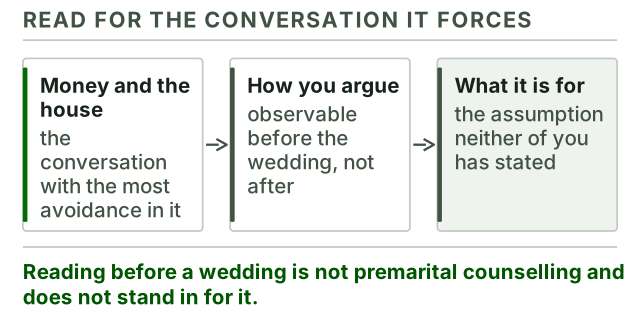
Money first, and specifically the difference between what each of you thinks is normal. Not a budget: an account of what money was for in the house each of you grew up in, and which spending feels like safety and which feels like waste. Books that raise it do so by asking about history rather than by asking for figures.
- For example, a couple arguing about what the reception costs may not be disagreeing about the reception. One of them is defending a family obligation and the other is defending a savings habit, and a chapter that separates those things gives the argument its real name.
- For instance, household work is easiest to discuss before the arrangement exists. Once a pattern has set in, a conversation about who does the laundry is a complaint; before it sets in, it is scheduling, and it takes a short exchange rather than a whole evening.
- Consider the question of families. Engagement is when both sets of expectations meet formally for the first time, and the useful chapters are the ones that ask what each partner will do when their own family’s expectation conflicts with the pair’s decision.
Time comes last here and gets the least attention. Partners who have not lived together, and partners who have, can arrive with unstated assumptions about how much of a week belongs to the couple, how much to friends, and how much to nobody. A book that asks the question in a neutral evening prevents it from being asked in a resentful one.
Do these books replace premarital counselling?
No, and the difference is easy to state: a book cannot ask a follow-up question. It cannot notice that one of you answered quickly to close the subject, and it cannot tell agreement apart from avoidance. Everything a book does well is on the page, and everything counselling does well happens in response to what a specific pair says in the room.
Used alongside, they fit together neatly. Reading a chapter before a session means the vocabulary already exists and the session is not spent building it. Some structured premarital programmes are built around a book anyway, and reading first lets a couple arrive with a more specific version of what they want to discuss.
Where counselling is not available or not wanted, a conversation-led book is the structure that remains, and it is a real one. It is worth being honest about what that structure is: a reliable set of prompts and a shared vocabulary, with nobody watching to see whether the conversation actually happened.
What should an engaged couple not expect from reading?
Not a verdict on the relationship, and not a settled argument. A book gives two people the same words for the thing they keep circling; it does not tell them whether to marry, and any book that implies otherwise is selling something. The reading that helps before a wedding is the reading that produces better questions, not reassurance.
Smaller expectations are worth dropping as well. A book will not make an avoided subject comfortable, it will only make it harder to postpone. And finishing one is not the point: a pair who read part of a book and had real conversations got more from it than a pair who raced through it in silence.
There is also the asymmetry problem. When one partner picks the title, sets the pace and decides which chapter comes tonight, the reading is tilted before it starts, and the book takes the blame for a shape somebody else gave it. Agreeing on the title together costs little and heads that off.
What this page does not do
Engagement is a season people get sold to hard. Nothing here is being sold, and here is what that means in practice.
- We do not plan weddings
- Venues, etiquette, budgets, who pays for what: none of that is on this site. This page is about the reading, and the reading is about the marriage.
- We do not sell the books
- This page carries no route to a purchase of any kind: no retailer link, no affiliate arrangement, no price, no rating. A publisher page is cited when the edition matters, and for nothing past that.
- We do not predict outcomes
- No engagement or divorce statistics appear here. Those numbers are used to sell reassurance or alarm, and none of them are in our approved sources.
- We do not rank these titles
- The table groups books by what they raise, not by quality. A ranking would imply we know which conversation your relationship needs first.
The short version: pick one conversation-led book, start when the planning starts rather than close to the date, and treat the chapters as prompts for the subjects a wedding hides. The full guide to this shelf covers the rest of the reading, and the rule about which records get linked here, and which claims never do, is on our sources page.